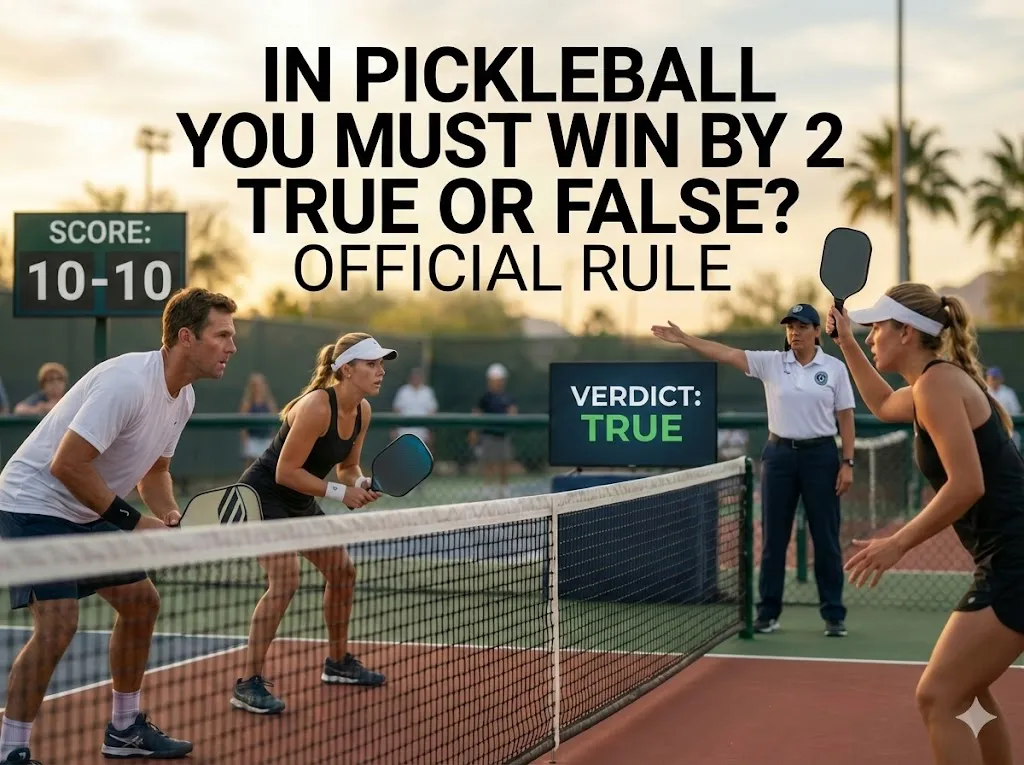
Imagine this scenario: You are on the court, sweating under the sun. The score is 10-10. Your partner serves, and the opposing team hits the ball into the net. The score is now 11-10. Do you drop your paddle and celebrate the victory? Or do you rush back to the baseline to serve again?
If you celebrate now, you might be embarrassed. Why? Because the game isn’t over.
One of the most common questions beginners ask when learning the nuances of scoring is: in pickleball you must win by 2 true or false? It is a fundamental rule that changes the psychology, the strategy, and the duration of the match. Whether you are a recreational player at the local park, playing regularly at the Best Pickleball Court In Vadodara, or an aspiring tournament competitor, understanding this rule is non-negotiable.
In this guide, we will break down the verdict, explore the “Endless Game” scenarios, and explain how this rule applies to different formats like Rally Scoring and tournament play.
The Short Answer: True or False?
Let’s cut straight to the chase. Is the statement “In pickleball you must win by 2” True or False?
The answer is True.
According to the official pickleball rules, a standard game is played to 11 points, but the winning team must hold a lead of at least two points to conclude the match. This means that a score of 11-10 is not a winning score. The game must continue until one team is ahead by two clear points.
This rule applies to:
- Standard recreational play (Games to 11)
- Tournament brackets (Games to 15 or 21)
- Singles and Doubles matches
If you are new to the sport and trying to grasp the basics of how to play pickleball, memorizing this rule is just as important as learning how to dink. It prevents premature celebrations and ensures that the winning team has definitively outplayed the opponent in the final moments.
How the “Win by 2” Rule Works in Practice
To understand why this rule creates so much tension, we need to look at the mechanics of the pickleball scoring system. Unlike sports with a running clock where the game ends when time expires, pickleball is played until a score threshold is met.
The “Overtime” Scenarios
In a standard game played to 11, the “Win by 2” rule kicks in the moment the score is tied at 10-10. In tennis, this is often referred to as “Deuce,” but in pickleball, we simply call it a tie. Here is how the progression might look:
- Score is 10-10: Next point makes it 11-10. The leading team has only a 1-point advantage. Game continues.
- Score is 11-10: The trailing team scores. Score is 11-11. Game continues.
- Score is 11-11: Team A scores. Score is 12-11. Game continues.
- Score is 12-11: Team A scores again. Score is 13-11. Game Over.
Because of this rule, matches that are supposed to end at 11 can theoretically go on indefinitely. It is not uncommon in competitive play to see final scores like 15-13 or even 20-18 in a game that was originally “played to 11.”
Note: This rule is a major reason why pickleball requires mental endurance. You cannot just “coast” to the finish line; you have to execute two successful rallies in a row (or break the opponents’ serve) to close the door.
Does the Game Ever End? (Score Caps vs. Hard Caps)
A frequent follow-up question is: “Is there a maximum score?” If two teams are perfectly matched, could they play until they collapse?
Recreational Play (The Soft Cap)
In typical open play or rec games, there is usually no cap. The game continues until someone wins by 2. This honors the spirit of the game and ensures the best team wins. However, if people are waiting for the court, players might mutually agree to a “sudden death” at a certain point (e.g., first to 15 wins), though this is not a standard rule.
Tournament Play (The Hard Cap)
Tournaments are different. They run on tight schedules. While major professional tournaments (PPA, APP) rarely use caps in main draws, local Round Robin tournaments often utilize “Hard Caps” to keep things moving.
For example, a tournament director might state that games are “played to 11, win by 2, with a 15-minute time limit.”
- Scenario A: The score is 10-9 when time expires. The leading team wins (Win by 1 is allowed due to time).
- Scenario B: The score is 10-10 when time expires. The format might switch to “Sudden Death” where the next point wins.
Always check the specific rules of your event. For a deep dive into standard terminology, check our guide on common pickleball terms to understand phrases like “side-out” and “second server.”
Tournament Variations: Games to 15 and 21
As you progress from recreational play to more competitive environments, you will notice that not all games are played to 11. Gold medal matches, singles ties, or specific tournament formats often extend the game.
Games to 15
It is standard for the “loser’s bracket” (consolation bracket) or specific Round Robin matches to be played to 15 points. Does the rule change? No. You must still win by 2. A score of 15-14 does not end the game; you must reach 16-14.
Games to 21
In some singles formats or unique endurance events, games are played to 21 (similar to badminton or table tennis). The physical toll of a game to 21 that extends into “overtime” (e.g., 26-24) is immense. This is where fitness and knowing your singles rules becomes critical. In singles, you don’t have a partner to cover the court while you catch your breath during these extended deuce scenarios.
Rally Scoring and the “Freeze” Exception
Pickleball is currently experimenting with different scoring methods to make the game more TV-friendly and predictable in duration. The most prominent variation is Rally Scoring.
In traditional Side-Out scoring, you can only score points when you are serving. In Rally Scoring, a point is scored on every single rally, regardless of who served. But how does “Win by 2” apply here?
The “Freeze” Rule
To preserve the drama of the “Win by 2” rule, most Rally Scoring formats implement a Freeze.
Here is how it works: Suppose the game is to 21.
- Both teams score on every rally until one team reaches 20 (match point).
- Once a team reaches 20, their score “freezes.”
- To score the final winning point (the 21st point), that team must be serving.
- If they lose the rally while serving, they do not lose a point, but the ball goes to the opponent (side-out).
This hybrid creates a fascinating dynamic where the trailing team can catch up using Rally Scoring while the leading team is forced to play traditional scoring to close out the match. It ensures that the “Win by 2” victory is earned through offensive serving, not just a defensive error by the opponents.
Why Does the “Win by 2” Rule Exist?
You might wonder, why not just end it at 11? Why drag out the tension?
The “Win by 2” rule exists to reduce the impact of luck and variance. In a sport like pickleball, where the net is low and the ball is light, a single “net cord” dribbler can result in a point that is impossible to return.
If the game ended at 11-10, a lucky shot hitting the net tape could decide a Gold Medal match. By requiring a 2-point margin, the game forces the winning team to prove that their victory is not a fluke. They must win a confirmation point. This aligns with the philosophy found in tennis and volleyball, ensuring that the better team on that day takes the win.
For official citations on this philosophy, you can always refer to the Official USA Pickleball Rulebook, which outlines the integrity of the scoring system.
Strategies for the “Win by 2” Crunch Time
When the score is 10-10, the atmosphere on the court changes. Arms get tight, paddles feel heavy, and decision-making falters. Here are three tips to handle the pressure of the “Win by 2” scenario:
1. High Percentage Pickleball
At 10-10, this is not the time to try an Ernie or a Bert (advanced jumps over the kitchen corner). Stick to high-percentage drops and dinks. Let your opponents make the mistake. The pressure is on them just as much as it is on you.
2. Target the Weaker Link
If you are playing doubles, identify which opponent is struggling with the pressure. Hit the ball to them. In “overtime,” mental fatigue sets in, and the player who has made the most recent errors is likely to make another one.
3. Use Your Timeouts
If you were leading 10-8 and suddenly find yourself tied at 10-10, call a timeout. You need to break the momentum. The “Win by 2” rule allows for momentum swings; a timeout settles your heart rate and forces the opponents to think about their next serve.
Frequently Asked Questions
Does the win by 2 rule apply to tie-breakers?
Yes. In most tournament formats, if match sets are split 1-1, a tie-breaker game is played to 15. This tie-breaker must also be won by 2 points.
What happens if a game goes to 30 points?
Unless the tournament director has set a “Hard Cap” (e.g., first to 25 wins), the game continues. There are records of professional matches going well into the 30s before a team could secure that elusive 2-point lead.
Is “Win by 2” used in Skinny Singles?
Yes, Skinny Singles follows standard scoring rules. If you are practicing alone or playing modified versions, you still adhere to the win-by-2 philosophy to simulate real match pressure.
Final Thoughts
So, in pickleball you must win by 2 true or false? It is undeniably True. This rule is the heartbeat of competitive pickleball, transforming a casual game into a test of mental fortitude and consistency. Whether the game is to 11, 15, or 21, that final 2-point gap represents the difference between a lucky break and a well-earned victory.
Next time you find yourself locked in a 10-10 battle, remember: this is the best part of the game. Embrace the pressure, stay patient, and fight for that 2-point cushion.
Ready to improve your game so you can close out these tight matches? Check out our reviews on the best gear to give you that edge, or dive deeper into our guide on the pickleball scoring system to master the numbers before you step on the court.