Selecting the wrong paddle can cost you three to five hundred dollars and weeks of performance regression. Before you commit to any model based on an in-store feel or a friend’s recommendation, demo pickleball paddles give you the single most data-rich buying experience available to a serious player — real on-court time with the exact tool you are considering, under your personal playing conditions. This guide covers every angle of that process: national programs, local Long Beach options, the physics labs behind paddle ratings, the used-market grading system, and the regulatory landmines most sites never mention.
Pickleball Paddle Demo & Trial Programs
Trial policy · Shipping & returns · Used sale availability
For players who want the lowest financial risk combined with the broadest selection, JustPaddles and Total Pickleball are the clear national leaders — both offer true zero-cost returns with prepaid labels and access to used inventory. If you are locked to a 7-day window, Tennis Point’s $25 credit recovery makes it the strongest short-window option.
How to Find a Pickleball Paddle Demo Program Near You
On the national retail side, Dick’s Sporting Goods offers in-store “try before you buy” events at select locations during peak seasons, though these are typically 15-minute floor sessions rather than true on-court demos. Tennis Point has both national shipping programs and select physical retail locations. For the deepest in-store demo access, independent specialty racket and pickleball pro shops remain the most reliable option — staff expertise is higher, fleet rotation is more consistent, and the ability to ask technical questions about specific models is genuinely available.
For players searching for a pickleball paddle demo program in Long Beach near me, Southern California offers one of the most developed local demo ecosystems in the country. Long Beach specifically has multiple structured options that rival or exceed what most major metro areas can offer.
Sports Basement Long Beach (2100 N Bellflower Blvd, Long Beach, CA 90815) operates the most structured local demo program in the area, with four distinct tiers: 1 Day ($15), Weekend ($25), 1 Week ($35), and 1 Month ($60). Their recreational entry-level tier features the Gamma Micron 5.0 (12mm polypropylene core, 7.9 oz) at $10 per day up to $40 per month — an excellent starting point for newer intermediates testing the transition from a beginner paddle.
The standout feature of Sports Basement’s program is their Demo Credit Policy: 100% of all rental fees paid are applied as store credit toward a brand-new paddle purchase within the same equipment category, provided the purchase is made within 30 days of the original rental. This effectively makes any demo free if you purchase.
For players interested in a pickleball paddle demo program in Long Beach near me with a coaching component, the Billie Jean King Tennis & Pickleball Center (2760 North Studebaker Road) includes complimentary on-site demo paddles during adult group coaching programs, which run at $155 for a 10-week session — an exceptional value for players who want structured instruction alongside equipment testing. For budget-conscious players who simply need a paddle for a single session, Long Beach Boot Camp offers basic rental units at a flat $10 rate.
Pickleball Paddle Demo: What Every Intermediate and Advanced Player Must Know Before Clicking “Buy”
A pickleball paddle demo is not a luxury — it is an analytical tool. Every serious intermediate-to-advanced player should treat the demo period as a structured lab session: same drill patterns, same partner, same court surface, repeated across at least three sessions. One casual hit tells you almost nothing about swing weight fatigue or off-center twist behavior at high pace. Three structured sessions tell you everything.
When evaluating any pickleball paddle demo program, look for three non-negotiables: the demo window must be long enough for on-court repetition (minimum 7 days), the return process must be genuinely frictionless (prepaid label or no deduction), and the paddle received must be a current production unit — not a two-season-old batch with degraded core integrity.
The most overlooked factor in any pickleball demo paddles evaluation is the condition of the unit itself. A national retailer’s 30-day program ships you a brand-new paddle. A local pro shop’s rental fleet has often been demoed by 40 to 60 players before you ever pick it up. Those are fundamentally different products, and they should inform completely different decision frameworks.
Head to Head: National 30-Day Programs vs. Local 7-Day Demos vs. Short-Window Fee Programs
Understanding the structural differences between these three demo models is essential before committing to any program.
National 30-Day Free-Return Programs (JustPaddles, Total Pickleball, Pickleball Central) operate on a full-price-upfront model with a refund trigger. You pay retail, play for up to 30 days, and return the paddle in its original condition for a full or near-full refund. The primary advantage is time: 30 days allows for multiple court surfaces, weather conditions, and match formats. The risk is the float — your capital is tied up during the demo window. Pickleball Central’s program adds a small wrinkle: unless you purchase their “Redo” coverage at checkout, you absorb the return shipping cost, which typically runs $9 to $18 depending on weight and region.
Short-Window Fee Programs (Pickleball Galaxy, Tennis Point, 808 Pickle) charge a flat fee for a 7-to-15-day window and partially recover that fee as store credit if you purchase. Tennis Point’s $25 credit recovery on a $30 fee is the most generous recovery ratio of any national program. Pickleball Galaxy’s FedEx return tag eliminates the logistics friction entirely. These programs are best suited for players who have already narrowed their decision to one or two specific models and need on-court confirmation, not exploration.
Local Pro Shop Rental Fleets offer same-day access with no shipping delay, but the paddle condition is the critical variable. A fleet paddle at session 50 of its life has measurable core compression, reduced surface grit, and altered swing weight distribution compared to a factory-fresh unit. Use local programs to test paddle categories (elongated vs. standard shape, thermoformed vs. press-molded), not to make final purchase decisions about a specific model.
The Science of Paddle Lab Physics: What Demo Data Actually Measures
When manufacturers or independent labs publish demo evaluation data, they are measuring six distinct physical properties that have no relationship to each other and must be understood independently.
Swing Weight is the most misunderstood metric in pickleball equipment analysis. It is categorically different from static weight (the number on the scale). Swing weight measures rotational inertia — the resistance a paddle generates when accelerated through a swing arc. Two paddles at 7.9 oz can have swing weights that differ by 15 to 20 points depending entirely on mass distribution. A paddle with weight concentrated toward the tip generates dramatically more swing weight than one with the same total mass centered at the handle. The formal relationship is expressed as:
$$\text{Swing Weight} \propto \int r^2 \, dm$$
This means every increment of mass located farther from the pivot point contributes exponentially — not linearly — to swing weight. A 5-gram weight shift at the tip has four times the swing weight impact of the same shift at the throat.
Exit Velocity measures how fast the ball leaves the paddle face at a standardized impact force. Spin Rate is captured using high-speed cameras positioned at a 45-degree angle to the paddle face, measuring RPM at standardized swing speeds — the 45-degree angle is essential because it captures both topspin and sidespin vectors simultaneously. Twist Weight measures torsional stability during off-center impacts — higher twist weight means less angular deflection on edge shots. Vertical Consistency quantifies how uniform exit velocity is across the full face surface. Balance Point identifies the precise distance from the butt cap where the paddle achieves equilibrium, directly influencing both swing weight and maneuverability at the kitchen line.
Pickleball Paddle Used or Demo Sale: The Complete Buying Guide
The pickleball paddle used or demo sale market has matured significantly, and the best platforms now apply formal grading standards that provide genuine buyer protection. Understanding these grading systems is essential before any secondary-market purchase.
Pickleball Warehouse uses a four-tier system: Unused (minor cosmetic defects only, zero on-court use), Grade A — Excellent (wear restricted exclusively to grip and grommets, face surface pristine), Grade B — Great (minor cosmetic frame wear, zero graphite surface exposure), and Grade C — Good (visible wear from groundstrokes, paint chips present, surface grit reduction measurable). Grade C paddles are the highest-risk purchase for players sensitive to spin rate performance.
Bell Racquet Sports uses a strict 1-to-10 numerical scale where 10 is factory new and 1 is heavily worn. Their policy does not accept any used paddles rated below 7 for resale — a meaningful quality floor that eliminates the worst condition units from their inventory entirely.
The distinction between Factory Seconds and Used Demos is critical and frequently confused. Factory Seconds are brand-new paddles that never left the manufacturing facility for on-court use — they carry cosmetic imperfections (paint inconsistencies, minor edge seam irregularities) but zero structural wear. Used Demos have actual on-court miles: core compression, surface grit polish, and potential edge guard micro-damage. Factory Seconds are almost always the superior value in the pickleball paddle used or demo sale category; the performance is factory-grade at a meaningful discount.
For peer-to-peer (P2P) transactions, follow this safety playbook without exception: always use PayPal or Venmo’s “Goods & Services” payment option (never “Friends & Family,” which eliminates buyer protection entirely), request a tap-test video before completing payment (a sharp tap on the face of a healthy paddle produces a clean resonant tone; delaminated cores produce a dull thud or rattle), and cross-reference the listing across at least two platforms to verify pricing consistency. Sudden delamination sellers frequently price 15 to 25% below market average — that discount is the tell.
For players exploring specific high-performance models in the secondary market, reviewing the used pickleball paddles market alongside the current selection available at national demo programs gives you the most complete picture of where genuine value exists across both new and secondary channels.
Critical Content Gaps and Regulatory Hurdles: What Competitors Don’t Tell You
The Legality of “DEMO” Stamped Paddles in Tournament Play
Under USA Pickleball Rule 2.E.5.a and Rule 2.E.5.c, aftermarket graphics, paint alterations, and surface modifications are strictly prohibited on paddles used in sanctioned competition. A thick screen-printed or stamped “DEMO” label — particularly one applied directly over the paddle face rather than exclusively on the edge guard — can and does trigger disqualification at the discretion of strict tournament directors or opponents who formally challenge surface roughness. The risk extends to DUPR-rated matches, where equipment challenges are logged and can affect rating validity.
If you purchase a pickleball paddle used or demo sale unit with a “DEMO” stamp, have it evaluated against the USA Pickleball Approved Paddle List and consult the tournament director before competition use. Never assume cosmetic stamps are irrelevant to officials — the rules are explicit that surface alterations of any kind are grounds for removal.
The Structural Core Crush Trap
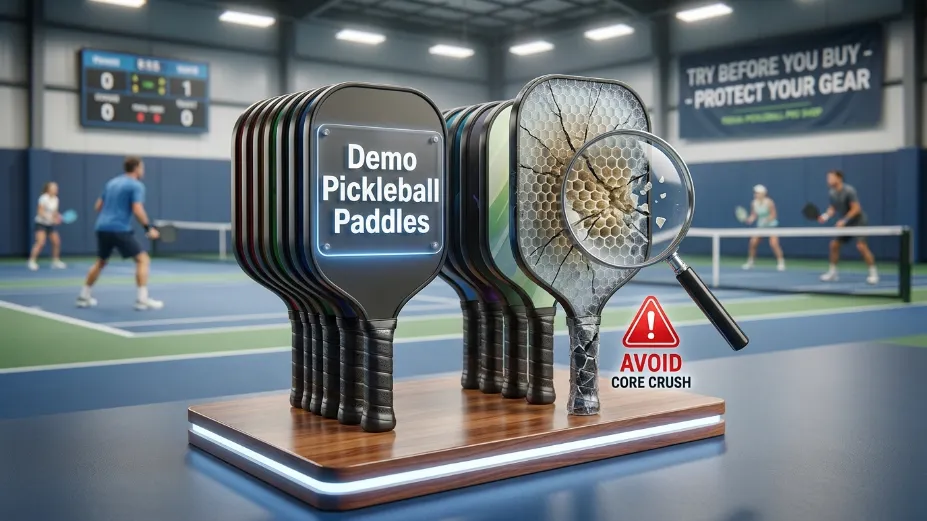
Heavily played demo paddles — particularly thermoformed Gen 2 and Gen 3 models — are statistically likely to have experienced some degree of core crush. Core crush describes the permanent compression deformation of the polypropylene honeycomb core, which occurs progressively under repeated high-impact use. At early stages, core crush creates an illegal trampoline effect (increased exit velocity beyond approved limits). At advanced stages, it creates complete dead spots — areas of the paddle face with dramatically reduced power transfer.
Compounding this problem is “Grit Polish”: the progressive smoothing of a paddle’s textured face surface under repeated ball contact, which reduces spin rate in ways that are invisible to the eye but significant in performance. A heavily demoed paddle’s lab spin rate is not representative of the same model in factory condition, which means spin-rate test data published by manufacturers is categorically inapplicable to used fleet units.
The Warranty Vacuum
All used, refurbished, and demo paddles are sold “As-Is” and “Final Sale” with no manufacturer warranty of any kind. This is non-negotiable and universal across all brands. Contrast this with new purchases: Selkirk offers a Lifetime warranty, Engage offers a Lifetime warranty, and JOOLA provides a 1-Year limited warranty. If a thermoformed paddle you purchase used develops delamination within 60 days — a documented failure mode at non-trivial rates in Gen 2 and Gen 3 models — you have zero recourse with the manufacturer and limited recourse with the secondary seller.
Top Paddles Worth Demoing in 2026: A Curated Performance Shortlist
Not every paddle merits demo time. These four represent the current performance benchmarks across distinct categories that intermediate and advanced players are most commonly evaluating.
The JOOLA Ben Johns Perseus Pro IV remains the gold standard for elite offensive play, with industry-leading exit velocity data and a swing weight optimized for aggressive groundstroke patterns. Demo it specifically in drilling scenarios that stress off-center impact stability — its twist weight profile is a key differentiator versus similarly priced competition.
The Selkirk LUXX Control Air Invikta is the reference point for kitchen-line touch combined with elongated-shape reach. Demo it with deliberate focus on third-shot drop execution and reset mechanics — these are the scenarios where its balance point advantage over standard-shape paddles becomes quantifiable rather than theoretical.
For players exploring the independent brand tier, Six Zero pickleball paddles have earned consistent praise for spin rate performance at price points below the flagship tier. Their demo availability through national programs is more limited than the major brands, making local pro shop access particularly valuable for hands-on evaluation.
The Proton pickleball paddle represents the emerging thermoformed construction category at accessible pricing. Demo evaluation should specifically stress the edge protection and face surface texture — these are the variables where Proton’s construction approach diverges most meaningfully from the flagship thermoformed competition.
Strategic Summary and Pro Recommendations
For US players navigating the demo ecosystem in 2026, the optimal approach follows a clear decision tree. If you are within reasonable distance of a structured local program — particularly Sports Basement Long Beach or a comparably equipped specialty shop — begin there. Use 3 to 5 local sessions to narrow your evaluation from a category decision (shape, weight class, construction type) to a specific model shortlist. Then deploy a national 30-day program (JustPaddles or Total Pickleball for lowest financial risk) to confirm your shortlisted model under your actual playing conditions over an extended period.
Approach the used market with forensic rigor. Prioritize Factory Seconds over Used Demos wherever available. Insist on tap-test video for any thermoformed model. Verify that any “DEMO” stamped unit is genuinely tournament-legal before competitive use. Never purchase used without PayPal Goods & Services protection. And recognize that the warranty vacuum in the used market is a real financial risk — especially for thermoformed models in their first two years of production, where delamination failure rates remain elevated relative to mature press-molded designs.
The best paddle you will ever own is one you have genuinely demoed, not one that looked compelling in a product video. Use the infrastructure that exists — national programs, local rental fleets, coaching center access — and make your final decision with on-court data, not marketing copy.
Frequently Asked Questions: Demo Pickleball Paddles
What is a pickleball paddle demo program and how does it work?
A pickleball paddle demo program allows players to test one or more paddles under real on-court conditions before committing to a purchase. National programs typically operate on a full-price-upfront model with a return window ranging from 7 to 30 days. Local pro shop programs charge a daily or weekly rental fee that is frequently credited toward a future purchase. The core value is eliminating the performance guesswork that comes from a brief store-floor swing.
Are demo pickleball paddles the same quality as new paddles?
Not always. Paddles shipped directly from national retailers like JustPaddles or Total Pickleball are brand-new, factory-fresh units. Local rental fleet paddles, however, may have been used by dozens of players and can exhibit measurable core compression, surface grit reduction, and altered swing weight. Always clarify the condition of any demo paddle before basing a purchase decision on its feel.
Can I use a “DEMO” stamped paddle in a tournament?
Potentially not. Under USA Pickleball Rules 2.E.5.a and 2.E.5.c, aftermarket surface alterations — including thick stamped or screen-printed “DEMO” labels — can trigger disqualification by tournament directors or formal opponent challenges. Always verify a used demo paddle’s tournament eligibility before sanctioned or DUPR-rated play.
What is the best pickleball paddle demo program in Long Beach near me?
Sports Basement Long Beach (2100 N Bellflower Blvd) offers the most structured local demo program, with four rental tiers from $15/day to $60/month and a 100% demo credit policy toward new paddle purchases within 30 days. The Billie Jean King Tennis & Pickleball Center (2760 North Studebaker Road) includes free on-site demos during adult group coaching sessions ($155 for 10 weeks). Long Beach Boot Camp offers basic single-session rentals at $10 flat.
What is the difference between a factory second and a used demo paddle?
A factory second is a brand-new paddle that has never been used on-court — it carries only cosmetic imperfections from the manufacturing process. A used demo paddle has actual on-court miles: core compression, surface wear, and edge damage are all possible. Factory seconds offer factory-grade performance at a discount; used demos carry meaningful performance degradation risk depending on their play history.
How do I safely buy used pickleball paddles peer-to-peer?
Always pay via PayPal or Venmo “Goods & Services” — never “Friends & Family.” Request a tap-test video before completing payment (a dull thud indicates core delamination). Cross-reference the asking price against at least two other platforms to identify suspiciously below-market listings. Pricing 15 to 25% below average is a reliable signal of undisclosed structural issues.
How long should I demo a paddle before deciding to buy?
Minimum three on-court sessions covering different match formats (drilling, recreational play, competitive play). One session is statistically insufficient to detect swing weight fatigue, off-center twist behavior, or kitchen-line touch limitations. A 30-day national program provides enough time for a genuinely comprehensive evaluation; a 7-day local rental requires more deliberate session planning to extract equivalent data.