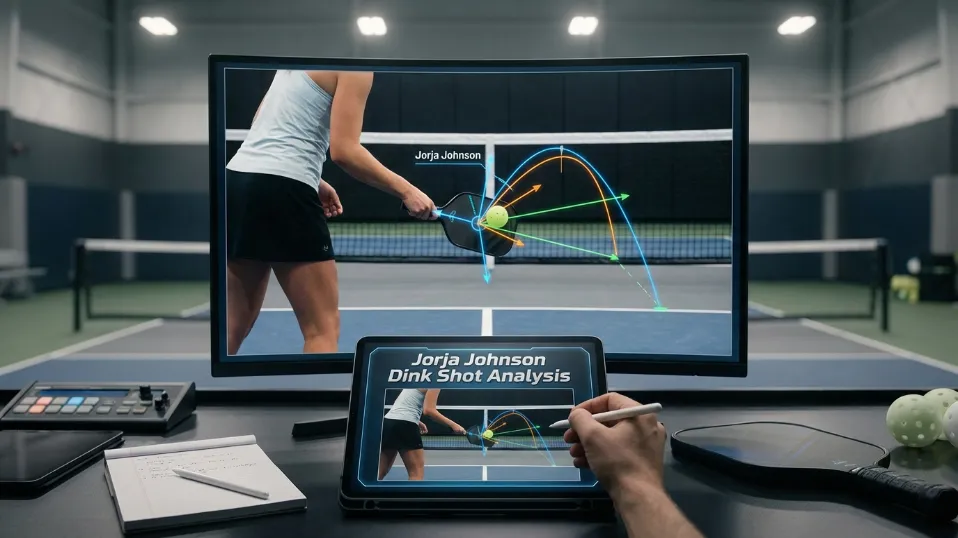
Ever wondered how Jorja Johnson makes the kitchen look so easy? The secret isn’t just speed—it’s her dink technique. In the high-stakes world of professional pickleball, the “soft game” has evolved from a defensive reset into a sophisticated weapon of attrition. At the forefront of this shift is 18-year-old phenom Jorja Johnson. Unlike many pros who transitioned from tennis, Jorja’s game was forged within the specific dimensions of the pickleball court, resulting in a specialized biomechanical efficiency that defies traditional teaching.
This technical Jorja Johnson dink shot analysis dives into the mechanics of her aggressive dinking, the physics of her controversial short-hop philosophy, and the advanced Pickleball Kitchen Strategy that allows her to go toe-to-toe with the world’s best. For advanced players looking to reach the 5.0+ level, understanding these nuances is no longer optional—it is the blueprint for net play dominance.
The Biomechanics of Neutrality: Jorja’s Ready Position
Success at the kitchen line begins before the paddle even touches the ball. A common error among amateur players is “over-extension,” where the arms reach too far forward into the kitchen, making them vulnerable to body shots. Jorja Johnson employs a “Neutral Paddle Position” that is remarkably compact.
- Navel Alignment: Jorja holds her paddle centrally, often aligned with her navel. This neutral starting point allows her to cover both the backhand and forehand wings with equal speed.
- Relaxed Levers: By keeping her elbows tucked slightly and closer to her body, she prevents the ball from “eating the paddle.” This position transforms her into a “brick wall” on the right side, capable of absorbing 100 mph speed-ups with minimal movement.
- The Box Step: When anticipating an attack, Jorja uses a “Box Step”—a quick step back combined with a split step—to buy the spatial window needed to react to balls hit at her feet.
The Short Hop Philosophy: Stealing Time at the NVZ Line
One of the most distinctive elements of Jorja’s game is her heavy reliance on the “Short Hop”—hitting the ball immediately after it bounces rather than waiting for it to reach its apex. While traditional coaching often discourages this due to the high risk of error, Jorja uses it as a core component of her How to win dink rallies strategy.
The primary benefit of the short hop is time theft. By hitting the ball earlier in its trajectory, Jorja reduces the opponent’s reaction window. It also allows her to remain “glued” to the kitchen line. Most players are forced to step back to handle a deep dink; Jorja stays put, closing down the angles and preventing opponents from pushing her off the line.
The Physics of the 10-Degree Rule
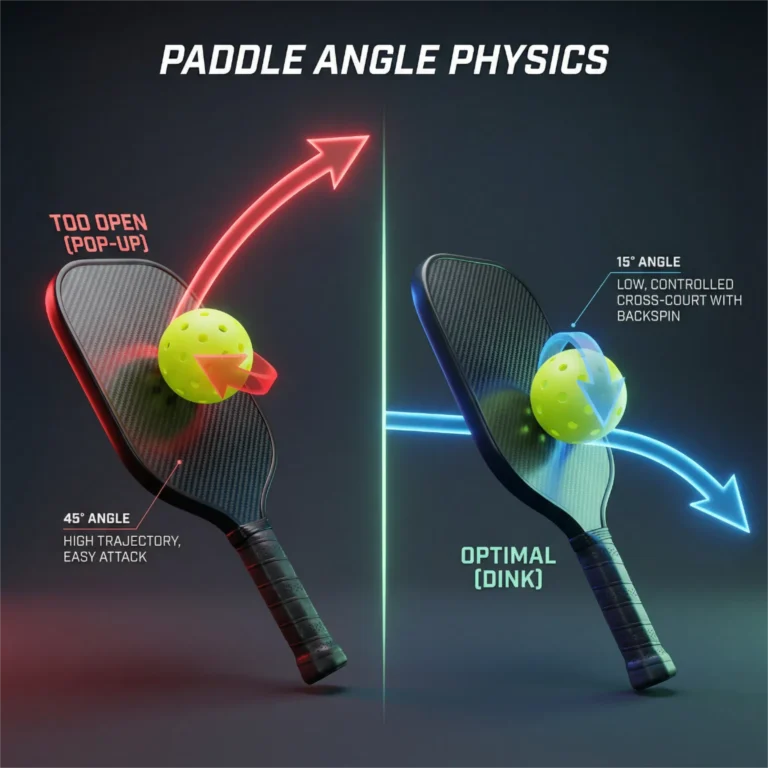
There is a technical reason why the short hop is so difficult to master. Because the ball is moving at its highest kinetic energy immediately after the bounce, the player is essentially redirecting energy rather than generating it. In this phase, the “10-degree rule” applies: a 10-degree shift in paddle angle results in a 20-degree change in the ball’s resulting trajectory. This explains why Jorja’s wrist must remain incredibly loose and stable simultaneously—a feat of hand-eye coordination that places her at the top of the PPA Tour official rankings.
Technical Comparison: Traditional Dink vs. Jorja Johnson Style
To understand how Jorja’s approach differs from standard “textbook” pickleball, consider the following metrics:
| Feature | Traditional Dink (Apex) | Jorja Johnson Style (Short Hop) |
|---|---|---|
| Contact Timing | At the highest point of the bounce | Immediately after the bounce |
| Paddle Angle | Open face, lifting through the ball | Neutral to slightly closed, redirecting energy |
| Footwork | Step back to create space | Hold the line, often lunging forward |
| Strategic Goal | Neutralize and reset the point | Steal time and pressure the opponent |
| Risk Level | Low; high margin for error | High; requires microscopic precision |
The “Twoey” Revolution: Mastering the Two-Handed Backhand Dink
Between 2024 and 2026, the Two-handed dink technique (the “Twoey”) has become the gold standard for pro players. Jorja Johnson is a master of this evolution, using the second hand to provide the stabilization that a one-handed slice lacks.
In Jorja’s 2HBH dink, the non-dominant hand (the left hand for righties) acts as the primary engine. By using a “windshield wiper” motion driven by the shoulder and elbow, she generates aggressive topspin that causes the ball to “dive” once it clears the net. This makes her dinks much harder to volley out of the air.
The Deception Factor: The true beauty of the Twoey is that the setup for a soft dink is identical to the setup for a “speed-up” attack. This forced ambiguity keeps opponents like Anna Leigh Waters guessing, as they cannot predict whether they will receive a feathered drop or a line-drive attack to the chest.
The Professional Shot Menu: The “Scoop” vs. The “Knife”
A deeper look at Jorja Johnson Pickleball Tips reveals two specialized shots she uses to manipulate the ball’s behavior at the net.
1. The Forehand Scoop Dink
When a ball is hit deep to her feet, Jorja doesn’t retreat. Instead, she uses the “Scoop.” This involves a 90-degree wrist flexion and a slight backward lunge, allowing the ball to “ride” the face of the paddle. This technique absorbs the incoming power and drops the ball soft and short, effectively resetting a dangerous situation.
2. The “Knife’d” Dink
For more aggressive exchanges, Jorja employs the “Knife.” Unlike a standard slice where the paddle moves at a 45-degree angle, the Knife involves dropping the paddle head almost vertical (between 5:00 and 6:00 on a clock face). This produces a heavy, sliding side-spin that skids off the court, often forcing opponents into a weak pop-up.
Advanced Tactics: The Middle “T” and Stacking Strategy
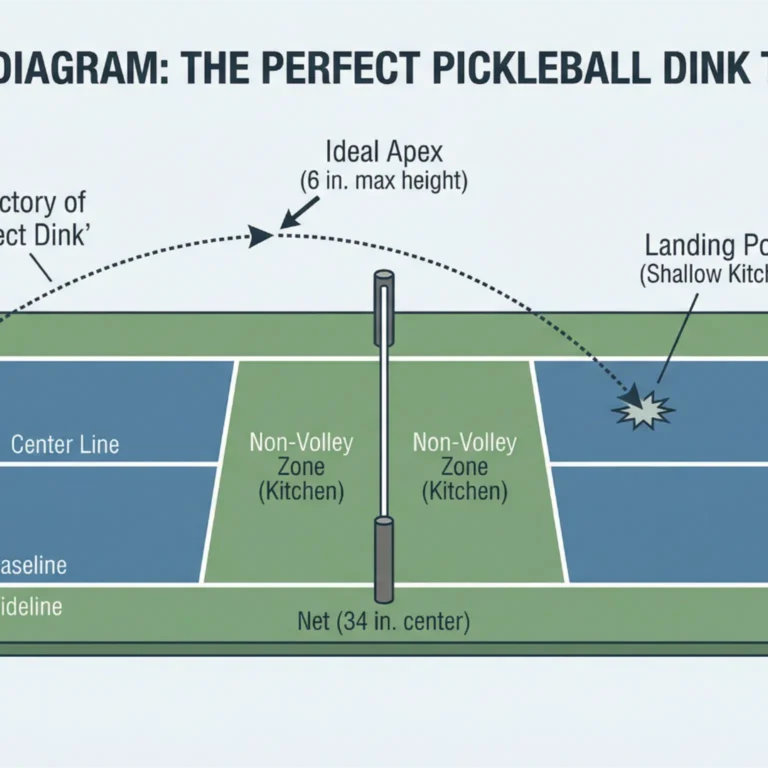
Effective Pickleball Kitchen Strategy isn’t just about how you hit the ball, but where you place it. Jorja frequently targets the “T”—the intersection of the center line and the kitchen line. This is the “Safety Zone” for several reasons:
- Angle Reduction: Hitting the middle takes away the opponent’s ability to create sharp cross-court angles.
- Communication Pressure: In doubles, the middle ball forces opponents to decide who should take the shot, often leading to hesitation or “paddle clashing”.
- Net Height: The net is at its lowest point in the center, providing a higher margin of safety for aggressive rolls.
Furthermore, Jorja and her partner (often her brother JW Johnson) utilize a strict “Stacking” strategy. By keeping Jorja as a right-side specialist, she can focus on lockdown defense, allowing her partner the freedom to “poach” and hunt for offensive middle attacks.
Elite Training: Top Pickleball Net Play Drills
To replicate Jorja’s success, players must transition from casual play to structured Pickleball net play drills. Here are three pro-level exercises used by the elite circuit:
- The Rule of Three Drill: Every dink is assigned a value: “1” for a soft/dead dink and “2” for an aggressive/probing dink. The goal is for every exchange between partners to sum to “3.” If your partner hits a “1,” you must reply with a “2” to apply pressure. If they hit a “2,” you must reset with a “1”.
- The 3-Spot Dinking Drill: Place cones at the wide corner, the middle “T,” and the straight-ahead line. Practice hitting 10 consecutive dinks to each spot without a miss. This builds the directional control necessary for high-level “Kitchen Chess”.
- The Fade + Counter: This drill builds Jorja-style fast hands. Have a partner speed the ball up toward your right hip. Practice “fading” your body to the right while using a backhand counter to block the ball back to their feet.
Managing the Elements: Windy Conditions and Equipment
Jorja’s technical precision is tested most during outdoor play. In high-wind scenarios at the kitchen line, she prioritizes height over touch. Trying to hit a perfect, low-clearing dink in 20 mph winds is a recipe for unforced errors. Instead, she aims for a foot above the net tape, allowing the wind to buffer the ball while ensuring it clears the net.
Additionally, the evolution of carbon fiber paddles with increased “dwell time” has allowed Jorja to shorten her swing further. Modern paddles do the work of generating spin, meaning she can maintain a compact, repeatable motion that is less susceptible to breaking down under the fatigue of a long tournament day.
Conclusion: The Mental Resilience of the Kitchen
The final takeaway from any Jorja Johnson dink shot analysis is the importance of mental resets. Because Jorja plays a high-risk, aggressive style, she occasionally leads her team in unforced errors during long rallies. However, her ability to “forget the last point” and maintain her aggressive posture is what separates her from the field. In the modern game, “time is currency.” If you are not stealing it from your opponent, they are stealing it from you.
By mastering the neutral ready position, embracing the physics of the short hop, and drilling the two-handed backhand with intention, you can transform your kitchen game from a game of patience into a game of pressure. As Jorja proves every weekend on the PPA Tour, the smallest technical adjustment often leads to the biggest gold medal.
Jorja Johnson Dink Shot Analysis-Frequently Asked Questions
1. Why does Jorja Johnson hit so many short hops instead of waiting for the apex?
Jorja uses the short hop to “steal time” from her opponents and maintain her position at the kitchen line. By hitting the ball early, she forces her opponents to react faster and prevents them from pushing her back into a defensive position.
2. Should I switch to a two-handed backhand dink like Jorja?
If you are looking for more stability and the ability to add topspin, yes. The two-handed backhand (Twoey) provides better control and allows your non-dominant hand to act as the engine for spin, making your shots more offensive.
3. How can I stop popping up my forehand dinks under pressure?
Most pop-ups are caused by “scooping” with the wrist or taking a backswing that is too large. Focus on keeping your wrist locked at a 90-degree angle and use your shoulder as the pivot point for the swing.
4. What is the “Rule of Three” in pickleball dinking?
It is a strategic framework where dinks are valued at 1 (soft) or 2 (aggressive). To keep a rally balanced and effective, the sum of two partner shots should equal 3. If you get a soft ball, you apply pressure; if you are under pressure, you reset softly.
5. Is Jorja Johnson’s “Knife’d Dink” different from a standard slice?
Yes. While a standard slice uses a 45-degree angle, the Knife’d dink involves a more vertical paddle drop (contact at 5:00-6:00 on the ball), which creates a heavy side-spin that skids low and away from the opponent.