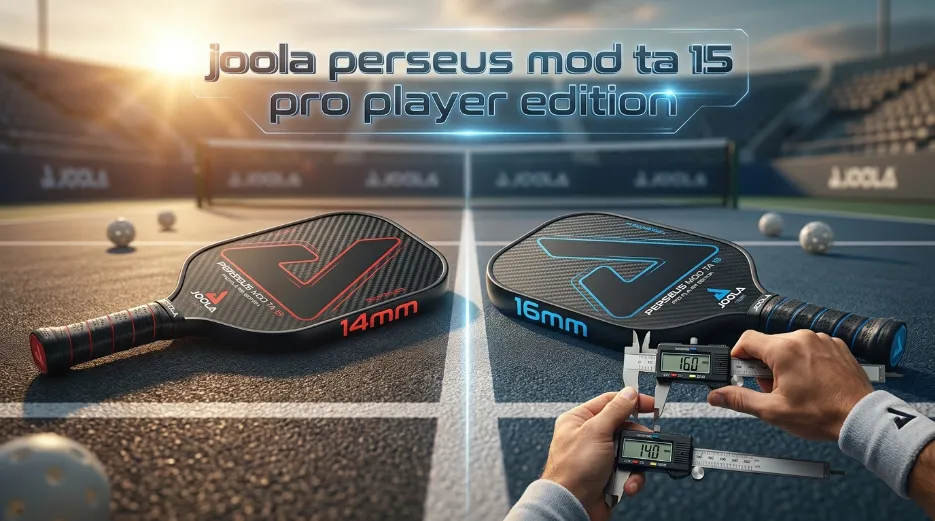
The illegal pop standard on the PPA Tour officially met its match when the joola perseus mod ta 15 pro player edition pickleball paddle hit the courts, instantly reshaping what players expect from modern thermoformed power. Most elite players spend months tweaking lead tape and grip weights just to find a balance between baseline drive force and kitchen line resetting, but JOOLA engineered this specific lineup to strip away that trial-and-error entirely. Whether you lean toward the razor-thin hand speed of the 14mm model or the plush cushion of the 16mm build, understanding how this paddle handles real-world resets and hand battles determines whether it upgrades your game or overpowers your touch.
JOOLA Perseus Mod TA-15 Pro
14mm vs 16mm · Pro Player Edition Comparison
For players prioritizing rapid hands at the non-volley zone and effortless speed-up accelerations, the joola perseus 14mm mod ta 15 pro player edition stands out as the ultimate weapon. Conversely, competitors seeking to master third-shot absorption, neutralize heavy drives, and maintain surgical dinking control will find that the joola perseus 16mm mod ta 15 pro player edition provides the ideal balance of dwell time, vibration dampening, and touch response.
Detailed JOOLA Perseus 16mm Mod TA-15 Pro Player Edition Review
Evaluating the joola perseus 16mm mod ta 15 pro player edition review performance requires analyzing how JOOLA updated its dynamic core architecture to bridge the gap between explosive power and delicate soft-game touch. Engineered as an interim flagship following regulatory adjustments on the PPA Tour, the 16mm build focuses on taming raw pop without sacrificing baseline drive velocity. The 0.63-inch core depth incorporates internal elastomeric foam cells that compress under heavy impact, creating a noticeable dampening effect during fast exchanges.
When standing at the kitchen line, executing a soft 3rd shot drop or absorbing a hard-driven ball demands predictable face feedback. The joola perseus 16mm mod ta-15 pro player edition excels in this category due to its extended dwell time. Unlike traditional raw thermoformed models that bounce the ball off the face instantly, the 16mm core allows the ball to sink deeper into the Charged Carbon matrix. This brief pocketing response gives advanced players precise directional control when maneuvering around the non-volley zone, enforcing strict adherence to kitchen line rules during tactical dink battles.
Key dynamic performance traits of the 16mm variant include:
- Vibration Dampening Core: The combination of perimeter Hyperfoam wall injection and a 16mm cell structure reduces harsh off-center feedback before it reaches the grip handle.
- Controlled Baseline Drives: Full-swing drives yield deep trajectory depth without the unforced pop-ups common to thin-core power frames.
- Spin Generation: The outer Carbon Friction grit surface produces standardized spin metrics averaging 2300 RPM, allowing heavy topspin dips on aggressive serves.
- Ergonomic Handle Layout: The 5.5-inch Octagonal handle, wrapped in Feel-Tec Pure grip material, provides ample leverage for two-handed backhand counters popularized by world number one players using the signature Ben Johns pickleball paddle.
For defensive-minded players and dynamic court resetters, the 16mm platform converts heavy opponent drives into manageable, soft-landing drops, effectively turning aggressive incoming pace into a reset opportunity.
Performance Dynamics of the JOOLA Perseus 14mm Mod TA-15 Pro Player Edition
While the 16mm variant focuses on touch and absorption, the joola perseus 14mm mod ta 15 pro player edition is engineered purely for aggressive hand speed and high exit velocity. Stripping 2mm of core thickness alters the physical dynamics of the frame, producing a stiffer flex pattern upon ball contact. With a static weight averaging 7.8 ounces and a slimmer 4.125-inch grip circumference, the 14mm chassis accelerates effortlessly through the air during rapid firefights at the net.
Understanding the fundamental 14mm vs 16mm pickleball paddle difference is essential for aggressive players. The 14mm model features an immediate trampoline response. Because there is less core depth to absorb shock energy, kinetic transfer is instantaneous. Off-the-bounce speed-ups, flick resets, and overhead smashes launch off the face with elevated exit speeds, leaving opponents with minimal reaction time during kitchen line speedups.
However, this added speed demands refined mechanical precision. The reduction in dwell time means that off-center contact near the upper edges yields a smaller sweet spot compared to its 16mm sibling. Players transitioning from traditional thick-core control paddles must adjust their soft touch, as gentle dinks can easily pop up high if the wrist is not held firm during absorption contact.
Head-to-Head Comparison: 14mm vs. 16mm Mod TA-15 Specifications
Choosing between these two elite offerings requires examining how mass distribution and core geometry affect real-world swing mechanics on court. Both models utilize the elongated 16.5-inch length and 7.5-inch width chassis, yet their playability traits diverge significantly due to physical core density differentials.
Below is a direct performance analysis comparing key mechanical metrics across both core thickness options:
- Swingweight Dynamics: The 16mm model registers a stock swingweight between 118 and 121, generating powerful leverage for baseline drives. The 14mm variant carries a lighter stock swingweight of 114 to 116, delivering faster manual rotation for quick net positioning.
- Twistweight and Torsional Stability: Due to its added mass along the perimeter, the 16mm model offers a higher stock twistweight (6.0 to 6.2) than the 14mm model (5.7 to 5.9). This makes the 16mm frame more resistant to twisting on off-center edge strikes.
- Dwell Time vs. Exit Pop: The 16mm variant deforms under high-velocity strikes to extend ball contact time, maximizing control. The 14mm core repels the ball quickly, optimizing counter-attack speed.
- Grip Ergonomics: The 14mm model comes stock with a thinner 4.125-inch grip, ideal for players who prefer aggressive wrist snaps or like adding overgrips. The 16mm model utilizes a standard 4.25-inch grip for solid palm contact.
Advanced players who customize their equipment often add tungsten tape to the 3 o’clock and 9 o’clock edge guard locations of the 14mm model. This modification raises the perimeter twistweight to match the stability of the 16mm build while retaining the rapid pop of the thinner core platform among thermoformed pickleball paddles.
Propulsion Core Engineering and Core Crushing Mechanical Breakdown
The defining innovation inside the MOD TA-15 lineup is JOOLA’s dynamic Propulsion Core architecture. Traditional core construction relies on static polypropylene honeycomb cells glued between carbon faces. In contrast, the MOD TA-15 integrates high-density elastomeric foam within the internal cell structure, surrounded by a high-pressure Hyperfoam Edge Wall. This hybrid assembly allows the inner cells to deform and rebound dynamically, functioning like a spring mechanism built directly into the core.
However, this dynamic compression capability introduces specific long-term mechanical breakdown risks that intermediate and advanced players must understand. Equipment tear-downs and extended field testing reveal that high-impact play can eventually lead to structural core crushing. This mechanical phenomenon occurs when the internal cell walls flex past their yield point and fail to return to their original shape.
The progression of core degradation typically follows three distinct operational phases:
- Phase 1 (Initial Break-In & Elevated Pop): During the first 15 to 30 hours of intense play, internal pre-compressed cell walls begin to relax. The paddle face gains dynamic flexibility, resulting in a temporary increase in sweet spot size and exit velocity.
- Phase 2 (Localized Shear Fracture): Repeated baseline driving against hard 40-hole outdoor balls creates concentrated shear stress across the central hitting zone. Select internal polypropylene walls fracture away from the carbon face skin, creating inconsistent trampoline pockets across the surface.
- Phase 3 (Core Structural Collapse): Extensive wall failure leads to dead spots or permanent soft zones. Impacting the ball in damaged regions produces an audible crunching sound, unpredictable launch angles, and a severe loss of directional accuracy, making the paddle unsuitable for competitive use among JOOLA pickleball paddles.
To maximize frame longevity, players should avoid using high-power paddles in sub-freezing temperatures, which make polypropylene cells brittle, and regularly inspect the face surface for soft spots or unexpected hollow sounds during ball bounces.
USA Pickleball PBCoR Standards and the July 1, 2025 Delisting
The operational trajectory of the MOD TA-15 series was reshaped by regulatory updates implemented by USA Pickleball (USAP). Originally submitted for testing in late 2023, the paddle passed official static deflection tests and was placed on the certified equipment register. Static testing applies force to a stationary paddle face to measure rigid flex. However, static tests failed to account for how dynamic foam-infused cores behave when hit by a ball traveling over 50 miles per hour.
To address rising exit velocities and protect player reaction times at the non-volley zone, USAP developed the Paddle/Ball Coefficient of Restitution (PBCoR) testing standard. PBCoR measures dynamic rebound velocity under high-speed laboratory conditions. When tested under these newly established dynamic limits (set at a maximum threshold of 0.44 and tightening toward 0.43), both the 14mm and 16mm MOD TA-15 models exceeded permissible rebound scores.
As a result, USAP scheduled both versions for decertification, establishing a structured phase-out period:
- Sanctioned Tournament Status: The MOD TA-15 remains fully legal for USAP-sanctioned competitive tournaments through June 30, 2025.
- Official Delisting Date: Effective July 1, 2025, the paddle will be permanently removed from the official USA Pickleball approved paddle list, making it ineligible for sanctioned events, regional qualifiers, and national championships.
- Unsanctioned Open Play & Club Games: For informal recreational play, local open play rotations, and non-USAP leagues, players may continue using the MOD TA-15 indefinitely, provided individual club rules do not enforce USAP equipment guidelines.
Navigating the Official JOOLA MOD TA-15 Paddle Refresh Program
Following the decertification update, JOOLA launched the official Paddle Refresh Program to support verified owners of the MOD TA-15. This customer program allows players to transition from the delisted TA-15 to fully compliant, next-generation equipment at a reduced cost.
Under the terms of the program, eligible customers receive a 50% discount voucher valid toward purchasing the successor model, the JOOLA Perseus Pro IV. Importantly, JOOLA does not require owners to return their original MOD TA-15 paddle, allowing players to keep their current equipment for recreational sessions while acquiring a fully approved tournament paddle.
To successfully navigate the digital verification workflow, follow these technical steps:
- Step 1 (NFC Chip Hardware Authentication): Locate the embedded Near Field Communication (NFC) chip inside the paddle handle shaft, positioned directly beneath the rubber neck collar. Unlock your smartphone, ensure NFC is enabled in system settings, and tap the top edge of your device against the handle collar.
- Step 2 (Digital App Link Redirection): The NFC scan automatically launches an authentication portal within the JOOLA Connect application, verifying hardware authenticity and populating the internal serial number. (Note: Manual serial entry is disabled to prevent counterfeit claims).
- Step 3 (Proof of Purchase Upload): Upload a digital photo or screenshot of your original retail sales receipt. Files must be submitted in standard .jpg, .png, or HEIC image formats; standard PDF files are automatically flagged and rejected by the portal.
- Step 4 (Voucher Code Generation): Upon verification approval by customer support, a 50% discount code is generated within your account dashboard. Applying this code toward the new JOOLA Perseus Pro IV completes the redemption process, while automatically voiding the legacy warranty on the registered TA-15 paddle.
For more details on claim windows and updated product offerings, players can consult the official JOOLA Pickleball website.
Lineup Evolution: Gen 3, MOD TA-15, Perseus 3S, and Perseus Pro IV
To understand JOOLA’s product evolution, it helps to review how core technology has progressed across four flagship generations. Each model reflects changes in design philosophy, legal compliance, and manufacturing durability.
The progression of JOOLA’s flagship series includes:
- JOOLA Gen 3 Series (Spring 2024): Introduced the initial Propulsion Core design, producing extreme exit speeds. However, wide rebound variance led to an immediate decertification without a grace period.
- JOOLA Perseus MOD TA-15 (Summer 2024): Developed as a retuned power bridge model. It delivered high baseline acceleration and excellent spin, but was eventually scheduled for decertification under updated 2025 dynamic PBCoR testing standards.
- JOOLA Perseus 3S Series (Fall 2024): Engineered with a standard thermoformed core structure without pre-stressed foam cells. The 3S offers reliable dwell time, high core durability, and permanent tournament approval for control-focused players.
- JOOLA Perseus Pro IV Series (Spring 2025): Introduces TechFlex Power (TFP) structural layering alongside an updated core cell configuration. The Pro IV delivers high power while fully complying with USAP PBCoR (.43) and UPA-A tour equipment guidelines.
For tournament players building a long-term equipment setup, selecting certified paddles for advanced players ensures compliant performance across all sanctioned competitive venues.
Frequently Asked Questions (FAQ)
Can I continue playing with the JOOLA Perseus MOD TA-15 in local club games after July 1, 2025?
Yes. The USAP decertification applies specifically to sanctioned competitive tournaments, regional qualifiers, and official league events. For informal open play, casual club matches, and local recreational sessions, you can continue using the paddle indefinitely, provided your local facility does not mandate strict USAP equipment lists.
What is the exact functional difference between the 14mm and 16mm core thicknesses?
The 14mm model offers a stiffer core flex, yielding faster manual hand speed and immediate pop for rapid counter-attacks. The 16mm model provides enhanced vibration dampening, longer dwell time, and a softer impact feel, making it easier to absorb hard drives and reset ball trajectory during dink rallies.
How do I troubleshoot an NFC chip that fails to scan on my smartphone?
If your phone fails to detect the NFC hardware, remove thick protective phone cases and ensure your device’s NFC reader is active. Position the top back edge of your phone directly against the rubber neck collar at the top of the handle. If auto-scanning remains unresponsive, clean the collar area and contact official support with your sales receipt for manual verification assistance.
Why did my original MOD TA-15 warranty become voided after claiming the Refresh Program code?
JOOLA’s official Refresh Program rules state that redeeming the 50% discount voucher for a new replacement model transfers product coverage to the newly purchased paddle. Because players are permitted to keep their original MOD TA-15 paddle without sending it back, the legacy hardware warranty on the original frame is retired upon voucher issuance.