Millions of Americans flood local courts every week, yet a staggering number of players unknowingly handicap their game with equipment that actively fights their mechanics. Choosing good pickleball paddles isn’t just about grabbing the nearest graphite surface off a retail rack; it is the definitive dividing line between unforced errors and effortless court dominance.
Whether you are browsing through options like dick’s sporting goods pickleball paddles, searching for dicks sporting goods pickleball paddles inventory, or trying to understand what makes a good pickleball paddle perform at a tournament level, mastering the core anatomy of weight distribution, core thickness, and face material changes everything. Finding a truly good pickleball paddle dictates your trajectory from casual recreation to relentless court control.
Best Pickleball Paddles
Verified specs & performance data (2026) · By play style
Comprehensive Anatomy: good pickleball paddles, what makes a good pickleball paddle
The engineering core of modern court dominance centers upon a non-traditional paddle setup. While legacy equipment relied primarily on standard cold-pressed glued variants, this modern silhouette bridges advanced thermoforming technology with the rigorous kinetic constraints of fast-paced transition zone sports.
- The Core Matrix (Gen 2 Thermoforming): Utilising expanded polypropylene honeycomb cells sealed under intense heat, the primary engine offers exceptional mechanical bounce. When executing high-velocity drives, the cells absorb massive kinetic energy before rebounding immediately to assist the next strike, completely eliminating the mushy dead zones of older generations.
- Twist Weight vs. Swing Weight Boundary: Because high swing weight is naturally exhausting under heavy hand-battle loads, it requires a structural countermeasure. The internal foam perimeter chassis wraps around the core boundary, locking the edges into place to raise the “twist weight.” This prevents the paddle from rotating in your hand during sharp off-center cuts, widening the sweet spot exponentially.
- Surface Mechanics: The raw Toray T700 carbon fiber formulation incorporates multi-directional peel-ply textures alongside a designated flex profile positioned beneath the hitting zone. This allows players to execute sudden heavy topspin dips near the kitchen line without the ball sliding off the synthetic fibers.
The face layer balances ultra-lightweight structural carbon with protective edge guards to prevent immediate premature wear caused by continuous court-scraping during low defensive dinks. For players analyzing options across the entire brand matrix, evaluating the dedicated structural differences outlined in our analytical look at top pickleball paddles provides clear contextual background before buying.
Retail Reality vs. D2C: Navigating dicks sporting goods pickleball paddles inventory
Navigating the product family requires a clear understanding of the mechanical differences between the flagship direct-to-consumer (D2C) brands and the exclusive models found on retail shelves. Selecting your specific version dictates both your budget efficiency and your kinetic velocity on court.
The Certification and Testing Variance
The 2026 landscape is heavily monitored by strict compliance standards. The USA Pickleball (USAP) architecture focuses extensively on surface grit limits and the trampoline effect (PBCoR testing) to maintain fair amateur play. Conversely, the newly mandated UPA-A professional configuration employs an ultra-rigorous ultrasonic bond test designed for elite-tier responsiveness. This gives professional competitors a sharper sense of security, but introduces a hefty testing cost that often narrows the available models at local big-box stores.
Return Policies and Commercial Discrepancies
The logistics of physical retail introduce an undeniable testing penalty. Buying in-store generally subjects you to strict policies where returning a slightly scuffed paddle is often rejected. The modern D2C option bypasses this restriction noticeably, providing a 30-day risk-free testing sensation for nimble players trying to find their perfect match. This policy variance reflects clearly across US commercial retail channels, where purchasing an exclusive model locally commands immediate ownership, while online variants enter the market with a highly accessible trial period.
If you are a high-level competitor seeking to match advanced paddle dynamics with elite-tier control tools, exploring the definitive structural mechanics detailed in our guide to the USA Pickleball approved paddle list will ensure your entire equipment setup functions in perfect technical alignment.
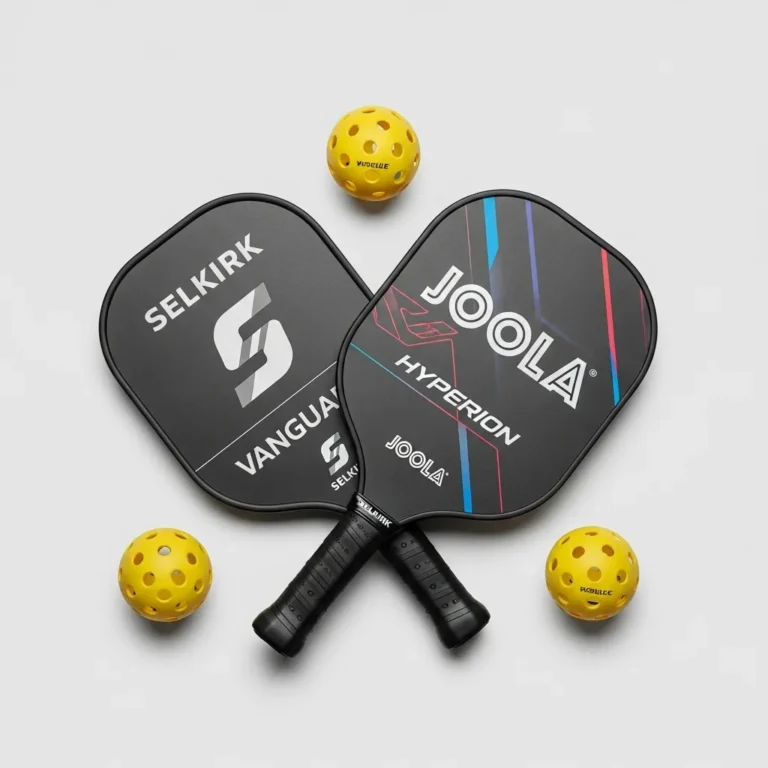
Head-to-Head: JOOLA Ben Johns Hyperion 16mm vs. Selkirk Vanguard Power Air
For players trying to choose between the premium JOOLA Ben Johns Hyperion and the legendary Selkirk Vanguard Power Air, the choice comes down to a fundamental split in design philosophy. Both models command top-tier placement across US retail outlets but approach court stability from completely opposing angles.
The primary differences in on-court performance are detailed in the comparison matrix below:
- Control and Dwell Time: The JOOLA compound wins decisively on instant control, delivering a plush, energetic feel the very first time you hit a drop shot. The Selkirk Vanguard features a remarkably stiff, aerodynamic structural layout that requires impeccable timing to harness its raw power accurately.
- Aerodynamics and Swing Speed: Selkirk dominates the maneuverability category through its rigid, edgeless design and throat cutout, which drops the swing weight completely. The heavier closed-throat system used by JOOLA provides excellent fluid stability but yields slightly more fatigue under extreme, high-velocity hand battles at the net.
- Lifespan and Value: The heavy edge-guard reinforcements on the JOOLA model easily deliver 9 to 12 months of structural integrity under harsh conditions. The lighter, edgeless painted texture of the Selkirk model generally shows significant cosmetic wear within 3 to 6 months of intense use, requiring more frequent investment cycles.
For a complete, comprehensive overview of the broad variety of choices currently occupying the competitive landscape across American clubs, take a moment to read our detailed breakdown of dick’s sporting goods pickleball paddles alongside our independent evaluation of basic what is pickleball strategies to select your ideal structural fit, and always cross-reference your gear on the official USA Pickleball Approved Equipment Database.
Frequently Asked Questions (FAQ)
Are these thermoformed paddles approved for strict HOA noise-restricted courts?
Not inherently. While advanced foam perimeters reduce some core vibration, true quiet-certified paddles are engineered specifically to drop acoustic frequencies below 600 Hz and stay under 80 decibels. Standard raw carbon paddles still emit a sharp pop that may violate strict residential community rules.
Can I safely add lead tape to the edge guard to increase my paddle’s power?
Yes, but it alters the physics dramatically. Applying tape at the 3 and 9 o’clock positions directly increases the twist weight, making the paddle highly forgiving on off-center strikes. However, it simultaneously increases the swing weight, trading away a small amount of instantaneous micro-response during hyper-fast net volleys.
How does the core thickness impact response speed compared to generic thin variants?
The inclusion of a thick 16mm polymer core raises your dwell time slightly over dedicated minimalist 14mm power frames. While this adds unmatched impact cushion and reset control, it softens the immediate energy return required for baseline passing shots.