Four numbers flashing through the air, arguments abruptly pausing matches on public courts from coast to coast, and a sudden, awkward silence when someone yells the wrong server number—mastering pickleball scoring doubles isn’t just about tallying points; it is the ultimate social currency across American communities. While singles strategy relies on basic arithmetic, doubles introduces a rhythmic, often baffling three-digit sequence that sends even seasoned tennis converts scrambling for clarity mid-match.
Whether you are stepping onto a neighborhood court in Austin or gearing up for a recreational league in Chicago, decoding pickleball doubles scoring instantly elevates your confidence and keeps the rhythm of the game seamless. Let’s break down the exact mechanics of scoring in pickleball doubles so you can command the court with absolute authority.
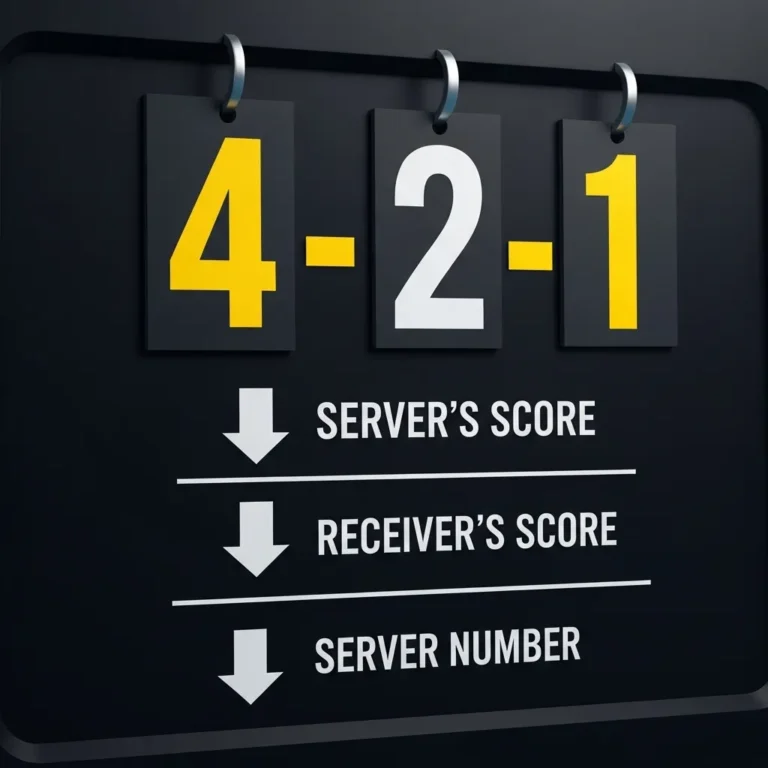
Official pickleball scoring doubles relies on four verified rule mechanics in 2026. The score call format (Rule 4.A.1 / 4.D.1) requires three numbers before the serve: Server Score, Receiver Score, and Server Number, as in “4-3-2”. The starting server exception (Rule 4.B.6) means only one player on the starting team serves before the first side-out, so the game starts at “0-0-2”.
The side-out mechanism (Rule 4.B.5) transfers possession to the opposing team after the serving team commits two faults (except first serve); for example, when Server 2 faults, the ball goes to the opponents. Finally, the court position logic (Rule 4.B.7) states that the starting right-side player serves or receives from the right on even scores and from the left on odd scores, so when the score is 4 (even), that player is on the right.
The rapid expansion of the club scene across the United States has fundamentally altered player expectations regarding specialized rules. Generic backyard scoring habits no longer suffice on highly competitive courts. With specialized 2026 rule updates firmly in place, understanding the underlying logic beneath the score calling becomes paramount to maintaining technical execution and controlling the tempo of the match.
pickleball rules and scoring doubles
The engineering core of scoring in pickleball doubles centers upon its non-traditional side-out setup. While legacy racquet sports rely primarily on alternating service games, this sport bridges continuous player rotation with rigorous lateral constraints. Many beginners get lost in the numbers, but the system is actually a self-correcting mathematical loop.
- The Three-Digit Call: Before striking the ball, the server must announce three numbers. The first represents the serving team’s score, the second is the receiving team’s score, and the third dictates whether you are Server 1 or Server 2 for that specific service rotation.
- The 0-0-2 Exception: To prevent an unfair early advantage, the team that serves first only gets one service turn before a side-out occurs. By starting the game as “Server 2”, the rules mandate that a single fault forces a turnover.
- Court Positioning: Your geographical location on the court is anchored strictly to your team’s score. The receiving team never swaps sides when they win a rally; teams only switch positions when they actively score a point while serving. Reviewing official pickleball rules doubles clarifies this mechanic.
The system requires precise communication. If a server initiates the motion without fully calling the score, or rushes the call while making contact (a “live ball” call), it constitutes a fault in sanctioned play. To fully master these nuances, understanding basic pickleball terms and court geography is essential.
Direct Comparison: Traditional Side-Out Scoring vs. 2026 Rally Scoring
For players trying to choose the right format for their local leagues, the choice often comes down to a fundamental split in design philosophy. Both models govern modern doubles pickleball scoring, but they approach match pacing from completely opposing angles.
The Pacing Variance
The traditional Side-Out architecture focuses extensively on earning the right to score. Because points can only be tallied by the serving team, matches naturally experience defensive standstills where the score remains static for multiple rotations. Conversely, the Rally Scoring configuration awards a point after every single rally, regardless of who served. This gives speed-focused events a highly predictable timeframe and punishes unforced errors instantly.
Strategic and Structural Discrepancies
The primary differences in on-court performance and mental strategy are detailed below:
- Game Length and Win Margins: Traditional matches are typically played to 11 points (win by 2). Rally scoring matches are frequently extended to 21 points to compensate for the accelerated point accumulation.
- The 2026 Freeze Elimination: The biggest update to the 2026 provisional rules was the complete removal of the “freeze” rule in rally scoring. Previously, a team had to be serving to score the final match point. Now, either team can score the match-winner on any rally, removing the artificial late-game bottleneck.
- Score Calling Simplicity: Rally scoring eliminates the need for a “Server 1” and “Server 2” designation. Because possession shifts after a single lost rally, players only need to call two numbers: the server’s score and the receiver’s score. For a deeper dive into point management, exploring dedicated pickleball scoring resources is highly recommended.
The Missing Angles: Fixing Court Confusion and Positioning Faults
Most guides cover the basics, but competitive matches are won and lost in the margins. Misinterpreting the advanced sections of the rulebook leads to unnecessary arguments and given-away points. Let’s dissect the most commonly misunderstood scenarios that disrupt the rhythm of American courts.
Rule 5.C – The “Wrong Server” Retroactive Reality: What happens if you play a grueling 20-shot rally, only to realize the wrong person served or received? In the past, this caused chaos. Under the refined 2026 rules (Rule 5.C.2), if the rally finishes and the ball is dead, the result of the rally stands. You cannot retroactively cancel an opponent’s hard-earned point just because they were standing on the wrong side. The score simply updates, and players correct their positions for the next serve.
Rule 4.K – The Wrong Score Trap: If a server yells the wrong score, you are allowed to stop play to correct them—but your timing must be flawless. You must halt play before the return of serve is struck. If you return the serve and then stop play to argue the score, you commit a fault and instantly lose the rally. Ensuring your serve mechanics are flawless is just as important; reviewing illegal pickleball serves and adopting advanced pickleball serve tips will keep you legally grounded.
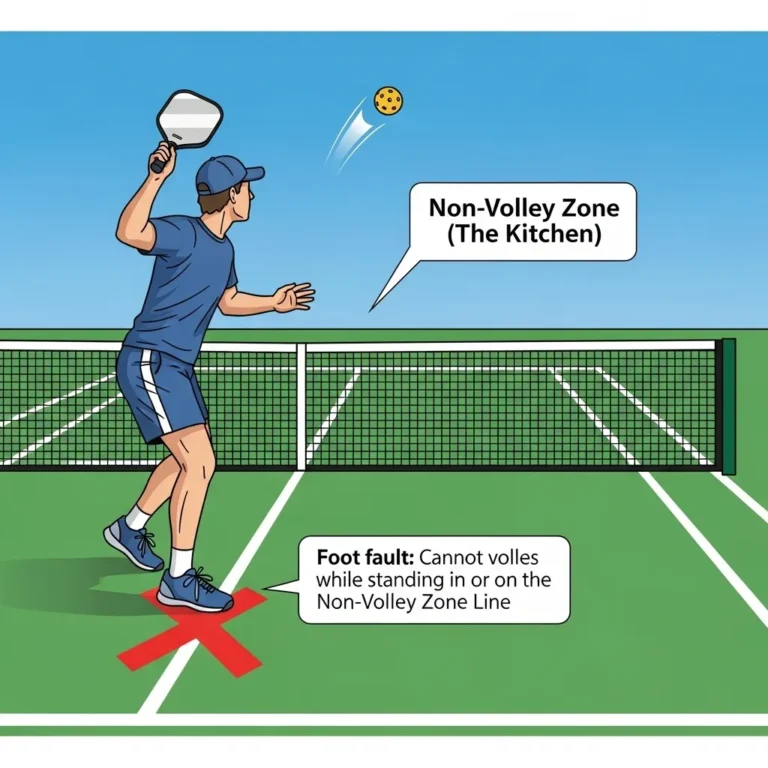
The “Nasty Nelson” Tactic: Often viewed as controversial but entirely legal, if a server hits a volley serve directly at the receiver’s partner (who is standing near the kitchen) and the ball strikes them before bouncing, it is an immediate fault on the receiving team. The serving team wins the point. The receiver’s partner must always be alert and agile.
Pickleball Scoring Doubles – FAQ
What is the new “Clearly Legal” standard for volley serves in 2026?
Referees are no longer giving the benefit of the doubt on borderline serves. A legal volley serve must *clearly* feature an upward arc, the paddle contact must be *clearly* below the waist, and the paddle head must be *clearly* below the highest point of the wrist. If it is too close to call, it is ruled a fault.
Can the non-receiving partner hit a short serve to force a replay?
No. Rule 5.C.1.c was updated to close this loophole. If the correct server and receiver are in position, but the receiver’s partner steps in and hits the serve (even if it was going to land short), it is an immediate fault on the receiving team. The serving team gets the point.
Is the spin serve still allowed in official doubles play?
Absolutely not. The rules strictly prohibit using your hand, fingers, or the paddle to impart any pre-serve spin on the ball during the release or toss. The ball must be released from a flat, visible hand or dropped naturally from the paddle face.