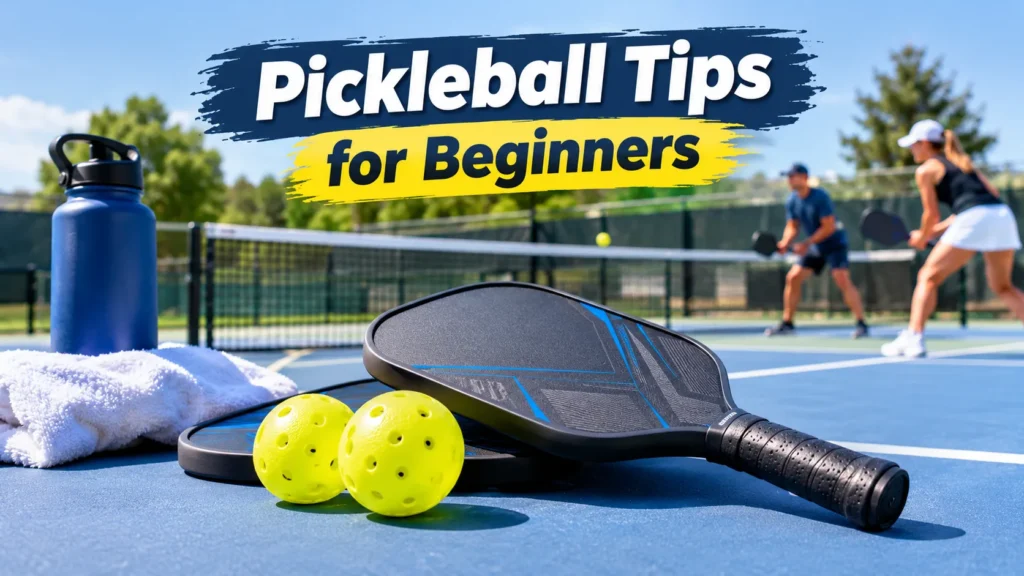
Most player failures on the pickleball court do not stem from a lack of athletic ability—they happen the second a tennis instinct takes over, leaving players stranded in “no man’s land” while an opponent gently dinks the ball into the kitchen. While court movement looks deceptively simple, mastering the core pickleball tips for beginners is what transforms erratic paddle swings into controlled, game-winning strategy. By making subtle adjustments to your footwork, paddle readiness, and kitchen positioning before ever stepping into open play, you instantly eliminate high-percentage mistakes and establish total control over every rally.
Pickleball Beginner Skills
Common mistakes · Actionable rules · Impact on play
Pickleball Tips and Tricks for Beginners: Fixing Common Court Mistakes
When diving into the granular mechanics of the sport, understanding the exact pickleball tips and tricks for beginners requires looking past the superficial advice often shouted across public courts. The most widespread error new players make is operating under the assumption that getting to the non-volley zone (NVZ), commonly known as the kitchen, is a pure sprint. This misconception creates massive geometric gaps in your defense. When you strike a ball and sprint forward without assessing the quality of your shot, you enter what coaches refer to as “no-man’s land” (the transition zone) while completely off balance.
To fix this, you must integrate the “split-step” into your muscular memory. A split-step is a micro-hop that brings your forward momentum to an absolute halt, allowing you to land in a wide, athletic stance precisely as your opponent makes contact with the ball. By stopping, you transition your brain from movement calculation to tracking the incoming ball trajectory. If the ball is hit hard at your feet, your stable base allows you to execute a block. If you are sprinting while the ball is struck, your kinetic energy is already committed, making lateral adjustments virtually impossible.
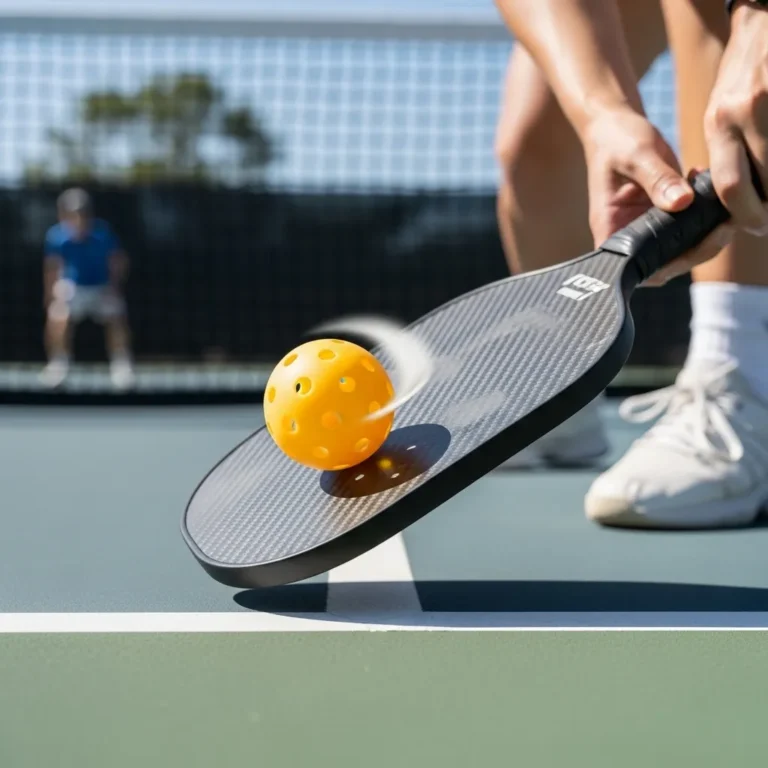
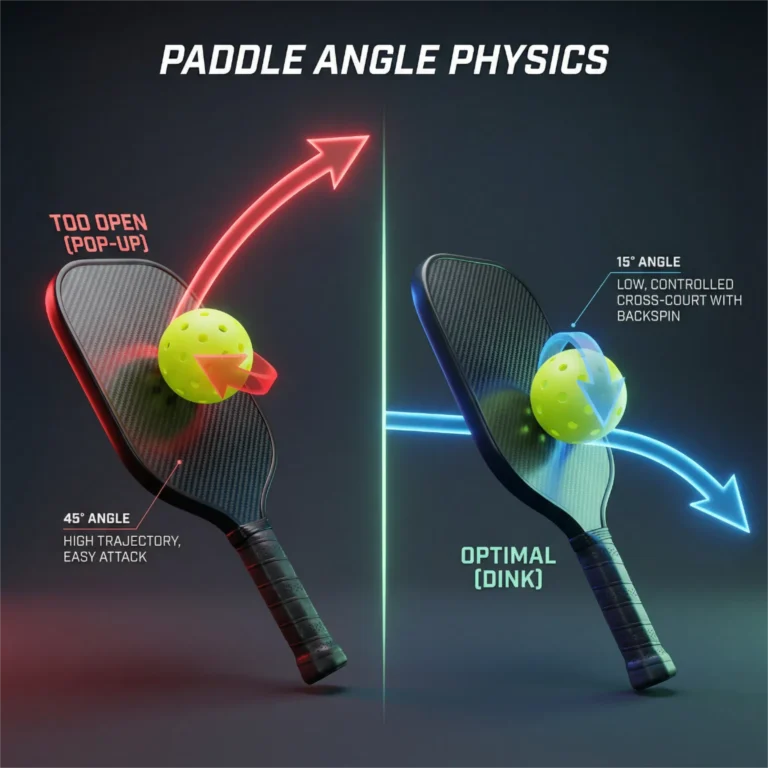
Another profound mistake is the “pop-up dink.” Beginners often try to lift the ball over the net using their wrists. In pickleball, the paddle acts as an extension of the shoulder. A proper dink requires a locked wrist and a gentle pendulum motion originating from the shoulder socket. When you incorporate these fundamental pickleball tips, you eliminate the flicking motion that imparts unwanted height on the ball, thereby denying your opponents the opportunity to hit a downward smash.
Equipment Choices Based on Applied Physics
One of the most critical beginner pickleball tips is recognizing that your paddle choice is a matter of applied physics, not just aesthetics. The modern pickleball market is flooded with varying core thicknesses, usually ranging from 13mm to 16mm. A paddle’s core thickness fundamentally alters the compression cycle of the ball upon impact.
A 16mm core features deeper polypropylene honeycomb cells. When the ball strikes the face, it compresses the core deeper and stays on the paddle face a fraction of a millisecond longer. This extended compression cycle absorbs kinetic energy, meaning the paddle actively dampens the speed of the ball. This provides a much wider “sweet spot” and superior rotational stability (twist-weight). For a beginner, this translates to maximum control and forgiveness on off-center hits. If you are struggling to keep your drops and dinks low, exploring the best beginner pickleball paddles that feature a 16mm core is your quickest route to improvement.
Furthermore, staying updated on equipment regulations is vital. As of late 2026, the sport’s governing body implemented strict new spin limits, capping maximum paddle spin rates at 2,100 RPM and introducing advanced coefficient of restitution (PBCoR) testing. This means you cannot rely on excessively gritty, non-compliant surfaces to generate spin. You must learn proper swing paths. Familiarizing yourself with the official USA Pickleball rules ensures your gear complies with these stringent new friction and trampoline-effect limitations.
Head-to-Head: 16mm Control Paddles vs. 13mm Power Paddles
For players trying to choose between a 16mm control core and a 13mm power core, the choice comes down to a fundamental split in design philosophy and skill level. While advanced singles players might appreciate the fast rebound of a thinner core, beginners are significantly better served by prioritizing stability.
- Energy Return (Pop): The 13mm core provides a highly volatile, fast energy return. The ball violently pops off the face, which is great for high-speed kitchen firefights but disastrous for beginners trying to master soft drops. The 16mm core absorbs energy, slowing the game down to a manageable pace.
- Twist-Weight and Forgiveness: A 16mm paddle inherently possesses a higher twist-weight. When you hit the ball near the edge guard instead of the dead center, the 16mm paddle resists rotating in your hand, keeping your shot relatively on target. A 13mm paddle will twist severely, resulting in a dead ball into the net.
- Developmental Value: Starting with a 16mm paddle forces a beginner to learn how to generate their own power through proper body rotation and weight transfer, rather than relying on the paddle’s “pop.” This builds exceptional foundational mechanics.
Serve and Return Mechanics: Building a Solid Foundation
The architecture of a pickleball rally is entirely dictated by the first two shots. Understanding exactly what is pickleball structurally means understanding the “Two-Bounce Rule.” By mandate, the receiving team must let the serve bounce, and the serving team must let the return bounce. This structural rule eliminates the oppressive “serve-and-volley” tactic seen in tennis, shifting the advantage slightly to the receiving team who can immediately take the net.
For the serving team, consistency is paramount. One of the best pickleball beginner tips is to adopt the “Drop Serve.” Introduced as a permanent rule, the drop serve allows you to release the ball from any height and strike it after it bounces on the court. However, the rule is strict: you must release it using only gravity (no throwing it down or spinning it). By allowing the ball to bounce, you completely remove the complex variables of a mid-air toss. This allows beginners to focus entirely on swinging through the ball with a consistent pendulum motion, drastically reducing service faults.
When returning the serve, your objective is depth. A short return invites the serving team to easily step forward and execute a high-percentage drop shot. By hitting a deep, lofty return—preferably targeting your opponent’s weaker backhand—you pin them deep behind the baseline. This geometric pressure gives you ample time to jog up to the NVZ line and establish a dominant defensive wall before they can even make contact with their third shot.
Deconstructing the Third-Shot Dilemma
If you ask any veteran for tips for pickleball beginners, they will almost universally tell you to master the “Third-Shot Drop.” While a perfect, un-attackable drop shot into the kitchen is the holy grail of pickleball, insisting that a beginner execute this shot 100% of the time is a tactical fallacy.
When a beginner is pushed three feet behind the baseline by a deep, heavy return, attempting a delicate, high-arcing drop shot spanning 40 feet is a remarkably low-percentage play. More often than not, the ball is popped up high over the net, giving the opponents a free overhead smash. To understand comprehensive how to play pickleball strategies, you must embrace the “Drive-to-Drop” sequence.
If the return is deep and aggressive, your third shot should be a low, topspin drive. The goal is not necessarily to hit a clean winner, but to force the opponents at the net to execute a defensive block volley. A hard drive reduces their reaction time and typically results in a slightly shorter, softer fourth shot. Because you drove the ball, you can now take a few steps into the transition zone. Now, from mid-court, your 5th shot is a much shorter, much easier drop shot into the kitchen. By breaking the transition into two distinct phases, you manage risk and maintain control of the rally.
Mastering Movement and NVZ (Kitchen) Dynamics
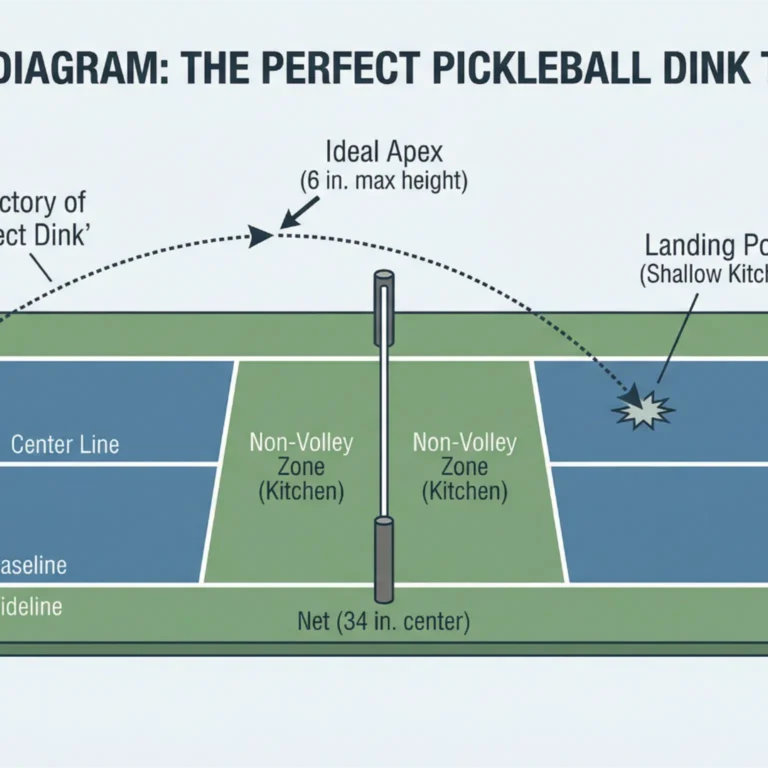
Once you navigate the transition zone, the battle is won or lost at the non-volley zone line. Comprehending pickleball kitchen rules is essential. You cannot strike the ball out of the air (a volley) while any part of your body touches the NVZ line or the surface inside it, nor can your momentum carry you into the zone after striking a volley. However, you can stand in the kitchen at any time as long as you let the ball bounce first.
The most crucial aspect of kitchen dynamics is “Partner Tethering.” In doubles, you and your partner must move laterally and vertically as if connected by an invisible rope. If you hit a drop shot and run to the NVZ line, but your partner stays back at the baseline, you have created a fatal geometric flaw known as “one-up, one-back.” Smart opponents will simply push the ball into the massive diagonal gap between you. Move together, stop together, and defend together.
Furthermore, when established at the NVZ, beginners often panic against “Bangers”—players who relentlessly drive the ball at maximum speed. The instinct is to take a massive backswing and fight power with power. Instead, use the “soft block” technique. Relax your grip to a 4/10 pressure and hold the paddle squarely in front of your body. Let the paddle absorb the kinetic energy. By simply redirecting their fastball downward toward their feet, you use their own pace against them, forcing them into a difficult low dig that usually results in a match-ending error.
Open Play Culture and Rating Systems in the US
As pickleball explodes across the United States, managing the influx of millions of players requires specific social protocols. Most public parks utilize a “paddle rack” system to manage open play. Understanding this etiquette is just as important as knowing pickleball scoring. When courts are heavily congested (more than 8 paddles in the queue), the standard rotation becomes “four on, four off.”
This means that after a game is completed (usually played to 11, win by 2), all four players must vacate the court and place their paddles back in the rack, allowing the next four waiting players to take the court. In less crowded scenarios, it may be “two on, two off,” where the winning team stays but splits up to accept two new challengers.
As you integrate into these communities, you will undoubtedly encounter the DUPR (Dynamic Universal Pickleball Rating) system. This algorithmic scale rates players from 2.000 to 8.000. A 2.5 player is a true beginner learning basic positioning and scorekeeping. A 3.0 player can sustain short rallies, execute basic serves, and is beginning to intentionally use the soft game. Understanding these brackets helps you self-assess and seek out matches that provide the right level of challenge without overwhelming your current skillset.
Finally, a word on the psychological environment of open play: you will receive unsolicited advice. Because players stand merely feet apart, well-meaning partners often bombard beginners with tactical corrections mid-game. The best approach is to smile, nod, and immediately return to your own internal focus. Attempting to overhaul your biomechanics during a live match based on a stranger’s advice leads to cognitive overload and “paralysis by analysis.” Focus on mastering one specific mechanic per session—like stopping your feet before you hit—and let the rest of the game flow naturally.
Pickleball Tips for Beginners- FAQ
Should I play with an indoor ball or an outdoor ball if I am just starting out?
You must match the ball to your court surface. Outdoor balls (like the Franklin X-40) feature 40 smaller holes and a harder plastic shell to cut through the wind and resist abrasive asphalt. Indoor balls have 26 larger holes and are softer, designed to bounce consistently on smooth gymnasium floors. Mixing them up will ruin your timing.
Is it illegal to stand in the non-volley zone (the kitchen) if I am not hitting the ball?
No, it is perfectly legal to stand inside the kitchen at any point during a rally. The rule strictly dictates that you cannot hit the ball out of the air (a volley) while touching the zone. If the ball bounces first, you are free to strike it while standing squarely inside the kitchen.
How do I avoid getting stuck in the transition zone?
Avoid the urge to sprint continuously toward the net. Use the “split-step” to halt your forward movement just before your opponent makes contact with the ball. If you are caught in the mid-court, prioritize hitting a soft “reset” into the opponent’s kitchen, which will buy you the necessary time to safely take two more steps forward.