Long before the first strategic dink or blistering drive down the line, every match teeters on a silent, universally dreaded ritual of collective amnesia at the baseline. Four competitors stand poised, paddles ready, while a quiet panic settles over who actually holds the opening ball rights. Cutting through the pre-match guesswork requires more than a casual coin flip or local open-play folklore; it demands absolute clarity on who serves first in pickleball. Whether you are navigating the nuances of tournament brackets under the official rulebook or decoding the chaotic dynamics of a crowded public park, mastering this foundational protocol changes how you control the entire momentum of the match before the scorekeeper even speaks.
Pickleball Serving Rules
Game formats · Server position · Score calls
Understanding the intricate dynamics of service rotation is what separates recreational hitters from advanced tacticians. The rules dictate far more than just putting the ball over the net; they dictate positioning, game flow, and strategic dominance. Once you grasp the foundations outlined in the 2026 USA Pickleball Official Rulebook, you will eliminate pre-game confusion and step onto the court with complete confidence.
Understanding Who Serves in Pickleball: The Core Mechanics
At its core, identifying who serves in pickleball hinges on the fundamental concept of side-out scoring. Unlike traditional tennis where games are won in blocks, pickleball dictates that you can only score points while your team is serving. If the receiving team wins a rally, they do not win a point; they simply win the right to serve. This makes the initial service a critical tactical element.
Once a side-out occurs, the right to serve always begins on the right side of the court, also known as the even court. As you accumulate points, you alternate sides. To master these transitions seamlessly, players must familiarize themselves with standard pickleball rules and scoring vernacular.
How to Determine Who Serves in Pickleball: Official Rules vs. Open Play Customs
Before the first rally, teams must figure out how to determine who serves in pickleball. According to Section 5.A.1 of the 2026 rulebook, players must use a “fair method” to decide. The winner gets four specific choices: serve first, receive first, pick the starting side of the court, or defer the choice to the opponents.
- The Coin Toss or Paddle Spin: This is the tournament standard. Players often spin a paddle on the ground and guess which way the logo will face.
- The Strategic Defer: Advanced players often defer. By forcing the opponent to choose the serve, the deferring team can select the “good side” of the court—taking advantage of favorable wind or sun conditions.
- The Bainbridge Island Homage: In casual US open play, a widely accepted unwritten rule states that the team physically closest to Washington State (the birthplace of the sport) automatically serves first. This is usually the North or West side of the court.
The First Server Exception: Who Serves First in Pickleball Doubles
Doubles play introduces a unique twist designed to neutralize the advantage of serving first. If you are asking who serves first in pickleball doubles, the answer involves the “First Server Exception.” At the absolute start of a new match, only one player on the serving team gets the opportunity to serve before committing a fault.
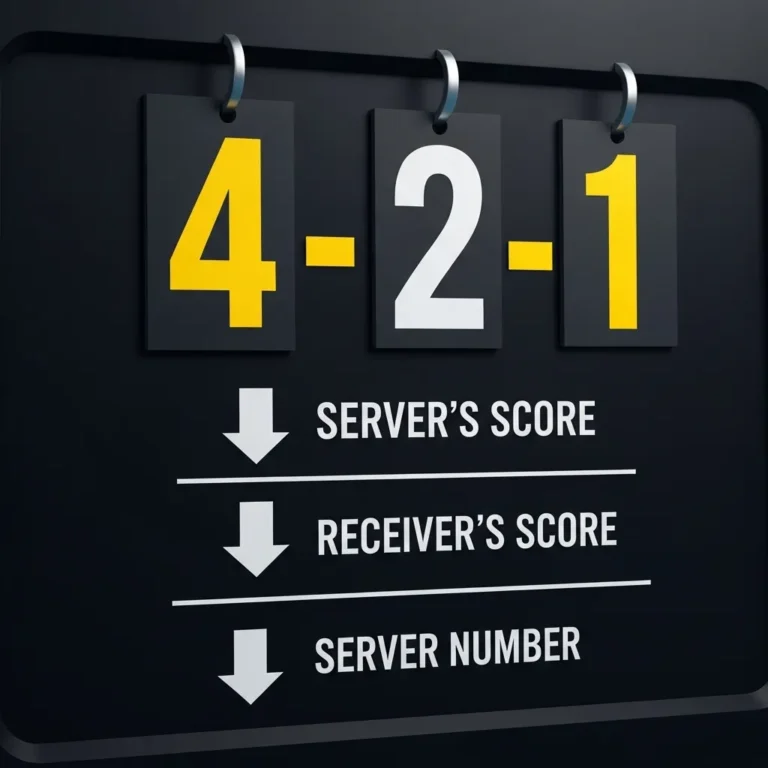
Because the starting team gets only one chance, the initial score call must clearly reflect this handicap. The player standing in the right-hand court calls out “0-0-2” (or “0-0-Start”). The “2” indicates that they are operating under the rules of the second server, meaning any fault results in an immediate side-out. To avoid confusion regarding your starting position as the game progresses, many players utilize red wristbands to track their initial orientation, a highly recommended tip found in modern pickleball rules doubles strategy guides.
How Do You Decide Who Serves First in Pickleball Tournaments: Games 2 and 3
The rules shift dynamically when playing a best-of-three match. A common missing piece of knowledge among amateur players is exactly how do you decide who serves first in pickleball during the second and third games. You do not re-flip the coin. The initial serve automatically alternates to the opposite team at the start of Game 2, regardless of who actually won Game 1.
For the decisive Game 3, the serve reverts to the team that started Game 1. However, to ensure maximum environmental fairness, teams must execute a mid-game switch. In an 11-point tiebreaker, players switch ends of the court the moment the first team reaches 6 points, ensuring no side holds a glare or wind advantage for the entirety of the finale.
Head-to-Head: 2026 USA Pickleball Serving Rules vs. UPA-A Professional Standards
As the sport evolves, a massive rift has formed between recreational governance and professional leagues. Understanding the biomechanics of in pickleball your serve must be compliant requires looking at this institutional split.
The core differences impacting modern court strategy are detailed in the matrix below:
- The “Clearly” Mandate (USA Pickleball): In 2026, USA Pickleball added the word “clearly” to all volley serve restrictions. The paddle must clearly move in an upward arc, contact must clearly be below the waist, and the paddle head must clearly remain below the wrist. This shifted the burden of proof, giving referees the power to fault borderline overhead-style serves instantly.
- The Drop Serve Ban (UPA-A): While USA Pickleball allows maximum flexibility with the drop serve (exempting it from the strict biomechanical arc rules), the UPA-A professional league has entirely banned the drop serve. Pro players must exclusively use the traditional volley serve.
- Toss and Spin Restrictions: Both organizations heavily police illegal spin. You are strictly forbidden from rolling the ball off your fingers to generate spin during the release. UPA-A goes a step further, restricting toss height to no more than one ball diameter to prevent aggressive overhead momentum.
If you find your serves frequently being called out or faulted during local tournaments, it is highly recommended to review advanced pickleball serve tips to ensure your swing mechanics remain unimpeachable under the strict new wording.
Singles and Mini-Singles: Streamlining the Court Dynamics
For those stepping onto the court without a partner, the mechanics are drastically simplified. In singles, there is no first server exception. Each player receives one serve per rotation. The scoring eliminates the third number entirely, resulting in a streamlined two-number call (e.g., 0-0).
Your physical positioning relies entirely on your current score. If your score is even (0, 2, 4), you must serve from the right side. If it is odd (1, 3, 5), you transition to the left side. This “Even-Right, Odd-Left” principle is the golden rule of pickleball rules singles play.
The Evolution of Mini-Singles
USA Pickleball’s introduction of Mini-Singles (Rule 14.B) has revolutionized half-court play. The rules dictate that players align based strictly on their independent scores. This creates dynamic situations where, unlike traditional cross-court requirements, players might find themselves serving straight down the line if one has an even score and the other has an odd score. To maximize your efficiency in this format, studying comprehensive tactics on how to play pickleball singles is crucial.
Statistical Strategy: Is it Better to Serve or Receive First?
Mathematical modeling of pickleball scoring probabilities reveals a fascinating truth about winning the opening coin toss. Conventional wisdom suggests taking the ball immediately, but analytics prove otherwise based on the length of the match.
In a standard 11-point game, starting with the serve is mathematically recognized as a slight disadvantage against equally matched opponents. Because of the First Server Exception, the starting team is highly vulnerable to losing their single serve quickly, handing the opponents a double-serve opportunity to build an aggressive early lead. Conversely, in extended 15-point matches, the compounding value of controlling the pace overrides this initial deficit, providing a statistically significant advantage to the first server.
Furthermore, elite professionals almost universally factor in the elements. By choosing to receive first, a team can guarantee they start on the side with the wind at their back or the sun out of their eyes, which heavily influences the ability to execute deep returns and avoid illegal pickleball serves caused by environmental interference.
Rally Scoring and The End of “The Freeze”
While traditional side-out scoring dominates open play, Major League Pickleball and provisional tournament formats have aggressively pushed Rally Scoring to speed up broadcasting times. Under rally scoring, a point is awarded on every single rally, regardless of who served. This completely eliminates the concept of Server 1 and Server 2.
The most dramatic 2026 update to this alternative format was the absolute elimination of “The Freeze.” Previously, a team could only score game-winning points while serving, leading to stagnant, drawn-out finales. Today, match momentum is fluid—either team can secure the final point to close the game. Knowing exactly when does a rally end in pickleball under these new paradigms is essential for competitive tournament entrants.
Avoiding Catastrophe: Navigating the “Wrong Server” Fault
Even seasoned veterans occasionally lose track of the rotation during intense rallies. Rule 5.C.1 explicitly defines the “Wrong Server” fault. If you serve out of turn or from the incorrect box, it results in an immediate dead ball and loss of rally. The opposing team, or the referee, can halt play at any moment to call this out.
However, there is a massive tactical caveat that many players misunderstand. If the wrong server initiates play, wins the rally, and the error is only discovered after the rally has completely concluded, the result stands. The points remain on the board, and you merely correct your positioning for the next serve. The 2026 mandates now require referees to aggressively correct positional errors before the score is called to prevent these technical controversies from ruining the pace of play. Always ensure your foundational knowledge of what is pickleball includes these strict regulatory nuances.
Frequently Asked Questions (FAQ)
If a serve hits the net but still lands in the correct service box, do we replay it?
No. Under the updated USA Pickleball rules, “let” serves have been entirely eliminated. If the ball clips the net cord, clears the non-volley zone, and lands properly in the diagonal service court, it is considered a live ball and play continues immediately.
Can I use a drop serve in professional tournaments?
It depends entirely on the governing body. While USA Pickleball fully authorizes the drop serve for standard tournament play, the UPA-A professional rulebook strictly prohibits it, mandating that elite players utilize the volley serve exclusively.
Do players switch sides of the court during a doubles match after scoring a point?
Only the serving team switches sides (left to right, right to left) after scoring a point. The receiving team remains stationary in their original positions until they win a side-out and transition to offense.
Are there specific court boundaries I need to be aware of when serving?
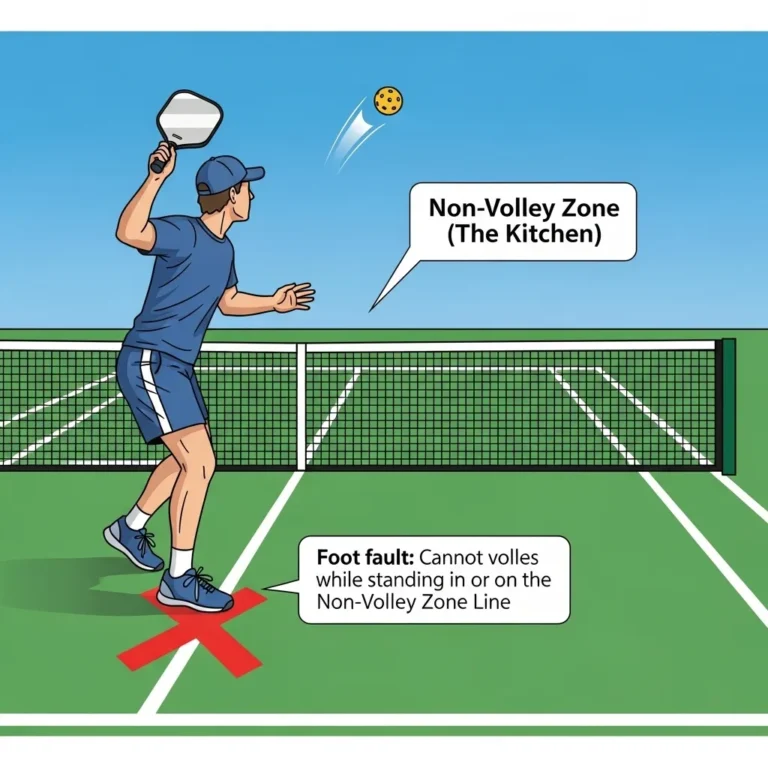
Absolutely. At the moment of paddle contact, you must have at least one foot firmly planted on the ground behind the baseline. Furthermore, your feet must remain strictly within the imaginary extensions of the sideline and the centerline. For detailed layout measurements, refer to standard pickleball court dimensions.