
can you play pickleball on a tennis court
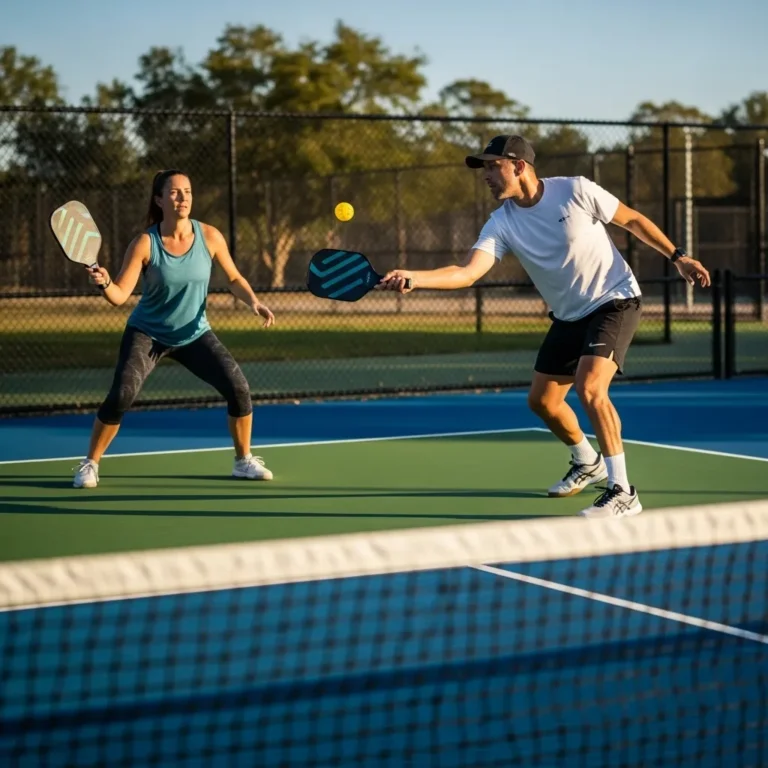
Picture this: It’s a beautiful Saturday morning. You’ve got your paddle, a pocket full of perforated plastic balls, and a group of friends ready to play. You’ve all caught the “pickleball bug” that seems to be sweeping the nation. But there’s a snag—every designated pickleball court in a ten-mile radius is packed. The distinct thwack-thwack of rallies is ringing out, but there’s no room for you.
Then, you look over at the tennis courts. They are often empty, spacious, and sitting right there, begging to be used. It makes you wonder: Can you play pickleball on a tennis court?
The short answer is a resounding yes! In fact, before dedicated courts started popping up in parks and recreation centers, the tennis court was the birthplace of many local pickleball communities. It is the ultimate makeshift solution that allows you to get your game on without waiting hours in line. However, it’s not quite as simple as just walking onto the larger court and starting to serve. There are lines to draw, nets to adjust, and a few etiquette rules to follow to keep the peace between the tennis loyalists and the pickleball newcomers.
In this guide, we are going to walk through everything you need to know about transforming that massive tennis rectangle into a perfect pickleball playground. We’ll cover the gear, the setup, the “do’s and don’ts,” and even the reverse scenario (can you play tennis on a pickleball court?). Grab a coffee, sit back, and let’s dive into the art of the court conversion.
Feasibility & Basics
When you first step onto a tennis court with a pickleball paddle, the sheer size of the space can feel a bit overwhelming. Tennis courts feel like vast arenas compared to the intimate, quick-reflex box of pickleball. But fear not—bridging this gap is easier than it looks.
Can you play pickleball on a standard tennis court without permanent modifications?
Absolutely. You do not need to pour new concrete or drill holes in the ground to enjoy a game. Playing pickleball on a standard tennis court without permanent modifications is arguably the most common way the sport is played outside of professional clubs.
The beauty of this setup is its flexibility. You are essentially “borrowing” the infrastructure. The surface is already flat and hard, which is exactly what the ball needs to bounce consistently. The lighting is usually already installed if you’re playing at night, and the fencing is there to keep your errant shots from rolling into the parking lot.
The temporary nature of this setup is perfect for community groups or families. You can set up in 15 minutes, play for two hours, and leave the court exactly as you found it. The key here is using non-permanent markers and portable equipment, which we will discuss later. It’s about adaptation. Just like street hockey players used to turn a cul-de-sac into a stadium, you are turning a tennis court into a pickleball haven.
What are the main differences between tennis and pickleball court dimensions?
To understand why we need to adjust the space, we have to look at the numbers. They tell the story of two very different games.
A standard tennis court is a beast. It measures 78 feet long and 36 feet wide (for doubles). That is a lot of ground to cover. In contrast, a pickleball court is remarkably compact, measuring just 44 feet long and 20 feet wide. To put that into perspective, you could fit roughly four pickleball courts into the footprint of a single tennis court if you utilized the entire fenced area, though usually, we fit two to four depending on safety zones.
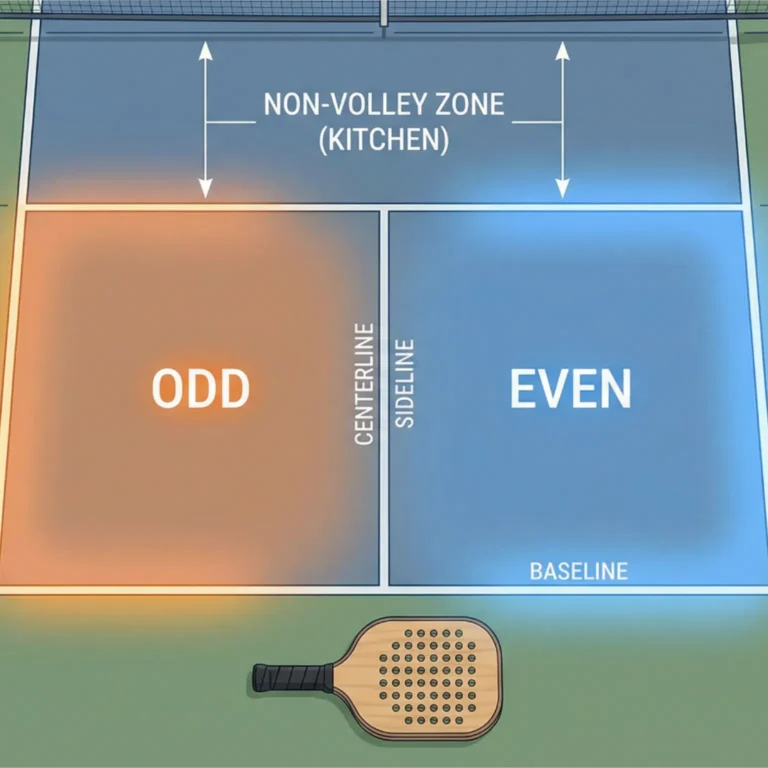
The “Kitchen” or Non-Volley Zone is another major dimensional difference. In tennis, you have service boxes, but in pickleball, you have a 7-foot zone on either side of the net where you cannot volley. This doesn’t exist in tennis.
When you stand on a tennis court, the tennis service line is often confused with the pickleball baseline, but they don’t match up perfectly. The tennis service line is 21 feet from the net. The pickleball baseline is 22 feet from the net. That one-foot difference might seem small, but in a game of inches, it changes everything. This is why knowing your dimensions is crucial—you can’t just rely on existing tennis lines; you have to create your own boundaries within the larger box.
Capacity & Surface
One of the most frequent questions people ask when they see a tennis court is, “How many of us can play here at once?” It’s a great question because it speaks to the social nature of the sport.
How many pickleball courts can fit onto one standard tennis court?
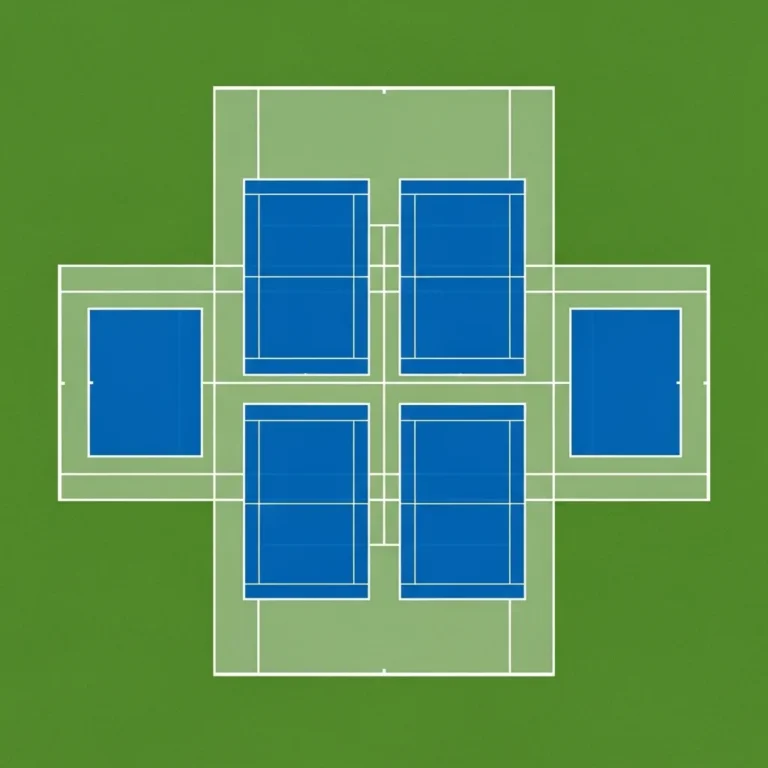
If you are looking to maximize space for a tournament or a big social gathering, you can generally fit four pickleball courts onto one standard tennis court area (meaning the full fenced enclosure, which is usually 60×120 feet).
However, if you are strictly talking about the painted hardcourt surface (the 78×36 box plus the immediate out-of-bounds color block), fitting two courts is the “sweet spot.”
Here is how the setup usually works for two courts: You position the pickleball courts side-by-side on either side of the tennis net. The tennis net acts as a backstop (or divider) between the two pickleball games. In this orientation, you will need portable nets for the pickleball games because you aren’t using the tennis net for play; you’re playing perpendicular to it.
If you only have one pickleball game to play and you want to use the actual tennis net, you simply overlay the pickleball court right in the center. This is the “one-court conversion.” It’s the easiest to set up but the least efficient use of space.
Can you play pickleball on clay or grass tennis courts, or must it be hardcourt?
This is where the physics of the plastic ball comes into play. Tennis balls are made of rubber and felt; they are pressurized and designed to bounce on a variety of surfaces. Pickleballs are hard plastic with holes.
Hardcourt: This is the gold standard. Concrete or asphalt with an acrylic coating provides the crisp, consistent bounce the game requires.
Clay: Can you play? Technically, yes. Will you enjoy it? Probably not. Clay courts (har-tru) are soft. They absorb a significant amount of energy. When a plastic pickleball hits clay, it tends to “die” or skid low rather than bounce up. It changes the game entirely, making it slower and frustratingly difficult to drive the ball. Plus, the plastic ball can scuff the clay, which might irritate the tennis groundskeeper.
Grass: Grass is even trickier. Unless it is Wimbledon-level manicured grass (which is very hard and flat), a plastic ball on grass is a nightmare. It might hit a patch of dirt and bounce left, or hit a tuft of grass and not bounce at all.
For the best experience, stick to the hardcourts. If you must play on clay, be prepared for a very different, slower, and lower-bouncing game.
Equipment & Setup (The Net)
The net is the centerpiece of the court. It’s the obstacle we are all trying to clear. But a tennis net and a pickleball net are not created equal, and knowing how to handle this hardware is vital.
Can you use a standard tennis net for pickleball, or do you need a portable one?
You can absolutely use a standard tennis net, but there is a catch—literally and figuratively.
If you are setting up a single pickleball court in the center of a tennis court, using the existing tennis net is the most convenient option. It’s sturdy, it’s already there, and it stops the ball well. However, it is wider than a pickleball court, so your shots around the post (ATPs) become much harder, if not impossible, because the post is way out of bounds.
If you are putting two pickleball courts on one tennis court (side-by-side), you must use portable nets. You cannot play perpendicular to a tennis net without bringing your own gear. Portable nets are fantastic investments. They are lightweight, assemble in about five minutes, and allow you to turn any flat surface—a driveway, a cul-de-sac, or a tennis court—into a game zone.
How do you adjust the height of a tennis net to match pickleball regulations? (Focus on the center strap/lowering to 34 inches)
Here is a fun fact to impress your friends: A tennis net is 36 inches high at the center. A pickleball net is 34 inches high at the center. That two-inch difference is massive when you are dinking or trying to hit a hard drive. If you leave the tennis net as is, you’ll find a lot of your standard shots hitting the tape.
To fix this, you need to lower the center. Most tennis nets have a center strap (a white adjustable strap anchored to the ground).
- Locate the Center Strap: It’s the vertical strap in the middle of the net.
- Tighten the Strap: Slide the buckle to tighten the strap, pulling the net down.
- Measure: Use a tape measure to ensure the net is exactly 34 inches off the ground at the center.
- The Sides: Note that at the sidelines of a pickleball court (which are 10 feet from the center), the net should be 36 inches high. Since a tennis net is tight across 42 feet (between posts), the height at the pickleball sidelines will naturally be close to 36 inches if the center is at 34.
Pro Tip: If there is no center strap or it’s locked, you can buy a “net converter” strap or simply fashion a makeshift loop using velcro or a bungee cord to pull the center down to the correct height. Just be gentle with the facility’s equipment!
Court Lines & Markings
This is the part that scares people off, but it shouldn’t. Marking the lines is like an arts and crafts project that precedes the workout. It’s satisfying to see the court take shape.
What is the best way to mark pickleball lines on a tennis court temporarily? (Chalk vs. Tape vs. Drop-down lines)
You have three main contenders here, and each has its own “personality.”
1. Sidewalk Chalk:
- The Good: It’s cheap, accessible, and washes away with the rain. It’s extremely low-risk for the court surface.
- The Bad: It’s messy. If you slide on a chalk line, you get dust all over your clothes. It also wears off during a long game, making “in or out” calls controversial.
- Verdict: Good for a quick, casual hit-around with kids, but not for serious play.
2. Drop-Down Lines (Rubber/Plastic Markers):
- The Good: These are pre-cut strips or corners you lay on the ground. Setup takes seconds.
- The Bad: They can be a tripping hazard. Since they sit on top of the court, the ball can hit them and take a weird bounce (“the hockey puck effect”).
- Verdict: Great for drills or very casual play where precision isn’t paramount.
3. Painter’s Tape / Court Tape:
- The Good: This is the gold standard for temporary courts. It lays flat, provides a clean visual line, and doesn’t affect the ball bounce much.
- The Bad: It takes time to apply (and remove). You must remove it after playing so you don’t annoy the tennis players.
- Verdict: The winner for a “real” game experience. Use Blue Painter’s tape or specific court tape (which leaves no residue). Never use duct tape—it melts in the sun and ruins the court surface.
How do you align the pickleball court lines using the existing tennis court markings? (Using the tennis service boxes as a reference)
If you have a tape measure and a roll of tape, you are ready to be the architect. The easiest way to align your court is to use the center of the tennis court as your anchor.
- Find the Center: The tennis net’s center strap is your “North Star.”
- The Non-Volley Zone (Kitchen): Measure 7 feet out from the net on both sides. Mark this. This is your Kitchen line.
- The Baseline: Measure 22 feet from the net (or 15 feet back from your new Kitchen line). This is your baseline. Note: The tennis service line is 21 feet from the net, so your pickleball baseline will be one foot BEHIND the tennis service line.
- The Sidelines: Measure 10 feet to the left and 10 feet to the right of the center line.
- Connect the Dots: Run your tape from baseline to baseline to create the box.
By centering everything on the existing tennis infrastructure, you ensure the net is perfectly positioned in the middle of your new court.
Etiquette & Rules
We are guests in the house of tennis. It is important to remember that. Pickleball has a reputation for being loud and social, while tennis has a culture of quiet focus. Merging these two worlds requires respect.
Is the “Kitchen” (Non-Volley Zone) the same size when playing on a converted tennis court?
Yes, the rules of the game do not bend just because the venue changes. The Kitchen is always a 7-foot zone extending from the net on both sides.
When you are drawing your lines on a tennis court, this is the most critical measurement. Do not just use the tennis service boxes as a proxy. The tennis service line is 21 feet back; it has nothing to do with the Kitchen. You must draw that 7-foot line manually. If you don’t, you aren’t playing pickleball—you’re playing “mini-tennis with paddles.” Respect the Kitchen; it’s where the magic of the game happens.
What is proper etiquette when setting up pickleball on shared-use tennis courts?
This is perhaps the most important section of this guide. As pickleball grows, tensions with tennis players have risen. Be a goodwill ambassador for the sport.
- Priority Rules: Check the facility signage. Some courts are tennis-only during peak hours. If people are waiting to play tennis on a tennis court, and you are taking up a court to draw lines and set up portable nets, you should probably yield the court.
- Tape Clean-Up: If you use tape, take it up. All of it. Don’t leave sticky balls of tape in the corners or little scraps stuck to the asphalt. Leave the court cleaner than you found it.
- Noise Control: Pickleball is louder. The ball creates a popping sound that can be distracting to tennis players next door. While you can’t silence the ball, you can control your voices. Try to keep the shouting and cheering to a respectful level if serious tennis matches are happening adjacent to you.
- Wait for the Point: If your ball rolls onto a neighboring tennis court, do not run after it immediately. Wait until their point is finished, then ask for your ball back. This is the golden rule of court sports.
The Reverse Scenario
We have spent a lot of time talking about putting pickleball on a tennis court. But for the sake of thoroughness, we should look at the flip side.
Can you play tennis on a pickleball court?
The short answer is: No, not really.
While you can physically stand on a pickleball court with a tennis racket, the dimensions make the game of tennis impossible. A pickleball court is 44 feet long. A tennis court is 78 feet long. If you tried to play tennis on a pickleball court, almost every normal groundstroke would fly wildly out of bounds. The service boxes would be minuscule.
Furthermore, the net height is different (lower in pickleball), so you would be hitting flat winners that would normally be errors in tennis. While you might be able to practice “mini-tennis” or touch volleys for warm-ups, playing a regulation game of tennis on a pickleball court is simply not feasible. The geometry just doesn’t support the flight path of a tennis ball.
Conclusion
So, can you play pickleball on a tennis court? You certainly can, and for many of us, it’s the best way to ensure we get our weekly dose of dinking and driving.
It takes a little bit of effort—measuring, taping, and adjusting the net—but the payoff is worth it. You get to play on a high-quality surface, usually with good lighting and fencing, without the wait times of dedicated pickleball hubs. It’s a DIY solution that embodies the accessible, community-driven spirit of pickleball.
Just remember to pack your tape measure, respect the tennis players who share the space, and always clean up after yourself. The world is your court—sometimes you just have to draw the lines yourself. Now, go call your friends; you’ve got a game to set up!
you may like it