pickleball rules singles
Picture this: You’ve just walked onto the court. Usually, you have a partner by your side—someone to high-five after a great shot or to cover the line when you get pulled wide. But today, the court feels just a little bit bigger. It’s just you, your paddle, and an opponent staring you down from the other side. Welcome to the adrenaline-pumping world of singles pickleball.
If you’ve been playing doubles for a while, you already know the vibe is social and strategic. Singles, however, is a different beast entirely. It’s a game of chess played at the speed of a sprinter. It tests your endurance, your angles, and your mental fortitude. But before you dive into this high-intensity format, you need to understand exactly how the game shifts when you remove two players from the equation.
While the spirit of the game remains the same, the pickleball rules singles players must follow have distinct differences that can trip up even seasoned doubles veterans. It’s not just about running more; it’s about knowing when to serve, where to stand, and how to score without a teammate to back you up.
In this guide, we are going to break down everything you need to know. We’ll strip away the confusion and chat through the singles pickleball rules just like we’re grabbing a coffee after a match. Whether you are looking to improve your cardio or just want to prove you can hold the court on your own, mastering the rules of pickleball singles is your first step toward domination. Let’s get into it.
related: pickleball kitchen rules: What You Can and Can’t Do
Court Dimensions & Boundaries
One of the first things that confuse people when they switch from tennis to pickleball—or even just from watching doubles to trying singles—is the court itself. In many racquet sports, the court changes size depending on how many people are playing. So, it is only natural to wonder if you get a bit of a break on the running when you play alone.
Is the pickleball court smaller for singles than for doubles?
I hate to be the bearer of bad news for your legs, but the answer is no. When you look at the pickleball rules for singles, you’ll find that the court dimensions remain exactly the same as they are for doubles. You are playing on a rectangle that measures 20 feet wide by 44 feet long.
When you are playing doubles, you are responsible for roughly 10 feet of width. In singles, you are covering the full 20 feet. That is a lot of ground to cover! This is why singles is often considered a power game or a “cat and mouse” game rather than the patience-based dinking game you often see in doubles. You have to be ready to move side-to-side and front-to-back constantly. The “skinny singles” format you might see people practicing is a training drill, not the official regulation game. In a real match, the court is wide open.
Are the sidelines different in singles pickleball?
If you have a background in tennis, you are probably used to “alleys”—those extra strips on the sides of the court that are “in” for doubles but “out” for singles. In pickleball, we keep things simple.
There are no alleys. The sidelines you use for doubles are the exact same sidelines you use for singles. If the ball lands on the line, it is in. If it lands a millimeter outside that line, it is out. This consistency actually makes it easier to learn the pickleball singles rules because you don’t have to mentally adjust your target zones. However, it does mean that passing shots are much more dangerous. In doubles, hitting a sharp angle might get cut off by the net player. In singles, if you hit a wide angle, your opponent has to sprint to get there.
Understanding that the boundaries don’t change transforms how you view the court. You realize very quickly that hitting the ball deep and down the middle is often safer than trying to paint the lines, simply because you have to recover back to the center of the court after every single shot.
Scoring System
Here is where things get a huge sigh of relief from players. If you have ever tried to teach a beginner how to keep score in doubles, you know the struggle: “One, zero, two… wait, is it second serve?” The three-number scoring system in doubles is notorious for causing headaches.
How is scoring different in singles compared to doubles?
In the world of singles pickleball rules, the scoring system is beautifully simplified. You can say goodbye to that third number. Since you don’t have a partner, there is no concept of a “first server” or “second server.” It is just you.
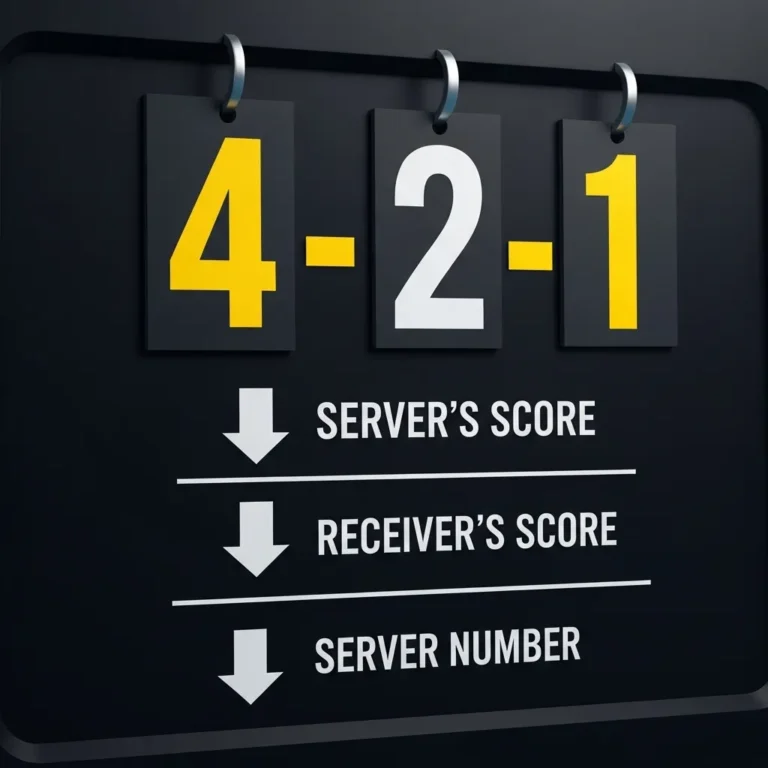
The score is called using only two numbers:
- The Server’s Score
- The Receiver’s Score
That’s it. If you have 3 points and your opponent has 2, the score is simply “3-2.” This makes the flow of the game much faster and the mental load much lighter. You don’t have to remember if you are the first or second server; you just need to know who is winning.
What is the correct way to call the score in singles?
Despite the simplicity, protocol matters. Before every serve, the server must call the score loud enough for the opponent to hear. You always say your score first.
For example, let’s say the game has just started. You win the first rally. You are now serving at 1-0. You shout “1-0” and serve the ball. If you lose the next rally, you don’t score, and the ball goes to your opponent (more on that in the serving section). Now they serve, and if they haven’t scored yet, they call out “0-1.”
It’s crucial to wait until the score is called completely before striking the ball. Serving while calling the score—or worse, before calling it—is a fault in tournament play and just generally bad etiquette in recreational play.
A helpful tip for beginners: Because there is no “second server” to bail you out, every point feels a bit more “do or die.” But the scoring reflects a pure meritocracy. You only score points when you are serving, just like in doubles. The rules of pickleball singles maintain this traditional “side-out” scoring method, which allows for epic comebacks. You could be down 0-9, get the serve back, and run the table to win 11-9.
Serving Rules & Positioning
This is the category that usually trips up players transitioning from doubles. In doubles, your position is largely dictated by whether you are the first or second server and who served first in the sequence. In singles, your position on the court is dictated entirely by your own score. It’s a mathematical link that you need to internalize.
Where does the server stand based on their score?
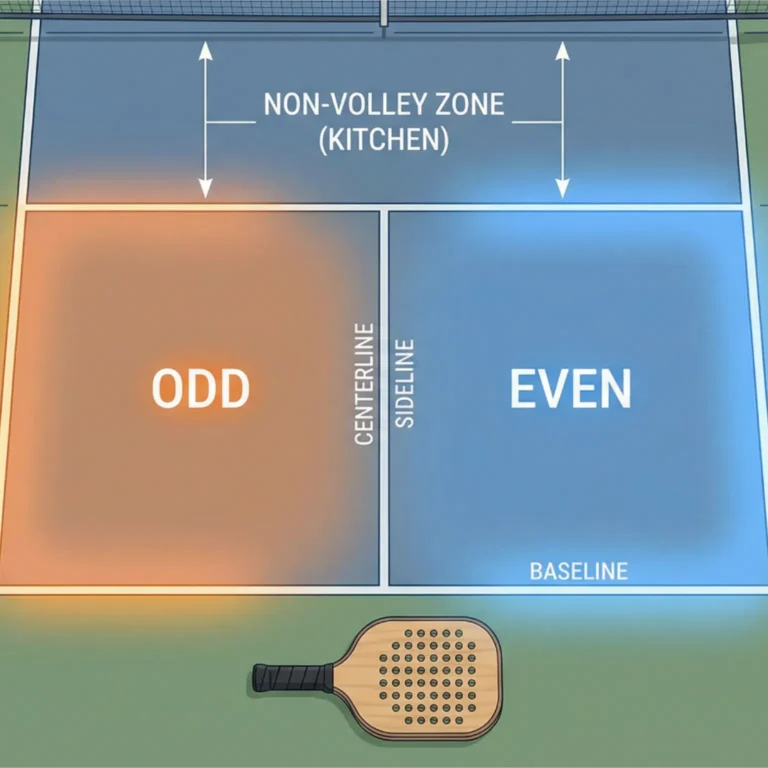
The golden rule of pickleball rules for singles regarding positioning is: Even is Right, Odd is Left.
Here is how it works:
- Even Score (0, 2, 4, 6, 8…): When your score is an even number, you must serve from the right-hand service court. You will serve diagonally to your opponent’s right-hand court (which is on your left from your perspective).
- Odd Score (1, 3, 5, 7, 9…): When your score is an odd number, you must serve from the left-hand service court. You serve diagonally to your opponent’s left-hand court.
This rule applies to the receiver as well. If the server has an even score, the receiver should be standing in their right-hand court to return the serve.
Let’s visualize a scenario. You start the game at 0-0. Zero is an even number, so you start on the right. You win the point. Now you have 1. You move to the left side to serve. You lose the rally. Now your opponent gets the ball. Let’s say their score is 0. They serve from their right side.
This is a fantastic memory aid during a game. If you ever forget your score, look at where you are standing! If you are standing on the left side but you think you have 4 points, one of those two things is wrong.
Is there a ‘second server’ in singles pickleball?
This is the biggest adjustment for doubles players. In doubles, if the first server faults, the serve goes to their partner. In singles, there is no partner to save you.
There is absolutely no second server in singles. If you serve the ball into the net, hit it out of bounds, or lose the rally, your turn is over immediately. The serve goes directly to your opponent. This is why the serve in singles is arguably more critical than in doubles. A missed serve in doubles is annoying; a missed serve in singles is a free gift of momentum to your opponent.
Because of this, you might see singles pickleball rules influencing strategy. Players often hit slightly more conservative serves in singles just to ensure the ball gets in play, rather than going for a high-risk ace every time.
What happens when the server loses a rally?
When the server loses a rally, we call this a “Side Out.” The ball is turned over to the opponent. No points are awarded to the receiver (unless you are playing rally scoring, which is rare in standard recreational play).
Upon a side out, the opponent (now the new server) needs to check their own score to decide where to stand. This can be tricky! Let’s say you were serving at 3-2. You served from the left (because 3 is odd). You lost the rally. Now the ball goes to your opponent. Their score is 2. They must serve from the right side (because 2 is even).
It implies a lot of switching sides. In doubles, you often stay on one side for a while. In singles, if you are winning points, you are constantly running back and forth between the left and right service boxes. It’s a workout within a workout.Gameplay & The Non-Volley Zone (Kitchen)
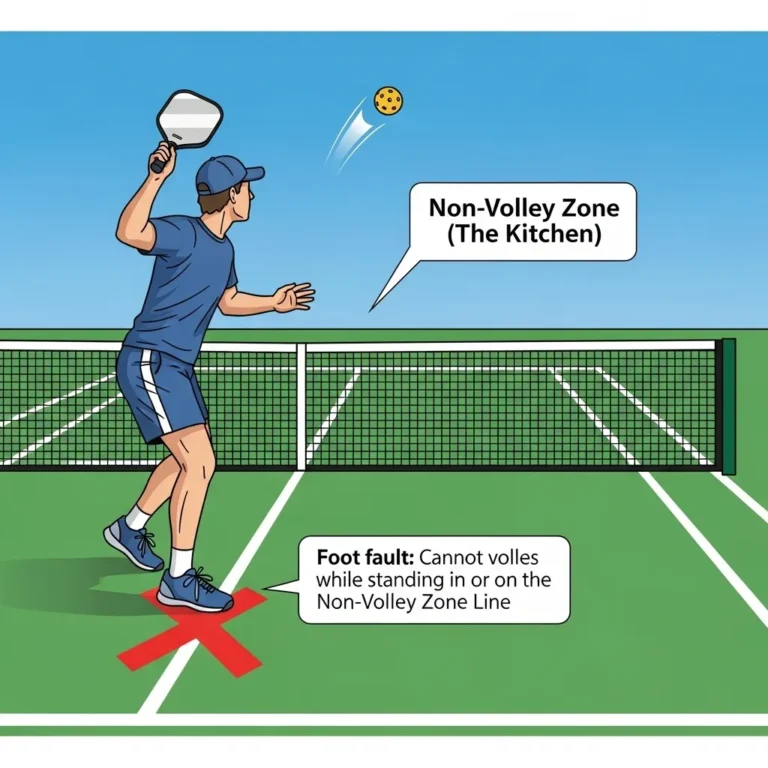
The “Kitchen,” or the Non-Volley Zone (NVZ), is the defining feature of pickleball. It prevents the game from becoming a pure smash-fest at the net. But does being alone on the court change how we treat this sacred 7-foot zone?
Do the Kitchen (Non-Volley Zone) rules change in singles?
The short answer is: The rules are identical, but the application is harder. The rules of pickleball singles state that you cannot volley the ball (hit it out of the air without it bouncing) while standing inside the Kitchen or touching the Kitchen line. This is the exact same prohibition as in doubles.
However, in singles, getting to the Kitchen line is a tactical risk. In doubles, the goal is almost always to get to the Kitchen line as fast as possible. In singles, if you rush the net, you leave the entire backcourt open for a lob. Because you don’t have a partner to cover the lob, rushing the net is a high-reward, high-risk play.
You will typically see singles players hanging back at the baseline much more than doubles players. They wait for a weak, short shot from their opponent before they approach the NVZ to put the ball away. And when they do approach, they have to have the brakes of a sports car—stopping their momentum instantly so they don’t accidentally step into the Kitchen while volleying a winner.
What is the ‘Two-Bounce Rule’ and does it apply to singles?
Yes, the Two-Bounce Rule (sometimes called the Double Bounce Rule) is alive and well in singles, and it dictates the early flow of every point.
To recap:
- The serve must bounce on the receiver’s side.
- The return of serve must bounce on the server’s side.
Only after these two bounces can either player choose to volley the ball or play it off the bounce.
In the context of pickleball rules for singles, this rule gives the server a slight disadvantage initially. The server has to stay back behind the baseline to let the return bounce. Meanwhile, a smart receiver might hit a deep return to keep the server pinned back.
This dynamic creates the fundamental tug-of-war in singles. The receiver wants to keep the server back; the server wants to hit a drive deep enough to allow them to move forward. Violating this rule—like the server creeping in and volleying the return of serve—is a common mistake for beginners who are eager to attack.
The Mental and Physical Nuances of Singles
Now that we’ve covered the technical pickleball rules singles enthusiasts need, let’s talk about what isn’t written in the rulebook but is just as real.
The Cardio Factor
If you are used to doubles, singles will humble your cardiovascular system very quickly. In doubles, you might hit the ball every 3 or 4 shots. In singles, you are hitting every single ball. There is no downtime. There is no walking back to the baseline while your partner chases a ball.
Because of this, energy conservation becomes a “rule” of its own. You shouldn’t try to blast every ball. Sometimes, keeping the ball in play deep down the middle is better than running yourself ragged trying to hit winners.
The Passing Shot vs. The Drop Shot
In doubles, the “third shot drop” (dropping the ball softly into the Kitchen) is the holy grail of shots. In singles, while useful, it is used differently. Since opponents often stay back at the baseline in singles, a drop shot can be a devastating winner if they are too far back.
However, passing shots (driving the ball past the opponent) are much more common in singles. With no second player to plug the gaps, the open court is massive. If you see your opponent cheating to one side, a firm drive down the line is often a winning play.
Gear Considerations
While the rules for paddles and balls don’t change, your choice might. Singles players often prefer a paddle with a bit more “pop” or power. Since you are driving the ball more often and playing from the baseline, power helps you get the ball deep. In doubles, where dinking is key, control paddles are supreme. For singles, you might want something that helps you finish the point when you get the chance.
Common Fouls and Misunderstandings
Even with the simpler singles pickleball rules, arguments can happen. Here are a few specific scenarios to watch out for:
1. The Service Motion:
The rules for the serve motion are the same (underhand, contact below the waist), but in singles, players often try to serve harder. Be careful not to violate the service motion rules in your quest for power. A side-arm serve that goes above the waist is illegal and will cost you the ball immediately.
2. Line Calls:
In singles, you are the sole referee on your side of the court. This requires integrity. If you are 99% sure the ball was out, but 1% unsure, the rule of etiquette (and the official rule) is to call it IN. Because you are running so much, your eyes are bouncing around. If you didn’t clearly see the space between the line and the ball, give the point to your opponent. It makes for a much friendlier game.
3. The “hindrance”:
Since you are alone, distractions are more noticeable. If a ball from another court rolls onto yours, stop play immediately. Don’t try to be a hero and play around it. Call “Ball!” and replay the point. Safety is always the number one rule.
Transitioning from Doubles to Singles
If you are reading this, you are probably ready to make the jump. Here is a quick checklist to help you transition smoothly, keeping the rules of pickleball singles in mind:
- Check your serve: Remember, if you miss, you lose the serve instantly. Aim for 80% power and 100% consistency.
- Adjust your base: Don’t rush the net blindly. Get comfortable playing from the baseline.
- Remember the score/position link: Even/Right, Odd/Left. Repeat it until it’s muscle memory.
- Hydrate: You are going to sweat twice as much. Maybe three times.
Conclusion
Singles pickleball is a fantastic variation of the sport. It’s raw, athletic, and incredibly rewarding. It strips away the complexities of partner communication and leaves you with a pure test of skill and will.
By mastering the pickleball rules singles requires—understanding the unchanging court size, the simplified two-number scoring, the strict positioning based on your score, and the unforgiving nature of the side-out—you are setting yourself up for success.
So, next time your usual doubles group is short a player, or you just want a killer workout, don’t pack up and go home. Challenge someone to a game of singles. You might just find that the challenge of covering that 20×44 court on your own is exactly the thrill you’ve been looking for. Grab your paddle, remember your even/odd positioning, and have a blast out there!