adidas pickleball metalbone lp paddle
If you have been watching the courts lately, you have probably noticed a shift in the gear landscape. It wasn’t long ago that the paddle market was dominated by niche brands that only die-hard enthusiasts knew. But when a titan of the sports world like Adidas steps onto the court, people pay attention. They didn’t just dip a toe in; they jumped in with both feet, bringing their engineering prowess from tennis and padel directly to the kitchen line. If you already wear Adidas pickleball shoes, you know the quality they bring to the court.
Enter the adidas pickleball metalbone lp paddle. It is arguably one of the most distinct, futuristic-looking pieces of equipment you can buy right now. With its exposed carbon frame and customizable weight screws, it looks less like a traditional honeycomb paddle and more like something designed by an aerospace engineer.
But let’s be honest with each other—looks aren’t everything. We have all bought that shiny new piece of gear that promised to change our game, only to realize it felt like playing with a frying pan. You want to know if the performance lives up to the hype. Is this just big-brand marketing, or is there real innovation here that can help your resets and drives?
In this deep dive, we are going to strip away the glossy advertisements and look at what it is actually like to live with this paddle day in and day out. We will explore the customization options, the durability of that gritty surface, and crucially, whether this paddle is a precision tool or an unforgiving plank. Whether you are eyeing the standard LP, curious about the adidas metalbone lp s pickleball paddle, or just wondering if the “Team” version is a better buy, we have got you covered.
Performance & “Real World” Feel
When you pick up a high-end paddle, you expect a certain “magic” immediately. However, the Metalbone LP is a bit of a polarizing figure in the community. It doesn’t try to be a paddle for everyone; it tries to be the perfect paddle for a specific type of player. Let’s break down exactly how it feels when the ball hits the face, because this is where most buyers get surprised.
Is the sweet spot on the Metalbone LP actually small, or does it just feel different?
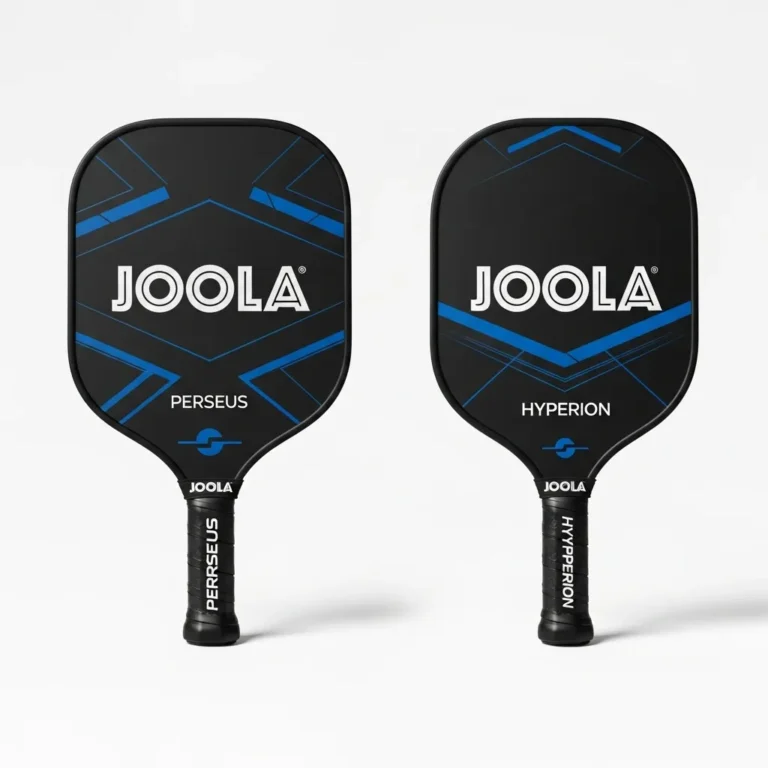
This is the question I get asked most often, and I’m going to give it to you straight: yes, the sweet spot is tighter than what you might be used to. If you are coming from a wide-body paddle or one of the newer “Gen 2” thermoformed paddles like the Joola Perseus or Selkirk Luxx, you might find the adidas pickleball metalbone lp paddle a little unforgiving at first.
Users consistently report that while the center of the paddle provides incredible pop and precision, the edges can feel a bit “dead.” This is largely due to its unique construction. Adidas uses a “Monocoque” design—essentially a structural carbon frame—and a distinct open throat. This makes the paddle very stiff. When you hit the ball dead center, it goes exactly where you want it with impressive speed. It is a precision instrument. But, if you are scrambling on defense and catch the ball near the rim, you will feel a harsh vibration and likely see the ball die into the net. It rewards clean mechanics but punishes lazy swings.
Why does the Metalbone LP sound so “hollow” or “jarring” compared to other 16mm paddles?
If you are used to the deep, muted “thud” of a traditional polypropylene core paddle, the sound of the Metalbone might startle you. It doesn’t thud; it pings. Users often describe it as a higher-pitched, metallic sound, almost like hitting a dinner plate.
Why does it sound like this? It comes down to physics and construction. Most modern paddles seal the edges with foam to dampen vibration and deepen the sound. The Metalbone LP relies on that rigid carbon frame we mentioned earlier. It lacks the edge-foam sealing found in many competitors. While this doesn’t negatively affect the ball’s flight, the acoustic feedback can be distracting. Some players love it because it sounds “crisp,” but many find it sounds “cheap” or hollow initially. Don’t let the sound fool you, though—the power is there.
Does the “Spin Blade Max” surface actually last, or does it wear off like spray-on grit?
We all love ripping a heavy topspin drive that dips at the baseline. To do that, you need grit. Adidas uses what they call “Spin Blade Max” technology on the adidas metalbone lp pickleball paddle. Out of the box, it is fantastic. You can practically feel the ball grabbing the face, generating spin rates upwards of 2000 RPM, which is elite territory.
However, we have to talk about longevity. This texture sits on top of the raw carbon face. It is significantly more durable than the cheap spray-on grit you find on $50 Amazon paddles, but it isn’t indestructible. Heavy users—those of us playing three or four times a week—have reported a noticeable drop-off in that “grabby” feeling after about three or four months. It doesn’t go smooth, but it loses that biting edge. Unlike some competitors that weave a peel-ply texture directly into the carbon fiber (making it permanent), the Metalbone’s texture is a surface treatment that will eventually smooth out over time.
Customization & The Weight System
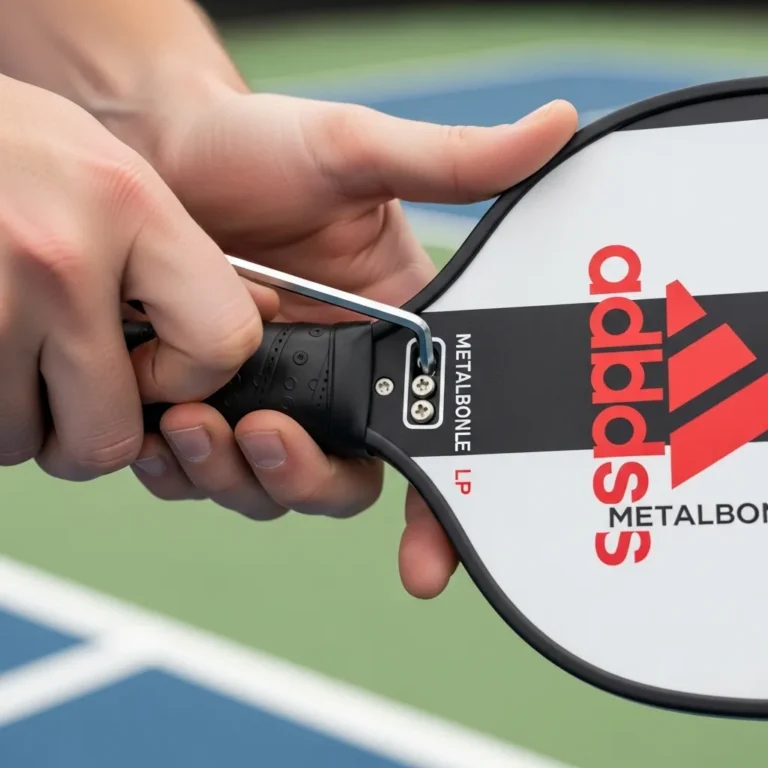
This is where the Metalbone really separates itself from the pack. If you look at the throat of the paddle, you will see silver screws. This isn’t just decoration; it’s the Weight & Balance System, a feature imported directly from Adidas’ pro Padel racket line.
Do the adjustable weight screws actually change the paddle’s stability, or are they a gimmick?
They absolutely work, but perhaps not in the way you might expect. The paddle comes with these screws installed in the throat area. When they are in, the paddle has a bit more mass near the handle, making it feel “head light.” This is great for fast hands at the kitchen line during a volley firefight.
However, many players realize that the adidas metalbone lp pickleball paddle suffers from a low “twist weight.” This means if you block a hard drive and the ball hits near the edge, the paddle wants to twist in your hand. The screws in the throat don’t fix this. To truly stabilize the paddle, many experienced users actually remove the screws entirely (making the paddle lighter) and then add lead tape to the 3 and 9 o’clock positions on the paddle face. This expands the sweet spot and stops the twisting. So, while the screws aren’t a gimmick, many players find that traditional lead tape is actually the better modification for this specific frame.
What should I do if the weight screws rattle or fall out during play?
Imagine you are in the middle of a heated match, you go for an overhead smash, and suddenly your paddle starts rattling like a maraca. It’s distracting and annoying. Because of the vibrations in pickleball, those little screws can work themselves loose.
There is a simple fix that every Metalbone owner should know. Go to the hardware store and buy a tube of Blue Loctite (242). Put a tiny drop on the threads of the screws before you tighten them. This “gums up” the threads enough to stop them from vibrating loose but still allows you to remove them with a screwdriver if you want to change the weight later. Do not use Red Loctite, or those screws are never coming out again. Another trick is to put a strip of electrical tape over the screw heads; it keeps them in place and actually helps dampen the vibration a little bit.
Can I use lead tape on the Metalbone LP despite the weird throat shape?
The Metalbone has a very angular, geometric throat (a shape called a polyhedron). It looks cool, but it is a nightmare to try and stick flat lead tape to it. The good news is, you don’t need to tape the throat.
As mentioned earlier, the “Community Recommended” setup is to ignore the throat entirely. The sides of the paddle face are flat and standard. By placing your lead tape on the lower corners of the paddle face, you get the stability benefits without wrestling with the weird angles of the handle area. This setup transforms the paddle from a “good” paddle into a “great” one by artificially enlarging that sweet spot we talked about earlier.
Comparisons & Confusion
Adidas makes equipment for many sports, and their naming conventions can be… let’s call it “confusing.” If you are shopping online, it is very easy to buy the wrong thing.
I see “Metalbone 3.2” and “Metalbone HRD” online—are these the same paddle?
No! Stop right there. This is a huge trap for new buyers. The “Metalbone 3.2,” “HRD,” and “CTRL” are Padel racquets. Padel is a different sport entirely (think tennis meets squash). They look incredibly similar—they have the same branding, the same colors, and even the same weight screw system.
However, a Padel racquet is much thicker (38mm vs. the 13mm-16mm of pickleball), perforated with holes, and is absolutely illegal and non-functional for pickleball. You must look specifically for “Pickleball” in the name. If you see the words adidas metalbone lp team pickleball paddle or “LP,” you are in the right place.
What is the real difference between the Metalbone LP and the Metalbone LP “S”?
Here is where things get technical but very important. The standard Metalbone LP uses a Polypropylene Honeycomb core. This is the industry standard. It is soft, offers good control, and is generally quieter. It is the safe, reliable choice for 90% of players.
The adidas metalbone lp s pickleball paddle is a different beast entirely. The “S” stands for speed (or stiffness), and it uses an EVA Foam core. Think of the difference between hitting a pillow and hitting a wall. The EVA foam is much harder and returns significantly more energy to the ball. The ball rockets off the face.
But there is a catch. Because EVA foam launches the ball so hard, many adidas metalbone lp s pickleball paddle reviews will warn you that it might not be legal for all tournament play. The USAPA (the governing body) has strict rules about ball deflection, and EVA paddles often test “too hot.” If you just play rec play with your buddies, the “S” version is a flamethrower that is incredibly fun to use. But if you plan on playing sanctioned tournaments, check the approved paddle list carefully. The standard LP is almost always safe; the “S” is a riskier buy for competitors.
Durability & Ergonomics
You are going to be holding this thing for hours at a time, so comfort matters. And since it’s not a cheap piece of gear, you want it to last.
Is the handle shape round or oval ?
Adidas comes from a tennis background, and you can feel it in the handle. The grip shape leans towards a rounded octagon, very similar to a tennis racquet. Many dedicated pickleball brands use a flatter, more rectangular handle shape that helps you feel the paddle face angle.
If you have small hands, be aware: even though it is listed as a standard 4 1/8″ grip, users often feel it plays “bulky.” The edges of the octagon are soft, making it feel rounder. If you like to feel sharp bevels to know exactly how your paddle is angled for a continental grip, you might need to strip the stock grip and replace it with a thin overgrip to get that definition back.
Does the “edgeless” design chip easily when scraping the court?
The Metalbone LP is sleek. It doesn’t have that chunky rubber bumper guard that most paddles have. It looks aerodynamic and beautiful… until you scrape it on the ground reaching for a low dink.
The “edgeless” design means the structural carbon frame is exposed at the perimeter. It is reinforced, but it is not invincible. If you are a “scrapper” who digs balls out of the asphalt, you are going to eat into the carbon. My strongest recommendation? Buy a roll of electrical tape or specific paddle edge guard tape the same day you buy the paddle. Apply it to the top edge immediately. It might hide the cool carbon look a little, but it will keep your new gear looking fresh from chipping and delaminating.
Why does the Metalbone LP feel stiffer than other paddles?
We touched on this with the sweet spot, but it is worth repeating regarding comfort. The Metalbone LP is a stiff paddle. Stiffness equals power and precision, but it also equals vibration.
When you hit the ball off-center, the vibration travels down the paddle and through the handle, giving distinct feedback to your hand. If you prefer a softer feel or are used to muted paddles, this stiffness might take some getting used to. The standard LP is better than the EVA-core “S” version, but it is still stiffer than a plush 16mm honeycomb paddle from other brands. If you love the paddle but hate the vibration, try using a softer, thicker replacement grip or adding a silicone vibration dampener (if you can find a spot to stick it near the throat). It can make a world of difference.
Recommended Reading
Top Pickleball Gifts 2025:From Stocking Stuffers to Pro Gear
Looking for unique pickleball gifts? We break down practical gear, funny apparel, and budget-friendly ideas to help you surprise the player in your life.
Final Thoughts
So, where does that leave us with the adidas pickleball metalbone lp paddle? It is, without a doubt, a high-performance piece of engineering. It offers a level of customization that almost no other brand can match, and when you connect with the sweet spot, the power and spin are intoxicating.
However, it is not a “pick up and play” paddle for everyone. It demands good mechanics. It requires you to be proactive with maintenance (tightening screws, adding edge tape). It asks you to tolerate a smaller sweet spot in exchange for higher precision. If you are a 4.0+ player looking to fine-tune your game and you love to tinker with weight and balance, this paddle could be your Excalibur. But if you are a beginner looking for a forgiving friend to help you keep the ball in play, you might find the Metalbone a bit too aggressive.
Adidas has proven they are serious about pickleball. The Metalbone LP isn’t just a copy of what everyone else is doing; it’s a bold step in a different direction. And for the right player, that direction leads straight to the podium.
You May Like It