The Definitive Standard: In Pickleball Your Serve Must Be Legal
Every thrilling rally starts with a single movement, yet many players find themselves losing points before the game even begins. Why? Because in pickleball your serve must be delivered within a very narrow set of legal constraints that differ significantly from tennis or badminton. Whether you are competing at the Naples Pickleball Center or playing a friendly match in your backyard, a service fault is an unforced error you simply cannot afford.
In this guide, we dive deep into the technical nuances of the serve. From the exact height of your wrist to the invisible extensions of the court lines, we ensure your game is compliant with the latest Pickleball Rules. Mastering these “must-haves” is what separates beginners from pros like Ben Johns.
To ensure absolute compliance with professional standards, always refer to the USA Pickleball Official Rules, which serve as the gold standard for tournaments worldwide.
The Mechanical Requirements: The “Three-Point” Check
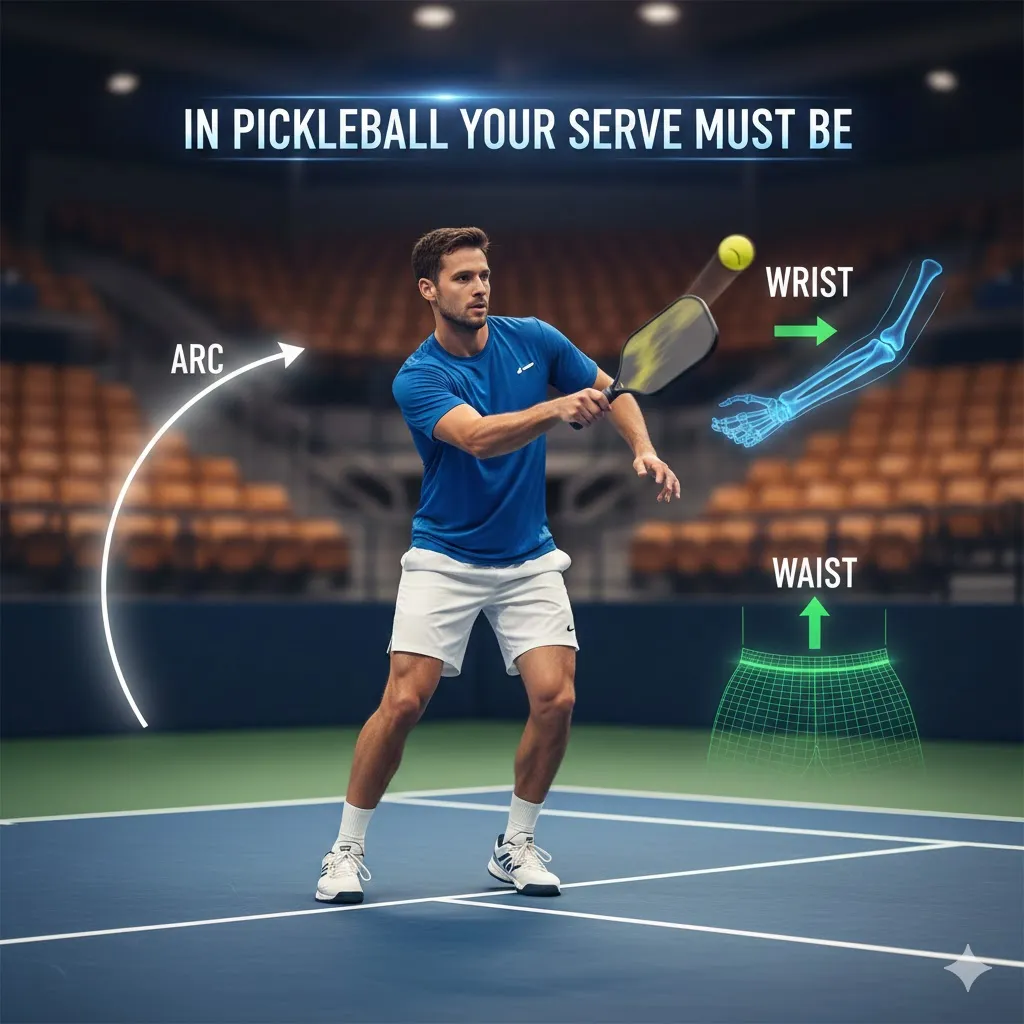
To keep the game’s integrity as a “player’s sport,” the serve is designed to be a neutral start rather than an aggressive weapon. In pickleball your serve must be an underhand motion. Specifically, the referee (or your opponents) will look for three things at the moment of impact:
- The Upward Arc: Your arm must be moving in an upward trajectory. This prevents the “downward smash” seen in tennis.
- The Paddle Head Position: The highest point of the paddle head must be below the highest part of your wrist (where the wrist bone joint is). This is arguably the most contested rule in local tournaments.
- The Navel Rule: Contact with the ball must occur below your waist. For the sake of the rules, the “waist” is defined as your navel.
Using a high-quality Carbon Fiber Pickleball Paddle can help you maintain the “feel” needed to execute this motion consistently without straining your wrist.
Volley Serve vs. Drop Serve: Navigating the 2026 Standards
Modern pickleball offers two distinct legal paths for serving. Understanding which one fits your style is crucial. In pickleball your serve must be one of the following:
1. The Volley Serve (The Classic)
This is hitting the ball directly out of the air. It requires the most precision because all three mechanical rules (upward arc, wrist position, and waist height) are strictly enforced. Most top players prefer this for the speed and spin it generates.
2. The Drop Serve (The Strategic)
Introduced to simplify the game, the drop serve allows you to let the ball bounce first. Crucially: If you use a drop serve, the “upward arc” and “waist height” rules are waived. However, you must not throw or shove the ball down; it must be a pure gravity drop. Many players practicing at the Performance Pickleball facility find this easier for consistency.
Boundary Logic: Where You Stand Matters
Even a perfect strike is a fault if your feet are misplaced. In pickleball your serve must be delivered from the correct side of the court based on the score (Even score = Right side, Odd score = Left side). But the lines themselves carry hidden traps:
The “Invisible” Extensions
You cannot stand “too wide.” You must remain within the imaginary extensions of the sideline and the centerline. If your foot touches the baseline or the court inside during the serve motion, it’s a foot fault. Using the right Nike Pickleball Shoes provides the traction needed to prevent your feet from sliding onto the line during your follow-through.
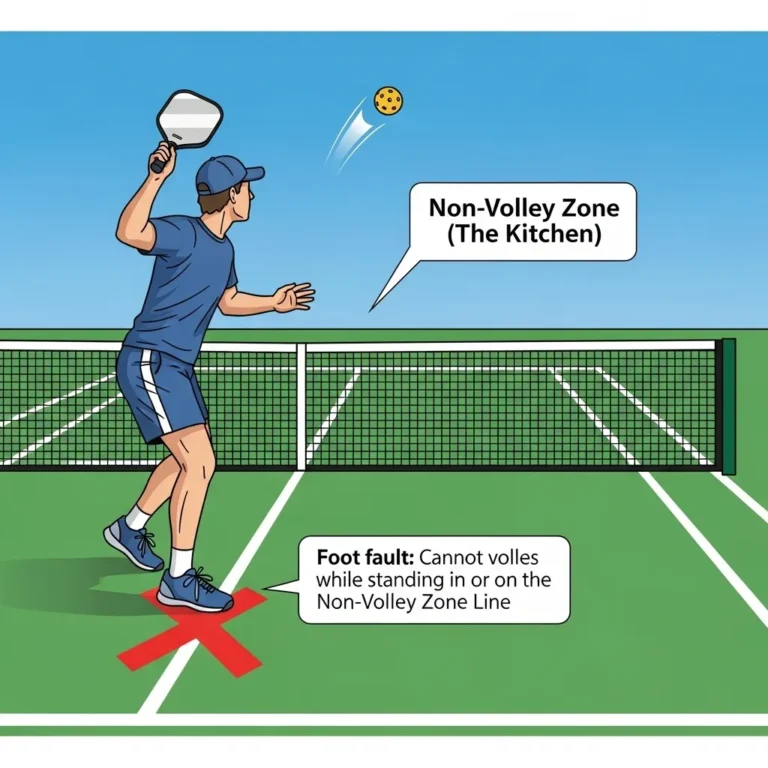
The “Kitchen” Line Exception
During a normal rally, hitting the line is “in.” However, on a serve, the Non-Volley Zone (NVZ) line is considered “out.” If your serve clips the kitchen line, you lose the serve. This is a common point of confusion that we detail further in our Pickleball Kitchen Rules guide.
Advanced Scenarios: Net Cords and Accidental Contact
What happens when things go wrong? Reddit and Quora are full of players asking about “edge cases.” In pickleball your serve must be clean, but the rules have evolved:
- The “Let” is Dead: If the ball hits the net cord but still lands in the correct service box, the ball is “live.” You must play it! This rule was changed to speed up the game and reduce disputes.
- Body/Clothing Contact: If the ball touches your shirt, your hat, or your arm before you hit it, it is an immediate fault. This is why choosing the right Pickleball Outfit is about function as much as fashion.
- The Paddle Handle: Interestingly, hitting the ball with the paddle handle is legal, provided the other height and motion rules are met.
Summary Checklist: Does Your Serve Pass?
Before your next match, run through this mental checklist to ensure in pickleball your serve must be unshakeable:
- Are both feet behind the baseline and within the sidelines?
- Is my arm moving in an upward arc (for volley serves)?
- Am I aiming deep enough to clear the kitchen line entirely?
- Is my paddle head below my wrist at impact?
Frequently Asked Questions (FAQ)
Does the paddle head have to be below the wrist during the serve?
Yes, for a volley serve, the highest point of the paddle head must be lower than the highest part of the wrist at the moment of contact.
Can I drop the ball and hit it on the bounce?
Yes, this is called a Drop Serve. It is legal as long as you drop the ball from your hand or paddle without adding any downward force.
Is it a fault if my serve hits the kitchen line?
Yes. Unlike the sideline or baseline, the Non-Volley Zone line is considered “out” for the service of the ball.
Can I use a sidearm motion?
A sidearm motion is only legal if the paddle head is below the wrist and the stroke has an upward arc at impact. Purely horizontal sidearm serves are often called as faults.
What is the “Double Bounce Rule” on the serve?
After the serve, the ball must bounce once on the receiver’s side and once on the server’s side before anyone can hit a volley. For more on this, see our Pickleball Rules Doubles guide.
Conclusion
Mastering the legalities of the serve is the first step to becoming a formidable player. While it may seem restrictive at first, these rules ensure that pickleball remains a game of strategy and touch rather than just raw power. Once you are confident that in pickleball your serve must be legal every time, you can focus on more advanced techniques like the 3rd Shot Strategy to truly elevate your game.