pickleball socks
Here is a comprehensive, human-centric guide to the often-overlooked hero of the court. I’ve woven in your requested keywords naturally and adhered to your structure.
You know that feeling when you step onto the court? The distinct “pop” of the ball echoing off the asphalt, the friendly banter across the net, and that rush of adrenaline as you get ready to serve? It’s addictive. We spend hours researching the perfect paddle, debating the merits of graphite vs. carbon fiber, and finding the right court shoes. But let’s be honest with each other for a second—how often do you think about what’s inside those shoes?
I’m talking about pickleball socks.
It sounds trivial, I know. You might be thinking, “They’re just socks.” But if you’ve ever had to limp home after a three-hour session because of a hot spot on your heel, or if you’ve felt your foot sliding around inside your shoe just as you went for a dink, you know exactly why this matters. The truth is, your feet are your foundation. You can have the best backhand in the county, but if your feet are miserable, your game is going to crumble.
Let’s take a walk through the world of performance footwear. We aren’t just talking about fabric tubes here; we are talking about equipment. Whether you are a casual weekend warrior or someone obsessively tracking the Jack Sock pickleball ranking hoping to pick up pro tips, the reality remains the same: gear matters.
The Necessity: Why Special Socks?
It is the most common question beginners ask, and frankly, it is a valid one. Why does a sport played on a badminton-sized court require such specific gear?
Do I really need specific socks for pickleball?
Imagine you just bought a high-performance sports car—let’s say, a Ferrari. You wouldn’t go to a discount store and put the cheapest, generic tires you could find on it, right? You wouldn’t be able to handle the corners; you’d slip when you accelerated, and you’d probably ruin the car.
Your body is that Ferrari. When you play pickleball, you aren’t just walking or running in a straight line. You are lunging, pivoting, stopping on a dime, and sprinting backward. The torque and friction generated inside your shoe are intense. Specific pickleball socks are engineered to handle that stress. They are designed to lock your foot in place, manage the intense sweat of a hard match, and cushion the high-impact zones. So, the short answer? Yes. If you want to play your best and keep your feet happy, you absolutely need them.
Can I just wear regular cotton socks for playing pickleball?
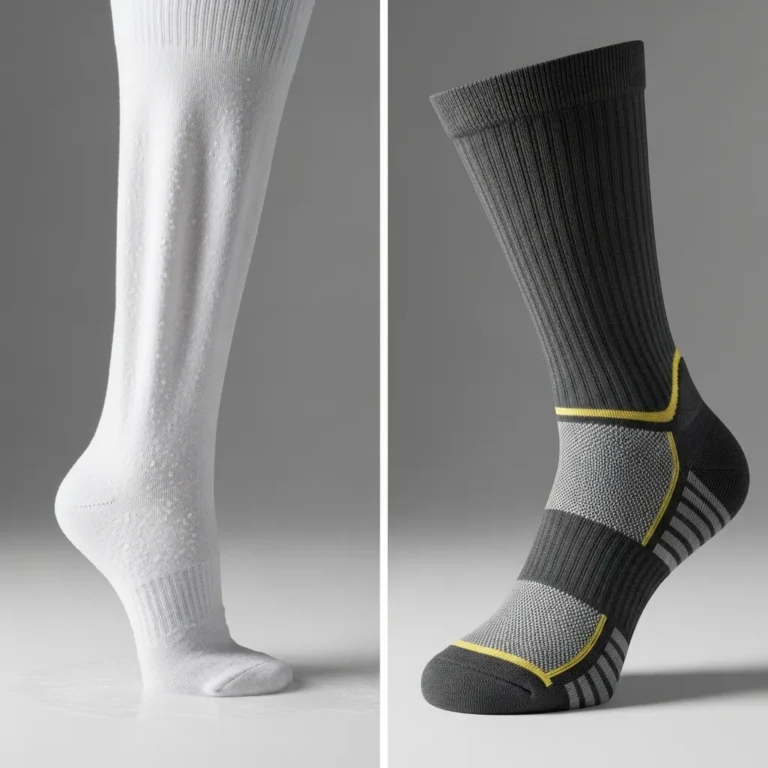
Ah, the cotton trap. We all grew up wearing those white tube socks. They feel soft and cozy when you first put them on in your living room. But on the pickleball court? Cotton is essentially a sponge.
Here is the problem: Cotton loves water. It absorbs sweat and holds onto it for dear life. Once a cotton sock gets wet, it loses its shape. It starts to sag and bunch up. Wet fabric against soft skin, combined with the friction of moving side-to-side, is the perfect recipe for blisters. By the end of a match, a cotton sock is just a heavy, damp rag wrapped around your foot. It provides zero temperature regulation and actually increases the friction that tears up your skin. Avoid the “cotton is rotten” scenario at all costs.
What happens if I wear the wrong socks on the court?
We have all been there. You grab whatever pair is clean from the laundry basket. Halfway through the second game, you feel it.
First, it’s the slippage. As you plant your foot to return a serve, you feel your foot slide inside the sock, or the sock slide inside the shoe. That micro-second of instability kills your confidence. You stop trusting your movement.
Then comes the heat. Without breathable materials, your feet turn into ovens. Overheating feet can actually make your whole body feel fatigued faster.
Finally, the aftermath. Blisters, chafing, and bruised toenails (often called “pickleball toe”) are usually the result of your foot slamming into the front of your shoe because your sock didn’t provide enough traction. Wearing the wrong socks isn’t just uncomfortable; it’s a distraction that pulls your head out of the game.
Material & Features: What to Look For
If cotton is the enemy, what is the hero? This is where technology meets comfort. When you are looking for the best pickleball socks, you need to become a bit of a label reader.
What is the best fabric/material for pickleball socks?
You want to look for moisture-wicking synthetic blends or natural performance fibers.
Merino Wool: Don’t let the word “wool” scare you. We aren’t talking about scratchy sweaters. Merino is magical. It is naturally antimicrobial (meaning it won’t stink), and it regulates temperature. It keeps you cool in the summer and warm in the winter. Plus, it moves moisture away from the skin while still feeling dry to the touch.
Synthetics (Nylon, Polyester, Spandex/Lycra): These are the workhorses of athletic wear. Nylon provides incredible durability (vital for the gritty court surface), while Spandex gives that snug, compression-like fit that keeps the sock from bunching up.
The goal is a “wicking” effect. You want the sweat to move from your skin, through the sock, and to the shoe’s outer mesh where it can evaporate. Cotton stops this process; synthetics and Merino facilitate it.
Should I choose thick (cushioned) or thin socks for pickleball?
This is largely a personal preference, but there is a strategic element to it.
Thick (Max Cushion): If you play on hard outdoor courts, the impact on your joints is significant. A sock with extra padding in the heel and forefoot acts as a shock absorber. It’s like adding an extra layer of insole to your shoe. If you struggle with foot fatigue or have sensitive feet, go for the cushion.
Thin (Light Cushion): Some players prefer a “responsive” feel. They want to feel the court beneath them to react faster. If your shoes are already a tight fit, a thick sock might make them too constricting, cutting off circulation. In that case, a thinner technical sock is the way to go.
Do pickleball socks need arch support?
Absolutely. You might notice that high-quality socks have a band of elastic around the midfoot. This isn’t just for looks.
That compression band supports the plantar fascia, the band of tissue that runs across the bottom of your foot. During a long day of tournament play, your arches can start to collapse and ache. That elastic hug helps reduce fatigue. Furthermore, and perhaps more importantly, the arch support acts as a locking mechanism. It keeps the sock from rotating around your foot during those aggressive lateral movements.
Which sock height is best for pickleball: No-show, Ankle, or Crew?
This is where fashion meets function.
No-Show: Great for avoiding tan lines, but risky. If the tab at the back isn’t high enough, the collar of your shoe can rub directly against your Achilles, leading to bloody heels. If you choose no-show, ensure it has a “heel tab.”
Ankle (Quarter): The “Goldilocks” choice. It covers the high-friction areas where the shoe tongue and heel collar sit, but it’s not too hot.
Crew: We are seeing a huge resurgence of crew socks, partly due to style trends and partly due to protection. If you scrape your ankles with your paddle or opposing foot, that extra fabric saves your skin. Plus, they catch the sweat running down your leg before it gets into your shoe. Even pros are rocking the crew look these days.
Comparisons: Pickleball vs. Other Sports
You might be thinking, “I already have a drawer full of gym socks. Can’t I just use those?” Well, maybe. But let’s look at why specificity matters.
Is there a difference between tennis socks and pickleball socks?
Truthfully? Not really. Tennis and pickleball share very similar movement patterns. Both sports involve short bursts of energy, split steps, lateral shuffling, and sudden stops.
If you have high-quality tennis socks, they will work perfectly for pickleball. Both are designed to protect the toes from jamming and the ankles from rolling. However, general “athletic” socks sold in bulk packs often lack the durability required for court sports.
Can I wear running socks for pickleball?
This is the most common mistake. Running is a linear sport. You move forward. Running socks are designed to be very thin and lightweight to reduce drag. They often lack padding on the sides of the toes because runners don’t move side-to-side.
Pickleball is all about lateral movement. When you wear a thin running sock and make a hard cut to the right, your foot pushes against the side of the shoe. Running socks often don’t have the friction to hold you in place, leading to sliding. Furthermore, running socks usually lack the protective padding in the toe box needed for the constant stop-and-go nature of pickleball. Keep the running socks for your morning jog; wear court socks for the game.
Performance & Comfort Issues
Let’s get into the nitty-gritty of playing the game. We all want to play like a pro. Whether you are swinging a beginner paddle or a top-tier Jack Sock pickleball paddle, your foot comfort dictates how long you can stay on the court.
How do I prevent blisters while playing pickleball?
Blisters are caused by the unholy trinity: Heat, Moisture, and Friction. To stop them, you have to break the cycle.
- Fit: Your socks must fit snugly. Any loose fabric will fold over and rub.
- Dryness: As we discussed, moisture-wicking fabric is non-negotiable.
- Lubrication: It sounds counterintuitive, but some players use anti-chafing balms on high-risk spots (like the back of the heel or the side of the big toe) before putting their socks on.
- Double Layer: Some socks feature a double-layer system where the inner layer moves with your foot and the outer layer moves with the shoe. The friction happens between the sock layers, not against your skin.
What are the best socks for sweaty feet during long matches?
If you are someone who “sweats out” their shoes, you need max ventilation. Look for socks that have a mesh weave on the top of the foot. This acts like a chimney, allowing heat to escape.
Another pro tip? Change your socks. If you are playing a tournament or a long Saturday session, bring a fresh pair for every 2 hours of play. The feeling of putting on a fresh, dry pair of socks halfway through the day is like getting a second wind. It’s a small luxury that makes a massive difference in your energy levels.
Do specialized socks help with foot fatigue on hard courts?
Yes. The hard court surface is unforgiving. Every step sends a shockwave up your leg. While your shoe does the heavy lifting, a sock with targeted cushioning adds a critical layer of defense.
Think of it this way: You might be researching the Jack Sock pickleball ranking to see how the best of the best compete, but remember that these athletes pay immense attention to recovery and body preservation. Specialized socks with padding under the ball of the foot and the heel help distribute your weight more evenly. This reduces the pressure points that cause aching feet (and subsequently, aching knees and backs) after the game is over.
Durability & Value
Finally, let’s talk about the wallet.
How long do pickleball socks typically last compared to regular socks?
The gritty surface of a pickleball court is like sandpaper. If you wear standard cotton socks, you will likely see holes in the toes or heels within a month or two of regular play.
High-quality pickleball socks use high-density knitting and reinforced yarns (like Nylon) in high-wear areas. They are built to take a beating. A good pair of performance socks can last a year or more, even with heavy rotation. They are designed to withstand the washing machine and the court equally well.
Are expensive pickleball socks worth the investment?
I know, paying $15 to $20 for a single pair of socks feels steep. But let’s break down the value.
If you buy a cheap 6-pack for $15, you might get three months of uncomfortable, blister-filled play before they wear out. If you buy one pair of $18 specialized socks, they might last you a year, provide arch support, prevent blisters, and keep your feet dry.
Think about the cost of your other gear. You wouldn’t hesitate to upgrade to a better paddle if you thought it would help your game. Your socks are the interface between you and the ground. Investing in the best pickleball socks is investing in your ability to play longer, harder, and more comfortably.
Even crossover athletes recognize this. When tennis stars transition, you see them bring their gear habits with them. Whether it’s watching highlights of a Jack Sock pickleball match or just seeing your local club champion play, you’ll notice they aren’t wearing flimsy department store socks. They are wearing gear that works.
The Final Dink
At the end of the day, pickleball is about having fun. It’s about the community, the exercise, and the joy of the game. But it’s hard to have fun when your feet are screaming at you.
Treat your feet with a little respect. Swap out those old cotton tubes for a pair of purpose-built performance socks. You might not instantly climb the rankings or land a sponsorship deal, but I promise you this: your feet will feel lighter, your movement will feel sharper, and you’ll be thinking less about your toes and more about hitting that winning shot.
So, go ahead. Treat yourself to a good pair. Your feet will thank you.
you may like it