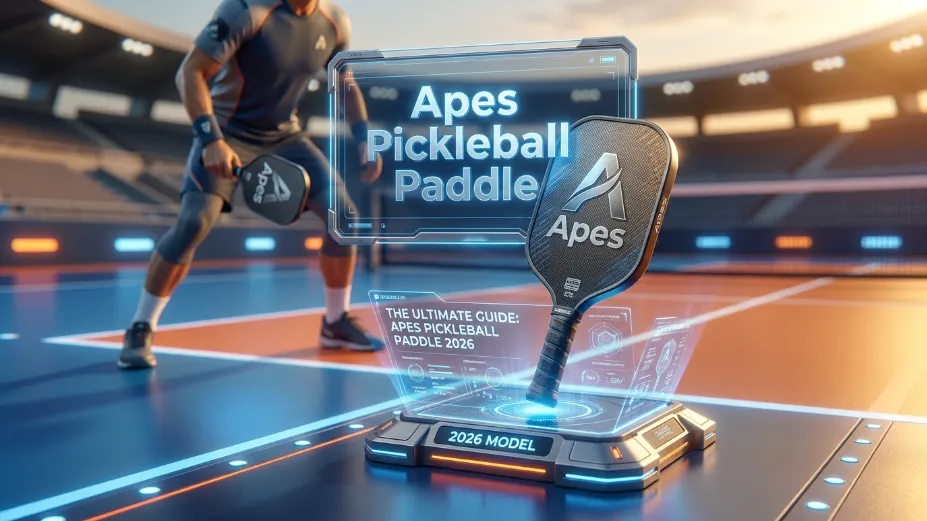
Raw carbon fiber revolutionized the court, but it also made every high-end paddle feel exactly the same. When baseline drives start losing their grit and soft kitchen dinks turn into unpredictable pop-ups, upgrading to just another generic block of graphite won’t fix your game. That is why the market shifted when an hybrid aramid and carbon weave hit the scene. Finding the definitive apes pickleball paddle setup means looking past the unique simian logo and dissecting how this specific dual-material face fundamentally changes ball dwell time and plow-through power.
Pickleball Paddles — Control vs Power Comparison
Face · Core · Shape · C/P Ratio · Price (USD)
For aggressive baseline players coming from a tennis background who want extreme reach and maximum plow-through power, the elongated Pro Line Energy is the ultimate choice. If you prioritize absolute kitchen control and uncompromised speed during hand battles, the Harmony S stands out as the most balanced weapon. Players looking for premium technology on a budget should immediately secure the Joy S+, which offers unrivaled stability and forgiveness for under $100.
The Chemistry of Kevlar Spin Decay: Exposing the “Bare Fibers” Cliff
The materials science behind modern paddle faces is often obscured by flashy marketing campaigns. A common question among players looking to purchase an ape pickleball paddle centers on the durability of its textured surface. While competitive brands often market aramid (DuPont™ Kevlar®) as an indestructible, wear-free composite that outlasts any standard carbon fiber pickleball paddle, laboratory analysis and court wear-tests paint a more nuanced chemical reality.
Kevlar® (poly-paraphenylene terephthalamide) is highly valued for its exceptional tensile strength-to-weight ratio and high impact resistance. However, it suffers from a significant physical limitation on the court: low surface energy and high chemical inertness. Unlike carbon fiber, which has a molecular surface that binds tightly with modern thermoforming resins, Kevlar® does not readily form strong chemical bonds with epoxy. This weak connection directly impacts the longevity of the textured paint grit applied to the paddle face to generate spin.
During competitive play, executing high-shear topspin and slice drives subjects the face of a pickleball apes paddle to extreme localized forces. Because the epoxy-to-aramid mechanical bond is weak, the textured paint grit micro-fractures and peels away over time. Real-world performance logs reveal a distinct decay lifecycle:
- The 40-to-50-Hour Threshold: Around this mark, the protective resin coating completely wears off, exposing the bare aramid fibers of the weave.
- Micro-Fraying and Velvet Effect: Unlike raw carbon fiber—which remains rigid and retains some texture as it wears—exposed aramid fibers split and fray. They form soft micro-structures that feel velvet-like to the touch.
- Severe Spin Loss: Because these exposed fibers are soft and flexible, they lose their ability to grab the plastic surface of the ball. Friction drops sharply, causing spin rates to plummet from over 2,100 RPM to flat, uncontrollable launches under 1,400 RPM.
This decay is physically permanent. While a rubber cleaning eraser can restore friction to a raw carbon fiber face by removing plastic ball residue, using one on a worn Kevlar® surface will actually accelerate the micro-fraying of the soft aramid fibers, further lowering your spin potential. This is a critical technical detail often overlooked by standard review sites.
The Pulse Series “Break-In” Cycle: The Endless Softening Phenomenon
A primary talking point within competitive communities surrounding pickleball apes paddles is the distinct physical change these paddles undergo during their initial weeks of play. While standard carbon fiber models deliver their peak performance right out of the box, the Pulse series (including the Pulse V, Pulse S, and Pulse E) features a dynamic, multi-stage “opening up” period that significantly changes how the paddle behaves.
Initially, a brand-new Pulse S feels exceptionally stiff, dense, and slightly underpowered. This is due to the high-tension poly aramid and nylon weave on the face, which restricts the trampoline effect of the 16.5 mm core. However, speed tests reveal that the core undergoes a significant transformation after a short period of regular use:
Over the first 10 to 20 hours of play, the internal thermoformed structure experience what players describe as “opening up.” Speed gates confirm a power boost of nearly 5%—punch volleys that start at an average of 54.5 MPH increase to a highly competitive 57.4 MPH, accompanied by a deeper, bass-heavy acoustic profile. This is caused by the relaxation of the internal adhesive layers bonding the carbon fiber ring grid to the core walls, allowing the honeycomb cells to flex more dynamically.
However, players must understand that this softening curve does not stop at a plateau:
- Hours 0-20 (The Tight Phase): The paddle delivers maximum control and predictable touch, but lacks baseline depth and put-away power. Off-center hits can feel jarring and stiff.
- Hours 20-40 (The Golden Window): This is the sweet spot of the paddle’s life. The surface tension relaxes, and the dual-edge foam walls work in perfect harmony with the loosened aramid face to produce exceptional ball pocketing, plush kitchen drops, and explosive overhead speed.
- Hours 80-100+ (Continuous Degradation): Under constant impact, the internal honeycomb cell walls begin to buckle and the adhesive bonds break down. The paddle’s core continues to soften indefinitely, turning a control-oriented paddle into a springy, unpredictable “hot” trampoline. Dinks and resets pop up high, forcing players to adjust their mechanics to keep the ball from sailing long.
To address this issue, Pickleball Apes introduced a key manufacturing update. In earlier batches, the internal carbon fiber tubes were glued end-to-end with a thin adhesive strip, which quickly loosened under impact. The latest runs of apes pickleball paddles feature overlapped carbon fiber tubes, significantly increasing the adhesive surface area. This update successfully stabilizes the core, though the gradual softening of the composite weave remains an inherent property of the aramid fibers.
The Physics of EPP Core Incisions in the Charm Series
To eliminate the risk of honeycomb core crushing entirely, the Charm series utilizes an innovative core consisting of Expanded Polypropylene (EPP) solid foam rather than traditional honeycomb cells. While EPP foam is incredibly durable, it is naturally highly energy-absorbent, which typically results in a “dead” feel with very little put-away power. To solve this, the engineering team introduced horizontal precision cuts on both sides of the core.
This design is governed by the physics of strain-rate sensitivity in polymeric foams, which can be modeled using the flow stress equation:
$$\sigma = C \cdot \dot{\varepsilon}^m$$
Where:
- $\sigma$ represents the flow stress, or the core’s resistance to deformation.
- $C$ is a material constant specific to the EPP formulation.
- $\dot{\varepsilon}$ is the strain rate, representing the speed and force at which the ball impacts the paddle face.
- $m$ is the strain-rate sensitivity exponent of the foam structure.
At low strain rates (such as soft dinks, drop shots, and kitchen resets), the impact force is insufficient to compress the precision incisions. The incisions remain open, allowing the highly dampening EPP foam cells to fully compress and absorb the ball’s kinetic energy. This results in a highly controlled, predictable, and plush feel that tames aggressive speed-ups.
Conversely, at high strain rates (such as full-swing drives, overhead slams, and aggressive counters), the massive localized impact force overcomes the structural resistance of the cuts. The horizontal incisions collapse and close completely, instantly turning the core into a solid, rigid block of polymer. This transition maximizes the core’s Coefficient of Restitution ($e$), returning maximum energy to the ball for explosive put-away power.
Direct Technical Comparison: Head-to-Head Battle with Top Competitors
To truly evaluate these paddles, we must compare them directly to the top pickleball paddles currently dominating the United States competitive scene.
Pro Line Energy S vs. Six Zero Ruby (The Kevlar Showdown)
While both of these paddles are highly praised for their use of aramid materials, they utilize completely different face composites:
- The ruby pickleball paddle utilizes a 100% DuPont™ Kevlar® face. This produces a stiffer, crisper ball feel that behaves very similarly to the classic carbon fiber designs from six zero pickleball. It offers immense pop and an immediate rebound, but requires a highly developed soft touch to prevent pop-ups at the kitchen line.
- The Pro Line Energy S utilizes a hybrid aramid-carbon weave face. The addition of raw carbon fiber acts as a stabilizer, dampening vibration and significantly increasing the ball dwell time. This gives the Pro Line Energy S a much more muted, plush, and forgiving feel on resets and drops compared to the poppy response of the Ruby.
Harmony S vs. Vatic Pro Prism Flash 16mm (The Budget Control Duel)
For players looking for ultimate control without spending a fortune, these two models present a fascinating choice:
- The Vatic Pro Prism Flash 16mm is widely considered the absolute best budget pickleball paddle on the market. It utilizes a traditionally molded, non-thermoformed carbon face that offers incredible control and a soft feel. However, at an average weight of 8.1 ounces and a standard perimeter design, it can feel slightly sluggish during fast, close-range kitchen exchanges.
- The Harmony S ($179.99) is a thermoformed unibody model that features polyurethane (PU) foam in the corners and a structural fiberglass perimeter wall. This advanced construction allows the Harmony S to maintain a highly stable, twist-resistant sweet spot at an exceptionally low swing weight of just $112.95\text{ kg}\cdot\text{cm}^2$. This enables players to easily customize their weight distribution using lead or tungsten tape without making the paddle feel heavy or slow.
This comparison highlights the ongoing kevlar vs carbon pickleball paddle debate, proving that hybrid weaves offer a unique playability profile that traditional materials cannot match.
Tactical Review of the Joy S vs. Joy S+ Models
With the release of the Joy series, Pickleball Apes introduced an affordable, foam-core paddle designed to bring high-end performance to developing players. However, laboratory measurements show a massive performance difference between the Joy S and the Joy S+ models that buyers must be aware of before purchasing.
- The Joy S (The Narrow Hybrid): Featuring a traditional narrow hybrid shape, the Joy S registers a low twist weight of just 6.55. On the court, this translates to below-average stability on off-center hits. If you strike the ball even slightly outside the center, the paddle twists in your hand, resulting in erratic, dead-feeling shots that often die into the net.
- The Joy S+ (The Hybrid Widebody): The S+ model features wider, slightly shorter dimensions that raise the twist weight to a highly stable 7.00. The diced EPP core works beautifully in this wider frame, providing a much larger sweet spot and a significantly more forgiving feel. It easily tames off-center hits and delivers stable, plush feedback right out of the box without requiring lead tape.
While the Joy S is often marketed to players seeking maximum drive speed, most intermediate and control-focused players will find the Joy S+ to be a vastly superior option, offering the perfect balance of stability and touch.
The Hidden Realities of Ownership: Strict Warranties & Winter Limitations
Before purchasing an apes pickleball paddle, players must familiarize themselves with the strict legal and environmental policies enforced by the manufacturer, which are often glossed over in standard marketing material.
- The Weather Limitation: The official warranty explicitly excludes any damage incurred when playing in temperatures below 40°F. In freezing conditions, the specialized polymer adhesives and polyurethane foams used in thermoformed paddles crystallize and become highly brittle. Hitting a cold, hardened outdoor ball under these conditions can lead to instant core crushing, dead spots, or complete face delamination.
- The Modification Exclusion: While the lightweight nature of the Harmony and Joy series invites customization, adding heavy lead or tungsten tape to the perimeter of the frame will immediately void your 12-month manufacturer warranty. The brand’s engineers argue that altering the factory weight distribution concentrates mechanical stress at the neck, which can cause structural cracking.
- The Demo Program Catch: U.S. customers can take advantage of a 30-day trial program, but the return criteria are exceptionally strict. Returns will be flatly rejected if there are any scuffs on the plastic edgeguard, scratches on the face paint, or any sweat stains or odors on the white leather stock grip.
To ensure your gear remains tournament-legal and fully covered, always refer to the official USA Pickleball Approved Paddle List before applying any aftermarket modifications or overgrips.
Frequently Asked Questions (FAQ)
Q: How long does the grit last on an apes pickleball paddle before losing spin?
A: Real-world testing shows that the applied paint grit begins to degrade after 40 to 50 hours of intensive play. Once the bare aramid fibers are exposed, spin rates will decline permanently. It is highly recommended not to use a standard abrasive paddle eraser on woven surfaces, as it will cause the soft fibers to fray and further lose their grip.
Q: Is there a difference in playability between the Joy S and the Joy S+ models?
A: Yes, a significant one. The Joy S features a narrow hybrid shape with an average twist weight of 6.55, which can feel highly unstable and jarring on off-center hits. The Joy S+ utilizes a wider hybrid shape that raises the twist weight to a highly stable 7.00, providing a much larger sweet spot and a significantly more forgiving feel out of the box.
Q: Will adding lead tape to my Harmony paddle void the warranty?
A: Yes. The official manufacturer warranty policy states that any user modifications—including the application of lead, copper, or tungsten weight tape—will immediately void the 12-month warranty coverage. If you experience core issues or edgeguard separation after applying weight tape, your replacement claim will be denied.
Q: Why does the Pulse series feel so different after a few weeks of use?
A: The Pulse series is engineered to undergo a distinct break-in period. Over the first 10 hours of play, the carbon fiber ring grid and adhesive layers relax, expanding the sweet spot and providing a verified 5% boost in ball speed. However, after 100+ hours of heavy impact, the honeycomb cell walls will eventually begin to buckle, resulting in a springy, uncontrollable trampoline effect.