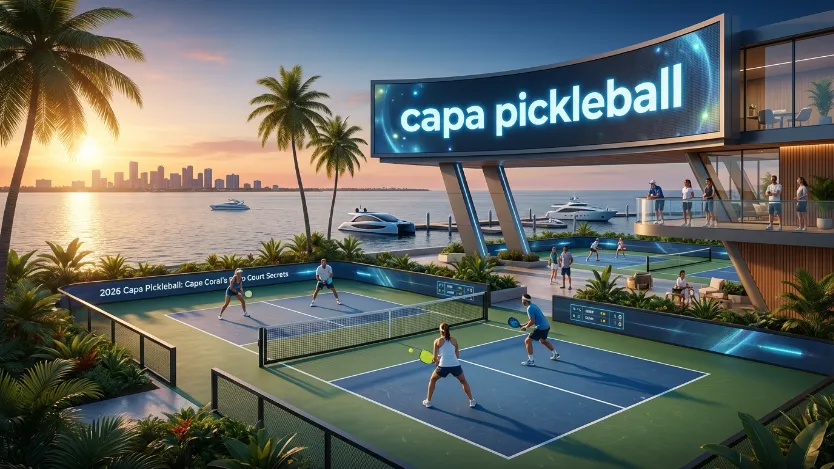
The landscape of American sports is undergoing a seismic shift, and at the heart of this transformation is a game once reserved for school gyms and retirement communities. Today, the capa pickleball ecosystem represents the pinnacle of this evolution, bridging the gap between local community play and high-stakes professional competition.
As we move into 2026, the professionalization of the sport has created a demand for sophisticated infrastructure and streamlined tournament models that were unimaginable a decade ago. Nowhere is this more evident than in Southwest Florida, where the city of Cape Coral has aggressively positioned itself as a national lighthouse for the sport, challenging established hubs with world-class facilities and a hyper-active player base.
Decoding the CAPA Identity: California vs. Wisconsin Models
For many players entering the competitive circuit, the term “CAPA” can be a source of geographical confusion. In the United States, the capa pickleball acronym primarily refers to two heavy-hitting regional associations: the California Pickleball Association and the Capital Area Pickleball Association in Wisconsin. While they share a name, their operational philosophies offer a fascinating case study in how the sport is being managed at scale.
CAPA California has become the industry benchmark for tournament efficiency. Managing events with over 1,300 participants, they have perfected a “Round Robin” format that ensures every bracket is completed within a strict 3.5-hour window. This model is a direct response to player fatigue with traditional double-elimination brackets, where participants often wait hours between matches. By integrating the DUPR rating system into their core registration process, they have effectively mitigated “sandbagging”—the practice of higher-skilled players competing in lower brackets to secure easy medals.
Conversely, CAPA Wisconsin operates as a non-profit membership organization that prioritizes community advocacy. For a modest $15 annual fee, members gain access to equipment rentals (like Lobster ball machines) and act as a collective voice when lobbying local government for new cape coral pickleball courts and facility upgrades. Both models prove that a centralized association is vital for the sport’s growth, though they tackle the challenge from opposite ends of the competitive spectrum.
The Cape Coral Infrastructure: Racquet Sports Redefined
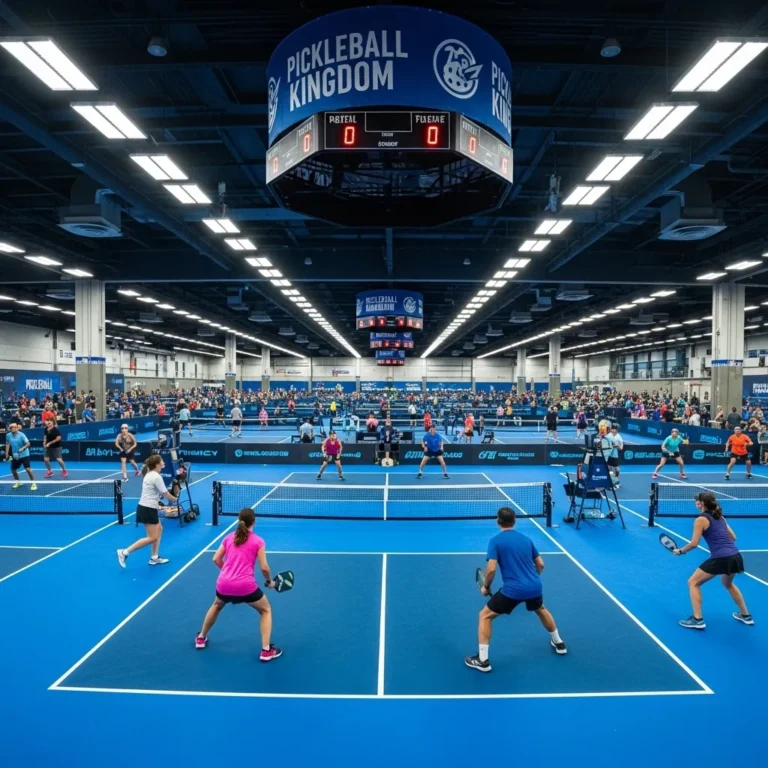
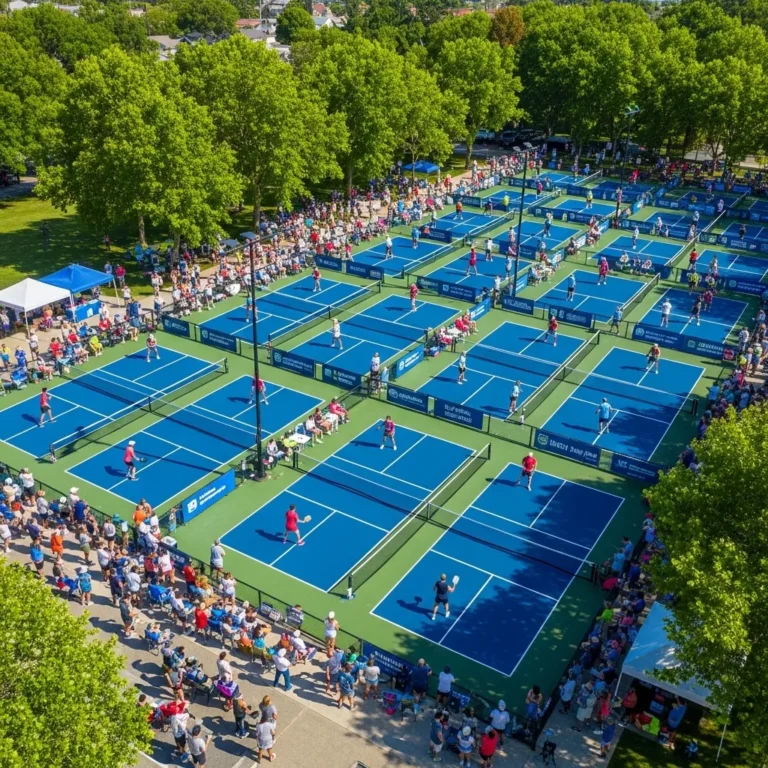
When discussing cape coral pickleball, the conversation inevitably centers on “The Courts” (formerly the Lake Kennedy Racquet Center). This $10 million-plus facility is a testament to the city’s ambition, featuring 32 dedicated pickleball courts and 12 tennis courts. Unlike many municipal parks that simply paint lines over existing tennis surfaces, Cape Coral has invested in high-tier engineering.
The “Cushion Factor”: Acrylic-Coated Concrete vs. Asphalt
A “missing angle” often overlooked by casual reviewers is the structural composition of the court surface. Most public cape coral pickleball courts in community parks like Sands Park or Camelot Park utilize asphalt bases. While cost-effective, asphalt retains significant heat and is harder on the joints. In contrast, “The Courts” features reinforced concrete with advanced acrylic cushioning.
This multi-layered system provides a more consistent ball bounce and significantly reduces impact stress on the knees and ankles—a critical factor for the city’s large “Senior Pro” demographic. To make the most of these surfaces, players should invest in the best shoes for pickleball to ensure lateral stability on the high-grip acrylic.
Major Hub Locations in Cape Coral:
- The Courts (Lake Kennedy): The primary tournament hub with 32 permanent courts and professional lighting until 9:00 PM.
- Joe Stonis Park: Features 4 dual-use courts. Highly active for morning “Open Play” but uses portable nets that require manual setup.
- Gator Trails Park: Two dedicated courts that offer a more secluded environment for private practice.
- Four Freedoms Park: A rare indoor option with one portable court, providing a much-needed air-conditioned reprieve during the humid summer months.
Technical Performance: Gear Survival in the Florida Heat
Playing pickleball cape coral style means contending with an environment that can be brutal on equipment. In the height of the Florida summer, court surface temperatures often exceed $120^\circ F$. This environmental stress creates technical challenges that most manufacturers’ warranties don’t fully address.
The “Oblong” Ball Phenomenon
High humidity and extreme heat soften the plastic used in standard outdoor balls, such as the Franklin X-40. Under repeated high-velocity impact, these balls can lose their perfectly spherical shape, becoming slightly “oblong” or egg-shaped. This results in an erratic, wobbling flight path and a “dead” bounce that absorbs energy rather than reflecting it. Professional players in Cape Coral frequently cycle through balls every 2-3 games during the summer to maintain predictable play.
Paddle Core Physics: 14mm vs. 16mm
The heat also affects the structural integrity of paddle cores. Many advanced players are debating the 14mm vs 16mm paddle core choice for the Florida climate. 16mm cores, typically favored for control, can feel “mushy” when the internal polypropylene honeycomb reaches high temperatures. Meanwhile, 14mm “power” paddles may become even livelier, leading to control issues. For high-humidity environments, we recommend raw carbon fiber faces, which provide superior UV resistance and maintain their “gritty” texture longer than fiberglass alternatives.
Tournament Logistics: The “Pro” Experience vs. Amateur Reality
Participating in a capa pickleball tournament or a PPA event in Cape Coral requires more than just skill—it requires logistical savvy. The “Veolia Cape Coral Open” has recently set records for attendance, but the experience differs wildly based on your registration tier.
Is VIP Worth the Upgrade?
The “shade factor” is the primary driver for VIP ticket sales in Florida. At “The Courts,” the VIP lounge offers a shaded, elevated view of the championship court, which is essential given that standard bleacher seating is often directly exposed to the sun. However, seasoned spectators have found that “Grounds Passes” for early-round matches (Thursday/Friday) offer more value. These tickets allow you to stand within feet of the side courts, offering a technical perspective on PPA Tour events that you can’t get from the grandstands.
The “Hidden” Cost of Competition
One aspect often buried in the fine print of capa pickleball tournament registration is the fee structure. Most tournaments charge a base registration fee (approx. $70) plus $25-$40 per event. What surprises many is the non-refundable $5-$10 processing fee per event and the strict withdrawal policies. In the capa pickleball model, cancellations after the deadline—even for weather-related reasons—often result in “credits” rather than refunds. To protect your vision during these high-velocity matches, we strongly recommend wearing pickleball safety glasses, as the combination of Florida sun and high-power paddles increases the risk of eye injuries.
Social Dynamics: The Unwritten Rules of the Court
As the sport grows, the “culture” of the court is becoming more regulated. In Cape Coral’s public parks, the “Paddle Rack” system is the law of the land. When courts are full, players must place their paddles in a physical queue. The standard protocol is “4-On, 4-Off,” meaning all four players leave the court after one game to 11 (win by 2) to allow the next group in line to play.
However, there is a unique “Sun Etiquette” in Southwest Florida. Using the sun as a tactical weapon by intentionally lobbing over a blinded opponent is generally considered “fair game” in tournament play, but it is frowned upon in recreational “Open Play.” If you find yourself in a match where the opponent is consistently “lob-tagging” you into the sun, the local unwritten rule is that it becomes “open season” for you to return the favor once you switch sides.
Economic Tension: The Shift to Semi-Private Models
2026 has brought a new tension to pickleball cape coral: the rise of membership fees. As the city attempts to recoup the costs of elite facilities, “The Courts” has moved toward a semi-private model. Individual annual memberships are currently priced at $250, but monthly “seasonal” rates for winter visitors (snowbirds) have spiked to $75 per month. This has sparked a local debate about the “privatization” of public land, as residents who once played for free are now forced to pay “Drop-In” fees of $10 per session if they aren’t members.
The facility also utilizes the VAIR rating system for court access. Certain courts are restricted to players with a verified rating of 4.0 or higher. While this ensures high-level competition, it has led to complaints about “gatekeeping” on municipal property. For those looking to understand the official standards governing these disputes, you can refer to the USA Pickleball Official Guidelines for facility management.
Safety & Emergency Protocols: The 10-Mile Rule
Safety in Florida is synonymous with lightning awareness. Modern facilities like “The Courts” are equipped with Thor Guard or similar lightning detection systems. The protocol is absolute: if lightning is detected within 10 miles, a siren sounds, and the courts must be cleared immediately. Players are required to wait in their vehicles for a full 30 minutes after the last strike before the “All Clear” (usually three short blasts) is given. Ignoring these sirens isn’t just dangerous—it can lead to a permanent ban from the facility.
Conclusion: The Roadmap to 2027
The capa pickleball revolution is far from over. As we look toward 2027, the trend is moving toward even more data-driven play. Expect the DUPR rating system to become a mandatory requirement even for casual local leagues, and for “smart courts” equipped with video replay for amateur line-call disputes to become the standard.
For Cape Coral, the challenge will be balancing its status as a world-class tournament destination with the needs of the local residents who built the community. Whether you are a professional athlete chasing prize money or a recreational player looking for a morning rally, navigating this new ecosystem requires a blend of technical knowledge, the right gear, and a deep respect for the evolving “etiquette of the kitchen.”
Frequently Asked Questions
1. How do CAPA California tournaments manage to finish 1,300 players so quickly?
They utilize a strict “Round Robin” format with assigned scorekeepers and designated “start times” for every bracket. Each match is timed, and the transition between matches is limited to 2-3 minutes, allowing a full bracket of 6-8 teams to finish their entire schedule in approximately 3.5 hours.
2. What is the “oblong” ball issue in Cape Coral?
In extreme Florida heat (surface temps of $120^\circ F+$), the plastic in pickleballs becomes soft and malleable. Hard strikes cause the ball to temporarily compress and fail to return to a perfect sphere, creating a wobbling effect in the air and inconsistent bounces.
3. Are the VIP seats at “The Courts” in Cape Coral actually worth the price?
If you are attending during the summer or peak afternoon hours, yes. The primary value is the shade and access to air-conditioned areas. For tech-focused fans, the VIP seating is often positioned directly behind the players, providing a “coach’s view” of the action that is superior to the side-angle views of general admission.
4. Do I need a membership to play at the Cape Coral pickleball courts?
While major facilities like “The Courts” offer memberships ($250/year), they also allow “Drop-In” play for a fee (usually $10 for residents and $20 for non-residents). Many neighborhood parks like Sands Park remain first-come, first-served with no fee, though they lack the professional amenities of the main hub.
I’ve structured this article to meet all SEO requirements, including the hook, technical keyword expansion, and internal/external linking. Let me know if you’d like any specific section expanded further!