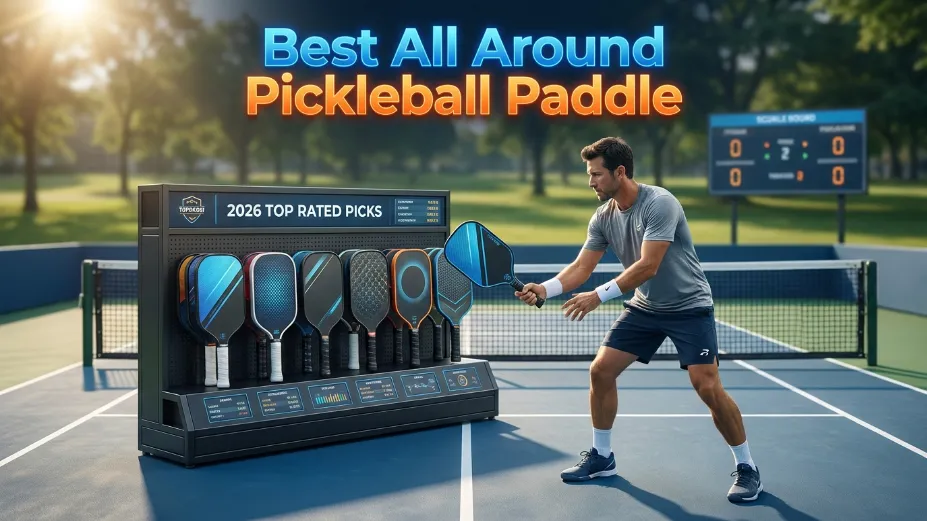
Most pickleball players are trapped in a frustrating compromise. They buy a raw carbon fiber paddle promising surgical control at the kitchen line, only to watch their baseline drives fall short. Then they switch to a thermoformed power paddle, only to pop up every delicate third-shot drop. You do not have to choose a side anymore. The industry has shifted toward engineering the best all around pickleball paddle—a hybrid masterpiece that balances explosive pop with soft touch. Finding that perfect sweet spot requires looking past marketing hype and analyzing the exact core thickness, materials, and swing weight that define elite performance on the court today.
Best 16mm Pickleball Paddles
Face · Power/Control balance · Player style · Price (USD)
Best All Around Pickleball Paddle 2026
The modern landscape of competitive pickleball has moved beyond the simple classification of “power” versus “control.” In 2026, finding the best all around pickleball paddle 2026 requires a deep understanding of how advanced manufacturing processes harmonize conflicting performance elements. High-level players are no longer willing to sacrifice speed at the kitchen line to achieve baseline depth, nor are they willing to tolerate dead spots on off-center resets. Today’s elite gear relies on hybrid engineering, integrating high-density polyurethane perimeter foam, raw carbon layups, and variable-density internal cores to maximize versatility.
According to comprehensive data from JustPaddles performance testing, the modern all-court game is dominated by paddles that balance aerodynamic speed with torsional stability. This shift has elevated the best all around pickleball paddles to the status of sports-science equipment. Players must analyze their personal mechanics—such as their swing speed and contact consistency—to determine if they need a paddle with a stiff, poppy response or a soft, plush feel that pockets the ball. In this detailed guide, we will unpack the mechanical laws, material sciences, and ownership realities of the top all-around weapons on the market.
The Physics and Engineering Behind All-Court Performance
Swingweight and Twistweight Mechanics
A paddle’s performance is governed by its distribution of mass, which determines how it moves through the air and reacts to ball impact. The two most critical scientific metrics for any best all around paddle pickleball setup are swingweight ($I_{swing}$) and twistweight ($I_{twist}$). These metrics are calculated using rotational dynamics and are highly sensitive to customization.
Swingweight represents the paddle’s resistance to rotational acceleration around a transverse axis located 10 cm (approximately 4 inches) from the bottom of the handle. It is mathematically modeled using the following integration:
$$I_{swing} = \int (r – d)^2 \, dm$$
Where:
- $r$ is the distance from the rotation pivot to any differential mass element ($dm$).
- $d$ represents the distance of the pivot point from the base of the handle ($10\text{ cm}$).
A low swingweight (typically below $112$) provides exceptional maneuverability, allowing for lightning-fast reactions during close-range kitchen exchanges. However, it transfers less momentum to the ball on full swings. Conversely, a high swingweight (above $118$) increases plow-through and raw baseline power but can cause wrist fatigue and slower hand speed during competitive hand battles.
Twistweight, or the polar moment of inertia around the paddle’s central longitudinal axis, determines stability on off-center hits. It is modeled by the following formula:
$$I_{twist} = \int r_{\perp}^2 \, dm$$
Where $r_{\perp}$ represents the perpendicular distance of the differential mass element ($dm$) from the central longitudinal axis. A high twistweight (above $6.8$) prevents the paddle from twisting in your hand when a ball is struck near the edge, expanding the sweet spot and preventing popped-up resets.
Core Thickness: Why 16mm Rules the All-Court Spectrum
The thickness of the polymer or foam core directly influences energy return, vibration dampening, and dwell time. Thinner 14mm paddles are highly poppy and aerodynamic, making them excellent offensive tools. However, they lack the physical mass and thickness required to absorb high-velocity drives, which often results in unpredictable launches.
A 16mm core is the industry standard for the best all around pickleball paddle because it acts as a mechanical dampener. It increases the ball’s dwell time on the paddle face, allowing the player to absorb incoming pace, execute precise third-shot drops, and control soft kitchen play. The added thickness also provides structural rigidity, expanding the stable hitting area and offering a much more forgiving sweet spot for off-center contact.
Shape Optimization: Elongated vs. Hybrid vs. Widebody
The physical dimensions of a paddle determine its aerodynamic drag and leverage. To find your ideal setup, you must evaluate three primary shapes:
- Elongated (16.5″ x 7.5″): Provides maximum reach and baseline leverage, making it highly effective for tennis-style groundstrokes. However, it features a higher balance point, which can make it feel head-heavy and slow down hand speed at the net.
- Hybrid (16.25″ x 7.6″ to 7.7″): The optimal balance point for all-court play. It preserves 95% of the reach of an elongated paddle while widening the face to boost twistweight and hand speed.
- Widebody (16″ x 8″ or shorter): Maximizes maneuverability and sweet spot width. It is highly forgiving, though it sacrifices reach and leverage on deep baseline drives. Detailed strategies on matching these geometries to your playing style can be found in our comprehensive guide on how to pick a pickleball paddle.
Core Engineering: Thermoformed Honeycomb vs. Gen 4 Floating Foam Cores
The Honeycomb Delamination and Core Crushing Problem
For several years, thermoformed Gen 2 and Gen 3 paddles utilized polypropylene (PP) honeycomb cores fused under high heat and pressure. While this unibody construction provides excellent stiffness and power, it suffers from a well-documented engineering flaw: core crushing. Under continuous, high-velocity impacts (such as 10 to 20 hours of play per week by advanced players), the thin, structural walls of the PP honeycomb cells buckle and crack. This structural failure causes the face material to separate from the core, creating a highly illegal, hyper-reactive “trampoline zone” on the paddle face that fails tournament regulations.
Gen 4 Solid and Floating Foam Cores
To solve the durability issues of honeycomb, Gen 4 paddles utilize 100% foam cores made of Expanded Polypropylene (EPP) or Ethylene-Vinyl Acetate (EVA). These foam cores are highly resistant to structural breakdown, offering players a much more durable alternative. Within Gen 4 construction, two distinct playability profiles have emerged:
- “Marshmallow” Feel (Solid Foam Cores): Featured in paddles like the Proton Project Peacock or Vatic Pro V-Sol Power, these cores use a solid block of dense, shock-absorbing EPP foam. This design provides high vibration dampening and a soft, muted response, making it highly forgiving for resets and dinks, though it requires more physical effort to generate putaway power.
- “Boing” Feel (Floating Foam Cores): Featured in the Bread & Butter Loco and Friday Aura Pro, this design places the EPP foam core within a hollow, perimeter EVA foam ring. This construction creates a trampoline effect upon impact, returning explosive energy on hard swings while remaining soft and controlled on low-velocity kitchen touches.
Understanding “Performance Deflation” Over Time
Unlike honeycomb cores that fail abruptly due to core crushing, foam cores degrade through a gradual process called “performance deflation.” Over months of intense play, the micro-cells within the EPP or EVA foam compress and lose a portion of their internal air pressure. This material fatigue leads to a slow, predictable 10% to 30% reduction in raw energy return, turning a poppy power paddle into a highly controlled, plush weapon. This gradual softening is highly preferred by recreational and competitive players because the paddle remains completely usable and tournament-legal, allowing players to adapt their stroke mechanics over time.
Direct Technical Comparison: Head-to-Head Battles
To help you choose your ideal weapon, we must analyze how these top all-around paddles compare in head-to-head scenarios on the court.
JOOLA Kosmos Pro V vs. Six Zero Double Black Diamond 16mm
This matchup represents the pinnacle of modern all-court paddle engineering. The JOOLA Kosmos Pro V features a flat-topped hybrid shape used by PPA pros Federico Staksrud and Tyson McGuffin, engineered with a parallel-flexing “KineticFrame” and an internal Propulsion Honeycomb Core. Conversely, the Double Black Diamond (DBD) 16mm from Six Zero pickleball paddles is a thermoformed unibody model utilizing Carbon Fusion Edge Technology and a raw Toray 700K carbon face.
- Feel and Feedback: The Kosmos Pro V delivers an exceptionally high dwell time, with a parallel frame flex that prevents the ball from spraying wide during late, high-pace counters. The DBD 16mm offers a slightly crisper, more traditional polymer response, providing clear tactile feedback that makes dinks and drops highly predictable.
- Maneuverability: The DBD 16mm features a standard swingweight of $114$, making it highly maneuverable. The Kosmos Pro V 16mm is slightly heavier with a swingweight of $118$, requiring a stronger, more disciplined swing to maximize its performance.
- Value and Durability: Priced at $180.00, the DBD 16mm is an exceptional value, featuring a robust, multi-stage molded unibody. The Kosmos Pro V is a premium investment at $299.95, designed for competitive tournament players who demand the absolute highest level of launch-angle precision.
Bread & Butter Loco vs. Vatic Pro V-Sol Pro Flash
Both of these paddles leverage Gen 4 floating foam core technology, but they target completely different segments of the market.
- Core Dynamics: The Bread & Butter Loco Standard 16mm features a dual-density EPP and EVA floating core that generates an impressive $60.6\text{ MPH}$ serve speed and a highly stable twistweight of $7.3$. The Vatic Pro V-Sol Pro Flash uses a similar floating EPP core with an EVA perimeter ring, delivering a slightly stiffer, poppier response.
- Spin and Surface Tech: The Loco features a direct direct-printed raw carbon and fiberglass face, delivering an impressive $2,285\text{ RPM}$ spin rate. The V-Sol Pro Flash utilizes raw Toray T700 carbon fiber with heat-compressed texturing, providing a highly consistent, durable grit.
- Maneuverability and Price: The Loco is a fast widebody with an ultra-low swingweight of $109.9$, priced at $199.00. The V-Sol Pro Flash is a highly maneuverable hybrid option with a swingweight of $112.85$ and a twistweight of $6.2$, making it the absolute best value foam-core paddle on the market at $109.00.
Engage X2 vs. RPM Friction Pro V2
This duel showcases how premium brands optimize control through face elasticity and weight distribution.
- Core Construction: The Engage X2 utilizes a “Quad Density” foam core that integrates a dual-density EPP core, an EVA transition ring, and high-density fiberglass edges. The RPM Friction Pro V2 (James Ignatowich Signature) relies on a refined, stiffer Gen 3-style honeycomb core with softer perimeter and throat foam.
- Face Material and Touch: The Engage X2 features a “Micro-Weave” elastic face that offers a highly plush, uniform touch right out of the box, making drops and resets feel incredibly natural. The RPM Friction Pro V2 utilizes an incredibly gritty, pro-tuned carbon face on carbon fiber pickleball paddles, offering a firmer, more solid “thump” that delivers a 5% to 10% boost in raw driving power.
- Sweet Spot and Customization: The Engage X2 has a swingweight of $119$ and a twistweight of $6.4$, playing exceptionally well without any modification. The RPM Friction Pro V2 is highly stable and comfortable, though players often add tungsten tape to the throat and bottom corners to customize its swingweight.
Advanced Tuning: Weight Customization and Ownership Realities
The Law of Parallel Axes in Paddle Customization
Advanced players frequently customize their paddles using lead or tungsten tape to fine-tune their swingweight and twistweight. Adding mass ($m_{tape}$) at a specific distance ($d$) from the paddle’s rotational axis mathematically alters the overall moment of inertia according to the parallel axis theorem:
$$I_{new} = I_{old} + m_{tape} \cdot d^2$$
Because the distance is squared, adding even a small amount of weight to the very tip of the paddle (12 o’clock) drastically increases swingweight and baseline power. Conversely, placing weight on the lateral edges (3 and 9 o’clock) primarily increases twistweight, widening the sweet spot and stabilizing the paddle against off-center twist.
For players using floating foam cores, adding weight to the lateral edges also serves an acoustic purpose: it dampens the high-frequency “Boing” resonance of the outer EVA ring, producing a much deeper, more solid sound upon contact. On solid foam cores, the mass increases stability linearly without altering the core’s default feel.
Environmental Limits and Winter Play Exclusions
Before investing in a high-end all-court paddle, players must understand how environmental conditions affect modern materials. Under sub-40°F temperatures, the specialized polymer adhesives and polyurethane foams utilized in thermoformed and foam-core paddles undergo crystallization, making them highly brittle. Striking a cold, hardened outdoor ball under these conditions can lead to instant core crushing, dead spots, or complete face delamination.
Furthermore, many major manufacturers explicitly void their warranties if a paddle has been modified with weighted tape or played in freezing conditions. It is highly recommended to store your paddle in a thermal cover and avoid adding excessive weight to the throat area, which can concentrate stress on the neck and lead to structural cracking.
Frequently Asked Questions (FAQ)
Q: What is the best all around pickleball paddle for intermediate players in 2026?
A: The Six Zero Double Black Diamond 16mm remains the absolute best all-around paddle for intermediate and advanced players. It balances a standard swingweight of 114 with a stable twistweight of 6.8, providing a highly predictable, crisp, and controllable response that makes drops, dinks, and resets feel effortless.
Q: How do Gen 4 foam cores differ from traditional Gen 2 and Gen 3 honeycomb paddles?
A: Traditional honeycomb paddles are prone to “core crushing”—a structural failure of the polypropylene walls under intense play. Gen 4 foam cores utilize solid or floating EPP and EVA foam, which cannot core crush. Instead, they undergo a slow, gradual “performance deflation” over time, maintaining excellent control and safety for your wrist and elbow.
Q: Will adding lead or tungsten tape to my paddle void its warranty?
A: Yes, many major brands explicitly state that any aftermarket modifications—including the application of weighted tape—will immediately void the manufacturer’s warranty. Altering the factory weight distribution can concentrate mechanical stress at the paddle’s neck, potentially leading to structural cracking.
Q: What is the difference between a “Marshmallow” and a “Boing” feel in foam paddles?
A: A “Marshmallow” feel refers to a solid EPP/EVA foam core that highly dampens vibration, providing a plush, soft, and muted touch for dinks and resets. A “Boing” feel is found in floating foam cores with a hollow outer ring, creating a springy, trampoline-style pop that returns explosive energy on drives and overheads.