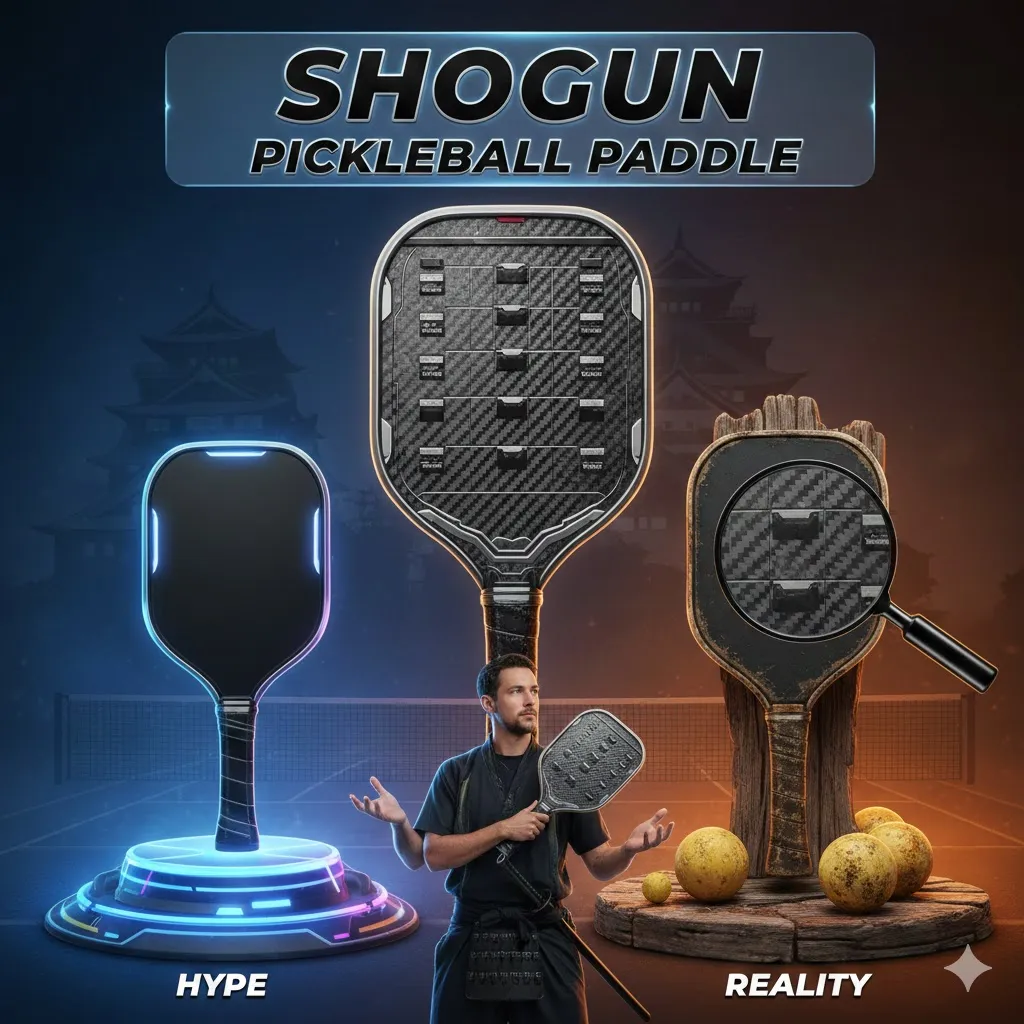
Are you tired of reading superficial paddle summaries that just repeat the manufacturer’s spec sheet? In a market flooded with exaggerated claims and identical raw carbon clones, competitive players are desperately searching for the real story behind their gear. Enter the shogun pickleball paddle. Released by the boutique and aesthetically rebellious brand Bread and Butter, this paddle has generated massive buzz for supposedly weaving aerospace-grade metal into its face. But does it actually live up to the hype, or is it just clever marketing?
In this comprehensive, no-holds-barred shogun pickleball paddle review, we are diving deep into the content gaps that major retailers and mainstream reviewers completely ignore. We will expose the truth about its “Carbotanium” surface, analyze its true grit lifespan, and reveal the biomechanical tweaks you need to make this paddle tournament-ready. If you are an intermediate or advanced player navigating the complex world of thermoformed pickleball paddles, this deep dive is specifically engineered for you.
The Material Truth: Decoding the “Titanium” Face Controversy
When you research the shogun 16mm pickleball paddle, the first thing you encounter is the claim of a “Beta Titanium and T700 Carbon Fiber weave” (often dubbed Carbotanium). Many top-ranking sites simply parrot this claim, leaving players to assume they are playing with an indestructible metal face. However, the competitive community has uncovered a completely different reality.
The metallic shimmer on the face of the paddle is not actually pure structural titanium metal. Instead, it is Electroplated Polyester (PET) plastic woven into the T700 carbon fiber base. The PET fibers undergo a microscopic electroplating process that gives them a metallic visual appearance and slightly alters the rigidity of the weave. While some players felt misled by the initial marketing terminology, the engineering reality of this PET/Carbon blend is actually highly beneficial for your game.
- The Plush Factor: Standard raw carbon fiber can feel harsh and stiff. The electroplated PET plastic softens the impact, providing a highly desirable “plush” feel that increases dwell time (how long the ball stays on the paddle).
- Vibration Dampening: The hybrid weave is excellent at absorbing high-frequency vibrations, making it an arm-friendly option for players suffering from tennis elbow.
- Offensive Pop: Even though it feels softer than pure carbon, the PET material is firmer than Kevlar, giving you a crisp, aggressive pop when driving the ball from the baseline.
Addressing the Elephant in the Room: Grit Inconsistency and Wear Cycles
One of the most critical missing angles in discussions about the bread and butter shogun pickleball paddle is the reality of its surface grit. Many consumers mistakenly believe that weaving metal or Kevlar into a paddle face makes the spin-generating texture last forever. This is scientifically false.
The Asymmetrical Grit Issue
A heavily discussed topic on community forums is the “asymmetrical grit” defect. Many players report that fresh out of the box, one side of the Shogun feels like aggressive sandpaper, while the other side is noticeably smoother, exposing the red PET weave underneath. This happens due to uneven pressure and temperature distribution during the peel-ply epoxy curing process. Fortunately, Bread & Butter’s customer service is top-tier; they acknowledge this manufacturing variance and swiftly replace asymmetrical paddles under their 30-day “Love it or Return it” policy. Always physically inspect both sides of your paddle the moment it arrives.
The 90-Day Spin Reality
The friction that generates top-tier spin (averaging around 1900+ RPMs) comes entirely from the microscopic peaks of the epoxy resin applied over the carbon/PET weave. If you are a high-level competitive player who hits with heavy topspin, you will physically wear down this epoxy layer within two to three months of rigorous daily play. Once the resin wears down, the paddle relies on the underlying weave, resulting in a slight drop in spin potential. To maximize its lifespan, strictly avoid abrasive cleaners and use a rubber paddle eraser after every session to extract the white plastic dust left behind by the pickleballs.
Biomechanical Nuances: Swing Weight, Twist Weight, and Lead Tape
To fully understand bread & butter shogun pickleball paddle performance, we must look at how it actually moves through the air.
- Swing Weight (120 – 122): This paddle is head-heavy.An elongated paddle with a swing weight over 120 acts as a powerful lever, delivering effortless baseline drives and crushing overheads. However, it can feel slightly sluggish in fast-paced hands battles at the kitchen line compared to aerodynamic hybrid shapes.
- Twist Weight (6.18): This is a lower twist weight for a modern premium paddle. It means the paddle is prone to twisting in your hand if you hit the ball near the edges (off-center).
The Pro Customization Secret: Because the swing weight is already high, adding lead tape to the top of the paddle (12 o’clock) will ruin your hand speed. To fix the low twist weight and expand the sweet spot, advanced players highly recommend adding 2 to 3 grams of tungsten or lead tape strictly at the bottom corners (4 o’clock and 8 o’clock). This widens the sweet spot and prevents the paddle from twisting without making it feel like a heavy club.
The Handle Illusion: Why 4.25 Inches Feels Bulkier
Another angle rarely covered is the handle ergonomics. The Shogun lists a standard 4.25-inch grip circumference. Yet, countless players with smaller hands complain that the grip feels unusually bulky and hard to manage. Why? The handle uses a pronounced octagonal shape wrapped in a thick vibration-dampening foam underneath the outer grip.This creates a wider cross-sectional feel. If you prefer a thinner grip, you will likely need to strip the factory grip completely and apply a thin overgrip directly to the core. Learn more about customizing your setup in our detailed guide on pickleball grips.
How Does the Shogun Compare to Banned Gen 3 Paddles?
Following the massive controversy where USA Pickleball delisted the highly propulsive JOOLA Gen 3 series, players have been scrambling for legal alternatives that still offer massive power. Can the Shogun fill that void?
The Shogun is a Gen 2 thermoformed paddle. It does not possess the illegal, trampoline-like suspended core of a banned Gen 3 paddle. However, within the legal framework of the USA Pickleball Equipment Standards, the Shogun ranks near the top for offensive plow-through and pop. It is widely considered an exceptional transition paddle for aggressive “bangers” who were forced to give up their Gen 3 models but still want a weapon that hits incredibly hard while offering superior control on dinks and resets.
Competitive Market Analysis: Shogun vs. Kevlar vs. Loco
To make an informed decision, you need to see how it stacks up against the competition.
- Vs. Kevlar Paddles (e.g., Six Zero Ruby or Pickleball Apes): Kevlar faces are incredibly flexible, offering massive dwell time and a very “mushy” feel. The Shogun’s PET/Carbon weave provides a similar softened touch but remains noticeably crisper and stiffer, yielding a more decisive offensive “pop” when attacking.
- Vs. Bread & Butter Loco: The Loco is the brand’s ultimate best pickleball paddle for control. It uses a hybrid shape for maximum maneuverability. The Shogun sacrifices some of that lightning-fast kitchen speed to give you significantly more finishing power and reach.
- Vs. Bread & Butter Filth: The Filth is a pure raw carbon fiber pickleball paddle that hits like a truck. The Shogun tames that wild power just enough to drastically improve your touch game, making it the superior all-court option.
Before making your final choice, we highly recommend checking the official USA Pickleball approved paddle list to ensure your gear is tournament-ready.
Frequently Asked Questions (FAQs)
Does the Bread and Butter Shogun actually contain Titanium?
No. Despite the early “Carbotanium” marketing claims, the metallic-looking threads in the paddle face are actually Electroplated Polyester (PET) plastic woven into T700 carbon fiber. While not structural metal, this PET plastic effectively dampens vibrations and provides a highly desirable plush feel that standard carbon paddles lack.
How long will the grit on the Shogun last before it wears out?
Like almost all premium thermoformed paddles, the Shogun relies on a peel-ply epoxy resin for its spin-generating grit. If you play rigorously 3 to 4 times a week with heavy topspin, you can expect the peak grit to wear down in about 2 to 3 months. The underlying PET/Carbon weave does not extend the life of the surface friction.
Why does one side of my new Shogun paddle feel smoother than the other?
This is a known manufacturing variance that occasionally occurs during the peel-ply curing process, resulting in asymmetrical grit. If you receive a paddle with a noticeably smooth side that exposes the red weave underneath, Bread & Butter’s customer service will replace it hassle-free under their 30-day return policy.
Where is the best place to add lead tape to the Shogun?
Because the Shogun is an elongated paddle with a naturally high swing weight (120-122), adding weight to the top will make it too slow at the net. To improve its relatively low twist weight (6.18) and expand the sweet spot, you should apply 2 to 3 grams of tungsten or lead tape at the bottom corners of the paddle face (the 4 o’clock and 8 o’clock positions).