Your paddle’s face gets all the glory, but its edge takes every hit. It scrapes the court on low digs, clacks against your partner’s paddle at the kitchen line, and slides off the bench onto concrete between games. Edge damage is usually where a paddle starts to look old, and it’s the cheapest part to protect. That’s the job of the Selkirk Pickleball Paddle Protective Edge Guard Tape. For about the price of a can of balls, this Selkirk Sport edge guard tape for pickleball paddle protection adds a padded, self-adhesive layer around the rim without shrinking your hitting surface.
Hundreds of verified Selkirk pickleball paddle protective edge guard tape reviews give it a near-perfect average. There’s one detail many buyers get wrong, though: the width. Choose the Selkirk pickleball paddle protective edge guard tape 20mm when your paddle actually needs the 30mm, and you’ll be cutting a second strip just to cover the edge. Keep scrolling to find the right width for your paddle, see how to apply it cleanly, and decide whether it belongs in your bag.
Selkirk Protective Edge Guard Tape
Pickleball paddles · Specs & fit by width · Nov 25, 2026
Edgeless paddles have taken over the American market, and that change made edge tape matter. A paddle without a plastic guard has its raw carbon or fiberglass edge sitting just millimeters from the court surface. *Selkirk.com doesn’t list strip length, so the 350mm figure comes from authorized retailer listings that describe the strips as 20mm × 350mm. At the time of writing, Selkirk’s official edge guard tape page lists the tape as a limited-edition item that is temporarily out of stock and not eligible for exchange. Authorized US retailers have listed it between roughly $7.95 and $8.99.
Selkirk Pickleball Paddle Protective Edge Guard Tape Reviews: Anatomy, Performance, Pros, and Cons
The numbers behind Selkirk pickleball paddle protective edge guard tape reviews are consistently strong. Selkirk.com shows a 4.7 out of 5 rating across 322 reviews, and large US retailers such as Scheels and Dick’s Sporting Goods have posted similar averages in the 4.5–4.7 range. A rating that high mostly tells you the tape does its basic job. It says much less about whether the tape suits your paddle, your playing style, or your budget, and that is what this section covers.
Anatomical Breakdown: What You’re Actually Sticking to Your Paddle
- Outer Surface: Buyers describe the surface as padded and slightly rubbery, and retailers usually call it faux leather. That cushion separates it from thin vinyl or electrical tape. It gives the rim a soft bumper instead of a hard shell.
- Adhesive Backing: The tape uses a self-adhesive peel-and-stick backing, with no glue or heat gun required. It holds firmly on a clean, dry edge. Reviewers say its grip weakens noticeably after a strip has been lifted and repositioned more than once or twice.
- Edge Profile: The strips have straight, smooth edges, not the notched “sawtooth” cut some competitors use. The finish looks clean on straight sections of the rim. On tight corners, the tape has to stretch instead of fanning out, and that is where most installation complaints come from.
- Pack Format: Every order contains three strips of one width and color. At about 350mm each, the pack adds up to roughly 1,050mm (41.3 inches) of tape.
- Undisclosed Specs: Selkirk does not publish the tape’s thickness or weight per strip. If a seller quotes exact figures, treat them as that seller’s own measurements, not official data.
Core Performance on Court
- Scuff and Scrape Defense: This is the tape’s main job, and it does it well. Low digs, scoops off the court, and paddle-to-paddle clashes at the kitchen line wear down the tape instead of your paddle’s rim. When the tape looks beaten up, you replace a strip that costs under $3.
- Hard-Impact Limits: The tape is not armor. If you slam a paddle into a fence post, drop it edge-first on concrete, or throw it in frustration, the force goes through a few millimeters of padding and into the core. The tape will not stop a crack or a delamination.
- Feel and Swingweight: Any material you add to the head of a paddle raises its swingweight, which is how heavy the paddle feels when you swing it. Selkirk doesn’t publish a weight for this tape. Community measurements of full-perimeter vinyl wraps report roughly 5–9 grams added. A top-arc-only strip of Selkirk tape weighs a fraction of that, and most players never notice it.
- Visual Fit: On Selkirk paddles especially, the black and white options blend in with factory graphics. It looks close to original equipment, not like an aftermarket patch.
Honest Pros and Cons
- Pro — Low Entry Price: At $8 for three strips, it is one of the cheapest ways to protect a paddle that may have cost $200 or more.
- Pro — Real Cushion: The padded surface takes court contact better than thin tape does.
- Pro — Clean Removal: Most buyers report that it peels off without leaving heavy residue.
- Con — Short Strips: One strip will not cover the full edge, and many buyers only find this out after they open the pack.
- Con — Corner Wrinkles: Because the edges are straight, the tape tends to bunch or bubble on tight curves if you rush the job.
- Con — Limited Colors and Stock: Only black and white are listed on Selkirk.com right now, and the product is currently out of stock there.
Most reviews skip the cost of protecting the whole edge. The sticker price is $8, but the real number to look at is cost per wrap. Covering only the top arc with a single strip costs about $2.67. Covering the full exposed edge usually takes most or all of a pack, which puts the cost closer to $6.40–$8.00. The tape is still cheap at either price. The difference is that a full pack protects one paddle completely, not three. If you’re still deciding whether your paddle needs it at all, our guide to edgeless pickleball paddles explains why the edge is the weak point of modern paddle designs.
Selkirk Pickleball Paddle Protective Edge Guard Tape – 20mm: Fit, Pros, and Cons
The 20mm width sells more than the other two, and it also causes the most sizing mistakes. The cause is simple. Buyers compare the tape width to their paddle’s advertised core thickness, when they should be comparing it to the paddle’s actual outer edge width. A factory edge guard adds roughly 1.5–2mm to the core thickness. You also want a few millimeters of tape folded onto each face so the sharp corner is covered.
- 13mm–14mm Edgeless Paddles: This is an ideal fit. On a 13mm paddle, 20mm tape leaves about 3.5mm folded onto each face, enough to cover the corner without being visible from across the net. Selkirk’s Power Air family sits in this range.
- 16mm Edgeless Paddles: This is a good fit, with about 2mm of overlap per side. Players with the AMPED Pro Air Invikta generally choose 20mm.
- 16mm Paddles with a Factory Edge Guard: The fit is tight. With an outer edge of about 18mm, the tape folds only about 1mm onto each face. Some owners of the LABS Project Boomstik like that slim, nearly invisible look. Others step up to 30mm for deeper coverage, accepting more effort on the curves.
- 20mm-Thick Paddles: Choose a different width. On the Luxx Control Air Invikta, 20mm tape sits exactly flush with zero overlap, which leaves the face corners exposed. The 30mm width folds about 5mm onto each side and is the one Selkirk recommends.
Measure before you buy. Hold a ruler or calipers across the rim at the top of the paddle, then add 4–6mm for overlap. If the total is 20mm or less, the Selkirk pickleball paddle protective edge guard tape 20mm is the right buy. If it is higher, choose 30mm.
- 20mm Pros: It fits the widest range of current Selkirk paddles, comes in both black and white, and leaves a slim, factory-style line on the face.
- 20mm Cons: It is too narrow for thick 20mm paddles, leaves very little overlap on 16mm paddles with factory guards, and shows wrinkles on curves just as easily as the other widths.
Selkirk Sport Edge Guard Tape for Pickleball Paddle Protection: Who Really Needs It?
Using Selkirk Sport edge guard tape for pickleball paddle protection makes the most sense when you look at what actually wears a paddle down. Very few paddles stop working because of normal ball contact on the face. Most wear out at the rim, where they scrape the court, other paddles, fences, and bag zippers. How much protection you need depends on how your paddle is built.
Edgeless Paddles: Close to Essential
Edgeless paddles such as the Power Air, Luxx Control Air, AMPED Pro Air, and LABS Project 007 leave the layered face and core exposed at the perimeter. Once a low dig chips that edge, you cannot snap on a replacement guard. Edge tape takes the place of the missing bumper, and Selkirk itself encourages edge protection on its edgeless designs.
Edged Paddles: Optional but Smart
Paddles with a factory plastic guard, such as many SLK models and the Boomstik, already have a built-in buffer. On these paddles, tape is mainly about keeping them looking good. It hides scuffs, keeps the guard from wearing through, and helps resale value if you upgrade every season.
The Warranty Angle Most Guides Miss
Selkirk’s paddle warranties cover manufacturing defects, such as a factory edge guard that comes loose or a structural failure. They do not cover normal wear, scratches from play, or faded graphics. That gap is exactly the kind of damage edge tape prevents. Adding tape does not void your coverage. It protects your paddle against the damage the warranty leaves out.
Strip Length and Coverage: Why One Strip Won’t Wrap Your Paddle
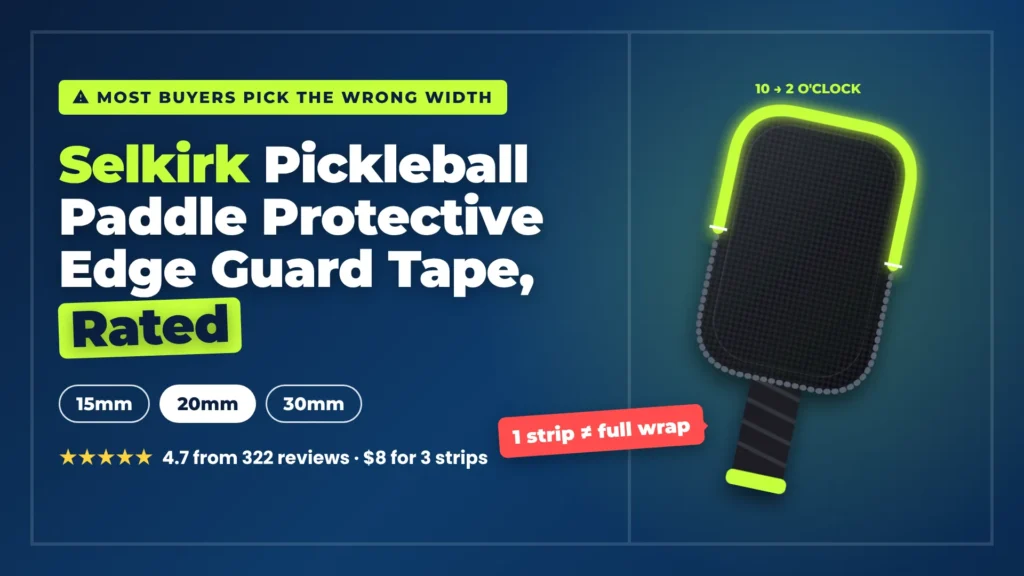
Strip length causes the most negative reviews, and almost no product page explains it. A full-size paddle head has roughly 30–33 inches of exposed edge, depending on its shape. One 13.78-inch strip covers less than half of that.
- Top-Arc Strategy (one strip): Center the strip at 12 o’clock and run it from about 10 to 2 o’clock. That arc takes most of the court contact on low digs, and covering only it keeps added weight close to zero.
- Full-Perimeter Strategy (whole pack): Butt two or three strips end to end so the tape runs down both sides to the throat. Coverage is complete, but you will have seams, and the full pack goes into one paddle.
- Hybrid Strategy: Use one strip across the top and add short pieces at 3 and 9 o’clock if you often hit hand-battle volleys off the side of the paddle.
If you care about every gram, our breakdown of paddle weight and swingweight explains why grams added at the tip affect how quickly the paddle moves in kitchen exchanges much more than grams added near the handle.
How to Apply Selkirk Edge Guard Tape Without Wrinkles
- Step 1 — Clean the Edge: Wipe the rim with a damp cloth, then let it dry completely. Dust, oils, and old residue are the most common reasons the tape lifts.
- Step 2 — Stand the Paddle Up: Rest the handle on a table so the top edge points straight up. Both of your hands stay free and the strip lines up evenly.
- Step 3 — Center at 12 O’Clock: Peel a few inches of backing, line up the middle of the strip with the top center of the rim, and check that the overlap is even on both faces before you press down.
- Step 4 — Work Outward Slowly: Press the tape down a little at a time toward each side. Give it light tension on the corners, but do not overstretch it. Straight-edged tape that is pulled too hard will wrinkle and form bubbles.
- Step 5 — Trim and Seal: Cut the ends square with small scissors, then run your thumb firmly along the whole strip to set the adhesive.
Try to get the placement right the first time. Buyers consistently report that the adhesive gets weaker after a couple of attempts to reposition a strip.
Edge Tape with Tungsten or Lead Tape: Over or Under?
For a permanent setup, put the weight tape on the rim first and cover it with edge guard tape. The guard holds the weights in place and keeps them from peeling. While you are still testing weight placement, many players stick weight strips on top of the edge guard and leave them easy to remove, then switch to the permanent setup once they have settled on a position. On the Selkirk OMNI and other paddles with external MOI weights at 3 and 9 o’clock, keep the edge tape on the top arc between those weight positions so it does not lift when you adjust them. For options and placement charts, see our guide to tungsten tape for pickleball paddles.
Is Edge Guard Tape Legal in USA Pickleball Sanctioned Play?
Yes. The USA Pickleball equipment standards specifically allow edge guard tape and lead or tungsten tape as paddle modifications. You do not need separate approval for the tape. A few limits do apply:
- The 0.5-Inch Rule: Tape may extend no more than 0.5 inch (12.7mm) inward from the outer edge of the paddle or its edge guard. Even 30mm tape on a 20mm paddle folds only about 5mm onto each face, well inside that limit.
- Overall Dimensions: The paddle with tape must still fit within the official length and combined length-plus-width limits.
- Reflectivity: Paddle surfaces cannot be highly reflective. Selkirk’s matte, rubbery finish is nowhere close to that limit.
Rules are revised from time to time, so check the current equipment standards before a big event, and confirm that the paddle itself is on the USA Pickleball approved paddle list.
Durability, Replacement, and Clean Removal
With regular recreational play, a strip usually lasts several months. Players who dig balls off rough outdoor courts every session wear through it faster. Replace the tape once the padding is scraped flat or the ends begin to lift, because a worn strip collects grit and no longer protects the rim.
- Peel Slowly at a Low Angle: Pulling the strip back along itself, rather than straight up, puts less stress on face graphics near the rim.
- Lift Leftover Adhesive with Duct Tape: Press a piece of duct tape onto any sticky patches and pull it away. Repeat until the edge is clean.
- Finish with Isopropyl Alcohol: A cloth dampened with 91% isopropyl alcohol removes the remaining film. A paddle eraser also works for stubborn spots.
- Skip Harsh Solvents: Acetone and nail polish remover can dull or remove paddle finishes and graphics.
Head-to-Head: Selkirk Edge Guard Tape vs. Sawtooth Edge Tape and DIY Wraps
Selkirk is not your only choice. Players usually compare it with two kinds of alternatives: notched “sawtooth” edge tapes from other paddle brands, and do-it-yourself wraps made from 3M electrical tape or clear hockey tape. Each one does better on some points and worse on others.
Here is how they compare on the factors that matter most:
- Corner Handling: Sawtooth tape is the clear winner here. Its notched edges spread out around curves without wrinkling, so you get a smooth result even on a first try. Selkirk’s straight-edged strips need more patience at the corners.
- Coverage per Strip: Many sawtooth tapes are sold as longer rolls that can go around the whole paddle in one piece, with no seams. Selkirk’s short strips are best for top-arc protection.
- Padding and Look: Selkirk wins on cushioning and on matching Selkirk paddles. Electrical tape and hockey tape are much thinner and add almost no padding.
- Weight Penalty: DIY wraps add the least weight, which is why some speed-focused players use clear hockey tape. Selkirk’s top-arc approach comes close if you use a single strip.
- Cost: DIY tape costs only cents per wrap. Selkirk has the lowest entry price of the branded options at $8. Sawtooth tapes usually cost more per pack but give you more length.
The verdict: Buy Selkirk tape if you own a Selkirk paddle, want padded protection where scrapes happen most, and plan to cover the top arc. Choose sawtooth tape if you want full coverage with no seams in one easy application. Use DIY tape if you care most about keeping weight down and don’t mind how it looks. To see where your paddle stands against other options, browse our independent pickleball paddle reviews.
Frequently Asked Questions (FAQ)
Can I reuse Selkirk edge guard tape after removing it?
Not reliably. The adhesive loses much of its grip once a strip has been peeled off. A reused strip tends to lift at the ends within a few sessions, so it is better to start with a fresh one.
Should I choose black or white tape?
Black hides scuffs and court dirt far better. White looks sharp on light-colored paddles but shows wear sooner. Both colors are listed for the 20mm and 30mm widths. The 15mm width comes only in black.
Will edge tape change how my paddle plays?
One top-arc strip adds so little mass that most players feel no difference. A tightly wrapped full perimeter can make the head feel a little heavier. Some players like the added stability, and others miss the quicker hand speed.
Does edge guard tape work on non-Selkirk paddles?
Yes. It fits any paddle that matches the width guidance. Measure the outer edge of your paddle, add 4–6mm for overlap, and choose the width that covers the total.
Is the Contour Protective Edge Guard Tape a different product?
Some retailers list the same $8, three-strip product under the name “Selkirk Contour Protective Edge Guard Tape.” Check the width and color on the listing and buy from an authorized seller, because some third-party marketplace listings charge well above the official price.
When should I apply the tape to a new paddle?
Apply it before your first session. Edgeless paddles can pick up their first chip on the very first low dig, and the tape grips best on a factory-clean edge.