The fastest-growing sport in America has one giant roadblock for newcomers: a 7-foot zone called “the kitchen” and a scoring system that sounds like binary code. Jumping onto the court without knowing the pickleball rules for beginners usually leads to immediate non-volley zone violations and lost points before the first real rally even begins. Master these core mechanics today, and you’ll instantly play your first doubles match with total confidence.
Pickleball Core Rules
Standard Requirement · Doubles Application · Common Beginner Fault
To start playing right away, select a dedicated facility with outdoor 40-hole acrylic courts or indoor wood surfaces, equip yourself with an approved composite paddle, and pair up with a doubles partner. Understanding the pickleball rules for beginners allows new players to enjoy immediate rally flow, minimize unforced errors, and navigate open-play rotations at any local club with ease.
Essential Blueprint: Basic Pickleball Rules for Beginners and Pickleball Serving Rules Doubles for Beginners
Stepping onto a court for the first time can feel overwhelming, but mastering the basic pickleball rules for beginners comes down to understanding three foundational pillars: proper court boundaries, serve mechanics, and scoring sequences. When playing doubles, executing compliant service techniques ensures that rallies start fairly and competitively. The official regulations set by USA Pickleball establish clear guidelines so players of all skill levels can share the court seamlessly.
Whether participating in a casual community match or entering an amateur tournament, learning pickleball serving rules doubles for beginners eliminates early confusion. Below, we break down every essential mechanical rule, rotational duty, and line designation required for confident play.
Official Court Layout and Equipment Specifications (2026 Standards)
Court Dimensions, Boundaries, and Net Height
Pickleball is played on a rectangular court measuring exactly 20 feet wide by 44 feet long for both singles and doubles play. This shared court sizing makes doubles play fast-paced while keeping physical demands balanced across partner coverage. Key court markings include:
- The Baseline: Located 22 feet from the net at each end of the court. Serves must be executed from behind this boundary line.
- The Sidelines: Marking the 20-foot width of the playing area.
- The Non-Volley Zone Line: Marked 7 feet back from the net on both sides, running parallel across the entire court width.
- The Centerline: Divides the court from the Non-Volley Zone line to the baseline, creating two equal service courts measuring 10 by 15 feet each.
The mesh net spans across the center of the court. Officially, the net height must measure 36 inches at the sidelines and drape slightly to 34 inches at the center point. Review complete structural details in our guide on pickleball court dimensions.
Approved Equipment: Paddles and Ball Variations
Players use solid-surface paddles constructed from composite materials, wood, or graphite. Official tournament paddles must conform to strict dimensional limits regarding length and width. Additionally, selecting the correct ball is essential for performance, as ball properties vary based on court environment:
- Indoor Pickleballs: Feature 26 larger drilled holes, softer plastic composition, and lighter weight for consistent bounce on smooth wood or composite floors.
- Outdoor Pickleballs: Feature 40 smaller precision-drilled holes, harder plastic shells, and heavier weight to withstand outdoor wind resistance and abrasive asphalt surfaces.
Learn more about selecting equipment in our complete comparison of indoor and outdoor pickleballs.
Complete Breakdown of Pickleball Serving Rules Doubles for Beginners
Volley Serve vs. Drop Serve Execution Rules
In official play, players may choose between two distinct serving styles: the Volley Serve or the Drop Serve. Both methods must meet distinct criteria under USA Pickleball regulations:
- Volley Serve Requirements: The server strikes the ball directly out of the air without allowing it to hit the ground first. Three mandatory conditions must be met:
- The arm motion must move in an upward arc at the moment of contact.
- Contact with the ball must take place below waist level (defined as the navel).
- The highest point of the paddle head must not reside above the highest part of the wrist joint upon impact.
- Drop Serve Requirements: The server drops the ball from hand or paddle and allows it to bounce once on the court surface before striking it. When executing a drop serve:
- The server is exempt from waist height, upward arc, and wrist position restrictions.
- The ball must drop purely under the force of gravity; throwing, tossing, or pushing the ball downward is illegal.
To explore mechanics in greater detail, consult our dedicated guide on pickleball serving rules.
Baseline Foot Placement and Pre-Spin Restrictions
When executing a serve in doubles play, proper foot positioning prevents costly foot faults. At the moment of paddle contact:
- At least one foot must remain grounded behind the baseline.
- Neither foot may touch the court inside the baseline or cross the imaginary extensions of the sideline or centerline.
Furthermore, rule updates explicitly ban finger-spun serves (often referred to as “chainsaw” serves). Players cannot manipulate the ball with fingers or paddle surfaces prior to release to impart artificial spin. Any spin applied to the serve must originate entirely from paddle impact.
Doubles Scoring Code and Server Rotation Mechanics
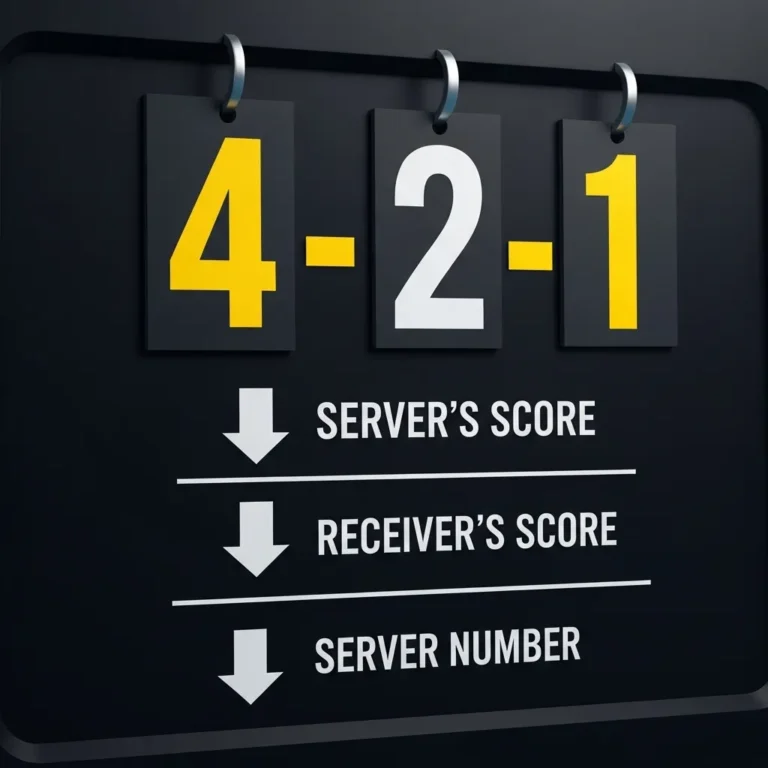
Understanding pickleball rules doubles for beginners requires mastering the three-number score callout format: (Serving Team Score – Receiving Team Score – Server Number).
For example, a score called out as 5 - 3 - 1 indicates that the serving team has 5 points, the receiving team has 3 points, and the current server is Server 1. Key operational rules in doubles include:
- Points can only be scored by the serving team.
- The player standing in the right-hand (even) service court always serves first for their team upon gaining a side-out.
- If the serving team scores a point, partners swap left and right positions, and the same server serves diagonally from the left court.
- When Server 1 loses a rally, service passes to Server 2 without swapping court positions. When Server 2 loses a rally, a side-out is declared, and service transfers to the opposing team.
- The Initial Game Start Exception (0-0-2): To balance the advantage of serving first, the team starting the game receives only one server rotation. The game begins with the score call
0 - 0 - 2, meaning if the first server loses the point, service immediately turns over to the opponents.
Deepen your understanding of score keeping with our comprehensive breakdown of the pickleball scoring system.
Head-to-Head Comparison: Volley Serve vs. Drop Serve Execution
Choosing between service styles depends on player preference, consistency, and tactical application. The comparison table below highlights key functional differences between the traditional Volley Serve and the Drop Serve option:
Pickleball Serve Types
Volley Serve vs Drop Serve — Rules & Requirements
Mastering the Non-Volley Zone (“The Kitchen”)
The 7-Foot Rule and Line Boundaries
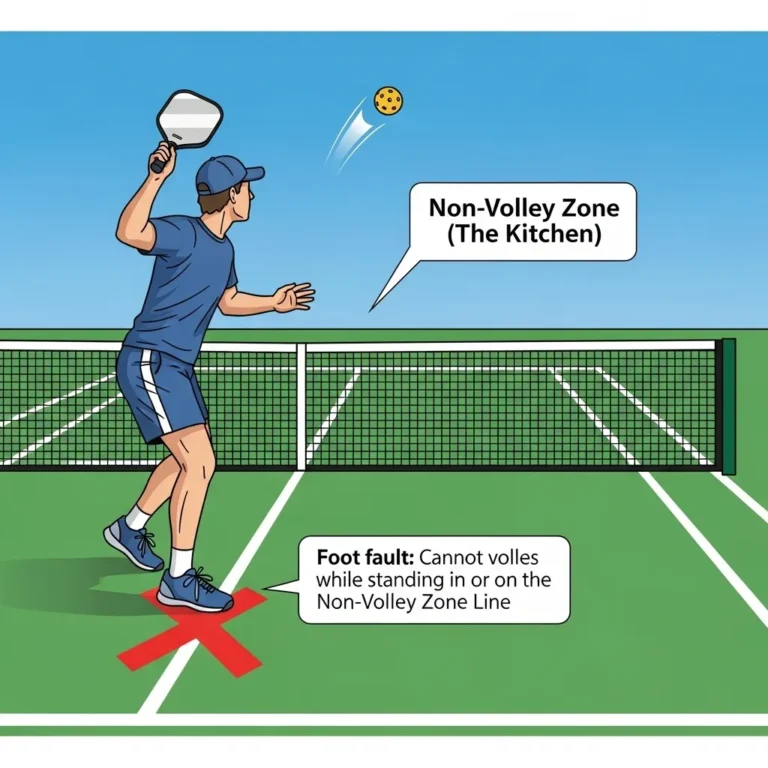
The Non-Volley Zone (NVZ), universally known as “the kitchen,” is a 7-foot section extending from the net on both sides. Designed to eliminate aggressive net-smashing, the kitchen restricts how airborne balls can be struck near the net. Learn official guidelines directly at the Official USA Pickleball Website.
Crucially, the 2-inch wide kitchen line is considered part of the kitchen itself. If a player touches the kitchen line during or immediately following a volley, a fault is committed. For complete tactical tips, visit our resource on pickleball kitchen rules.
Momentum Fault Scenarios and Legal Kitchen Entry
Understanding kitchen restrictions requires distinguishing between legal groundstrokes and momentum faults:
- Legal Kitchen Entry: Players may step into or stand inside the kitchen at any time, provided they are not hitting an airborne volley. If the ball bounces inside the kitchen first, a player may step inside to strike a groundstroke (dink) legally.
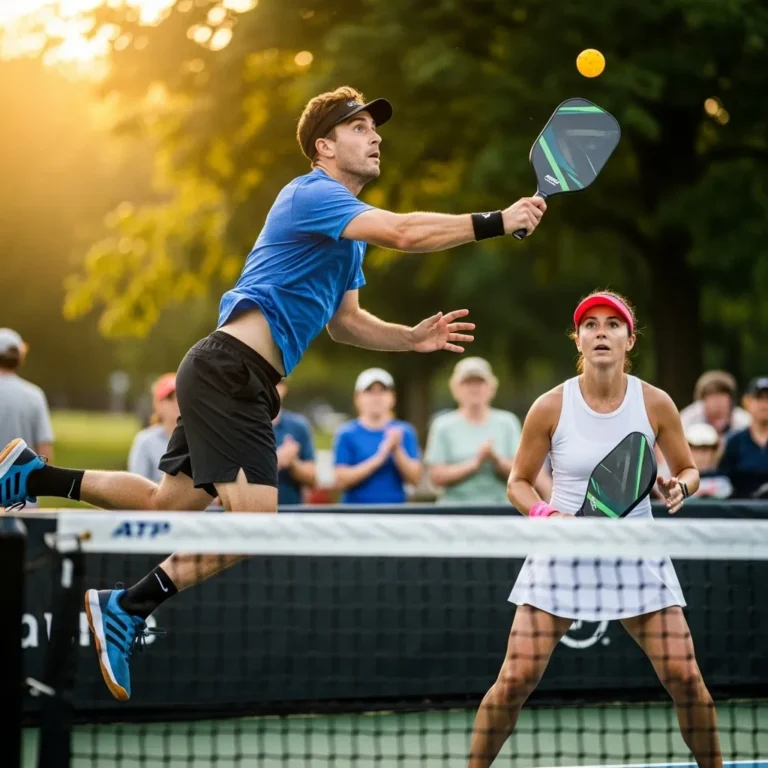
- Momentum Faults: If a player strikes a volley while standing outside the kitchen, but their forward momentum causes them—or any piece of their equipment, clothing, hat, or paddle—to touch the kitchen line or inside the kitchen zone, a fault occurs.
- Dead-Ball Momentum Rule: Even if the hit ball lands out of bounds or hits the ground before the player steps on the kitchen line, a momentum fault is still called if the step was part of the volley motion.
Game Flow: Two-Bounce Rule, Line Calls, and Modern Rule Updates
Executing the Two-Bounce Rule Sequence
The Two-Bounce Rule governs the start of every rally in pickleball:
- Upon serve, the receiving team must allow the ball to bounce once before striking their return.
- Upon return of serve, the serving team must also allow the incoming ball to bounce once before striking their shot.
After these two initial bounces have occurred (one bounce on each side of the net), both teams may choose to volley shots out of the air or play groundstrokes after a bounce. This rule prevents serving teams from rushing the net immediately, establishing a balanced tactical exchange. Master early rally positioning using our 3rd shot pickleball strategy guide, and gear up properly by selecting the best beginner pickleball paddles.
Line Call Standards and Competitor Rule Gaps
Navigating line calls accurately prevents common mid-game disputes. While standard line rules state that balls touching any boundary line are “in,” critical exceptions exist:
- Standard Rally Line Rule: During general rally play, if any part of the ball contacts the outer edge of a sideline or baseline, the ball is good (in-bounds).
- The Kitchen Line Exception on Serves: During a serve, the kitchen line is considered “out.” If a served ball contacts the kitchen line or falls inside the kitchen, a short serve fault is declared immediately.
- Elimination of the “Let Serve”: Historical rules allowed serve replays if the ball clipped the net cord and landed in the correct service court. Under current standards, net-touch serves that pass over the net and land beyond the kitchen line remain live and must be played by the receiver.
- Continuous Motion Double Hits: If a player accidentally strikes the ball twice in a single, continuous forward stroke motion, the shot is completely legal.
- Paddle-Hand Contact: Contact made with the player’s paddle hand below the wrist joint is legally treated as an extension of the paddle face, keeping the ball in play.
Summary of Common Misconceptions and On-Court Etiquette
Key Differences Between Pickleball and Tennis Rules
Beginners transitioning from racquet sports frequently carry over assumptions that do not apply in pickleball. Check our detailed guide on pickleball vs tennis to clarify main structural differences:
- Pickleball courts use a universal boundary size for both singles and doubles, whereas tennis expands sidelines for doubles play.
- Pickleball uses an underhand serving motion exclusively, whereas tennis emphasizes overhand service power.
- Pickleball features the Non-Volley Zone to encourage tactical dinking, whereas tennis permits net volleys anywhere inside court boundaries.
Fair Play Etiquette and Call Announcement Rules
Maintaining positive sportsmanship keeps recreational games running smoothly:
- Always announce the full three-number score audibly before striking the serve so opponents have time to prepare.
- Make line calls promptly and clearly on your side of the net. If a line call is uncertain, grant the benefit of the doubt to your opponents.
- Return stray balls to neighboring courts by waiting for their rally to finish, then tossing the ball back gently.
Frequently Asked Questions
What happens if the serve hits the net and lands in the service box?
Under official USA Pickleball rules, there are no “let” serves. If the server’s ball clips the top of the net and lands cleanly inside the correct crosscourt service court (past the non-volley zone line), the ball remains live and the receiver must play it.
Can you step into the kitchen if the ball does not bounce?
No. Stepping into the non-volley zone or touching the kitchen line while striking an airborne ball (a volley) is an immediate fault, regardless of where your paddle makes contact.
How does scoring work in doubles pickleball for beginners?
In doubles, scores are announced using three numbers: Server Score, Receiver Score, and Server Number (1 or 2). Points can only be scored by the serving team, and matches are typically played to 11 points, winning by 2.
Is a ball hitting the line considered in or out in pickleball?
During standard play, any ball that touches any part of an outer boundary line is considered in. However, during the serve, touching the non-volley zone (kitchen) line makes the serve out (short serve fault).
Why does the first serving team start with score 0-0-2?
The initial 0-0-2 starting rule balances the advantage of serving first by giving the opening team only one serve turn before turning the ball over (a side-out) to the opposing team.