Your $200 carbon fiber paddle shouldn’t be rattling around your backseat like loose change. High-intensity play demands gear that stays crisp, and throwing your equipment into a generic gym bag is the fastest way to ruin a surface texture designed for championship spin. A dedicated pickleball paddle bag is more than just a carrier; it is the insurance policy your gear deserves and the organizational edge you need before stepping onto the court for a high-stakes tournament.
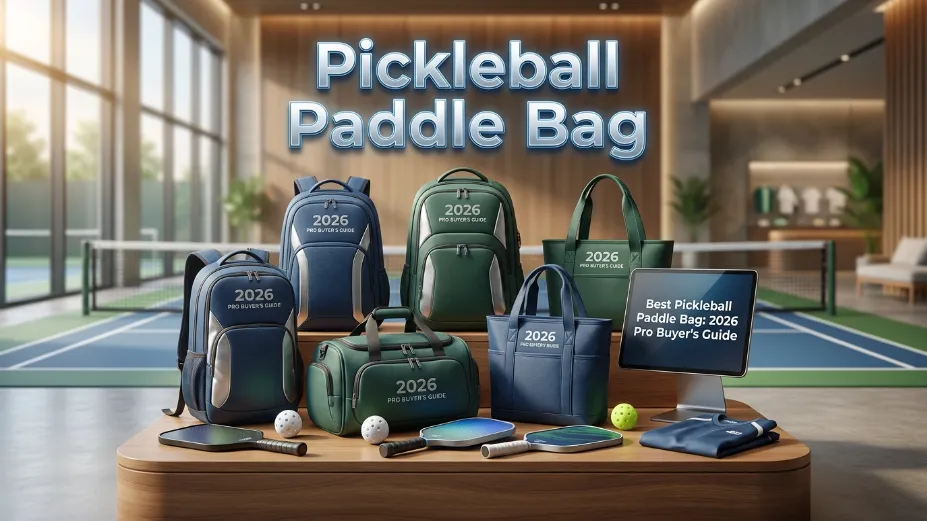
Best pickleball bags 2026: brand and model, paddle capacity, key feature, ball carrier, price in USD, and best for comparison
Best Pickleball Bags — 2026 Comparison
Capacity · Key Feature · Ball Carrier · Price (USD)
I. Categorizing Architectures: Finding Your Fit
The market for pickleball paddle bags has matured into three distinct tiers. Understanding which one fits your weekly routine is the first step toward organizational zen.
- Sling Bags: These are the “grab-and-go” champions. Typically holding ~12L, they are ideal for local open-play sessions where you only need two paddles and a handful of balls.
- Pickleball Backpacks: The pickleball backpack has become the universal choice for the average club player, offering a 20L–35L capacity that balances weight distribution with specialized pockets for shoes and electronics.
- Tour Duffels: For those hauling 6+ paddles, multiple pairs of best pickleball shoes for men, and full changes of clothes, these 45L+ monsters are essential for tournament logistics.
II. Material Science: Decoding Durability
When shopping for pickleball paddles bags, the term “Denier” (D) is your best friend. A 600D polyester is the industry baseline, but elite options like the ADV Backpack V2 utilize 1000D Cordura for the bottom panel to resist the abrasive court surfaces common in public parks across the US. This ensures your bag doesn’t develop “pavement rash” after a single season.
Equally critical is the zipper standard. Cheap bags use generic nylon coils that corrode from sweat and humidity. Premium pickleball paddle bag & ball carrier systems now standardize on YKK zippers. The FORWRD Court Caddy takes this further with AquaGuard technology, providing a water-resistant barrier that keeps your carbon fiber pickleball paddle safe from unexpected rain or morning dew.
III. Thermodynamics: The Silent Killer of Paddles
A major information gap in the community is the “Hot Car Effect.” In states like Florida, Arizona, or Texas, interior car temperatures can skyrocket, leading to paddle delamination—where the surface adhesive fails and creates dead spots. This is why a thermal-lined compartment is non-negotiable for serious players. Brands like JOOLA and CRBN use silver EVA sheeting to regulate temperatures, effectively acting as an “esky” for your expensive gear.
IV. Head-to-Head: JOOLA Tour Elite vs. FORWRD Court Caddy
This is the most frequent comparison requested by competitive players. Both are high-end, but they serve different philosophies.
- The JOOLA Approach: The joola pickleball bag is built for the tournament venue. It features a heavy-duty fence hook that allows the bag to hang vertically. However, players have noted that the strap durability can be a concern over 12+ months of heavy use.
- The FORWRD Approach: This bag ditches the fence hook in favor of YKK AquaGuard zippers and a modular paddle sleeve. It is a “Buy Once, Cry Once” product backed by a lifetime warranty, targeting the player who wants military-grade materials that will never need replacing.
V. Addressing the Functional Gaps: What Competitors Miss
Most pickleball paddle bags are just rebranded tennis bags. We’ve identified three “gaps” that actually matter to US players:
- The Hydration Gap: Most side pockets are designed for 16oz plastic bottles. Players actually use 32oz or 40oz Yeti or Hydro Flask containers. The FORWRD and ADV designs have finally expanded their elastic mesh to accommodate these larger American hydration standards.
- The Elongated Fit: With the rise of 16.5″ paddles like the joola ben johns perseus pro iv pickleball paddle, many older bag designs are too short, causing the handle to poke out and prevent the zipper from sealing.
- The Shoe Tunnel Reality: A shoe compartment is only useful if it’s ventilated. Sealed shoe pockets trap bacteria and odor. Look for bags with mesh grommets or “Grip” technology that allows the shoes to breathe after a sweaty 3-hour session.
Pickleball Paddle Bag – FAQ
Do I need a separate paddle cover if my bag is padded?
While a padded compartment is the primary defense, a neoprene cover prevents “zipper scratch” and provides a second layer of thermal insulation. For high-end $250+ paddles, using both is highly recommended.
Will a tennis bag work for pickleball?
Yes, but with trade-offs. Tennis bags are often too long (designed for 27″ rackets), causing pickleball paddles to “slosh” around. A dedicated pickleball bag provides a snugger fit and better internal organization for smaller items like balls and erasers.
What is the average lifespan of a budget bag?
Bags under $50 typically use lower-denier fabrics and non-branded zippers. For a 3x/week player, these usually see seam failure or zipper jams within 6–8 months. Investing in a mid-tier bag often saves money over a 2-year window.
How do I clean my pickleball bag?
Most 1000D Cordura or polyester bags are machine washable on a gentle cycle, but air drying is mandatory. For PU leather or “vegan leather” options like those from CRBN, a simple damp cloth with mild soap is best to maintain the water-resistant coating.
For more information on professional standards, visit USA Pickleball to ensure your gear meets current tournament regulations.