Pickleball Grips
Get a Grip: The Ultimate Guide to Perfecting Your Connection to the Paddle
You know that feeling when you first step onto the court? The sun is shining, your shoes are tied tight, and you’re ready to dink your way to victory. You’ve probably spent hours researching the top pickleball paddles. You’ve looked at the core thickness, the face material, and the swing weight. But there is one crucial element that often gets treated like an afterthought, and ironically, it’s the only part of the equipment you actually touch: your pickleball grips.
Think of your grip like the tires on a race car. You can have the most powerful engine in the world (that’s your arm and paddle face), but if your tires are bald or the wrong size, you aren’t staying on the track. The connection between your hand and the paddle dictates everything—your control, your power, and even your physical health.
I remember when I first started playing. I grabbed a paddle off the shelf, didn’t think twice about the handle, and spent three weeks wondering why my volleys were twisting in my hand. It wasn’t my form; it was my equipment. Whether you are a banger from the baseline or a surgeon at the kitchen line, understanding the nuances of pickleball paddle grips can instantly elevate your game.
It isn’t just about comfort, either. If you are looking for practical pickleball tips to master specific shots, like the backhand dink or an overhead smash, you might be transitioning into a continental grip pickleball players swear by for versatility. If your handle is slippery or the wrong size, finding those bevels without looking becomes nearly impossible.
In this guide, we are going to dive deep—really deep—into the world of the pickleball paddle grip. We’ll cover everything from the science of sizing to the art of wrapping, all while keeping things legal for tournament play. So, grab your paddle (and maybe a tape measure), and let’s get into it.
Sizing & Fit: Finding Your Perfect Match
Finding the right grip size is arguably the most critical step in setting up your gear. It’s a bit of a Goldilocks scenario: if it’s too big, you’re clumsy; if it’s too small, you’re straining. These questions address the most immediate hurdle for players: comfort and injury prevention.
How do I accurately measure my grip size without a ruler?
We don’t always have a flexible measuring tape handy when we’re browsing the pro shop or borrowing a friend’s paddle. Luckily, there are two distinct ways to check your fit, and one of them requires nothing more than your own hand.
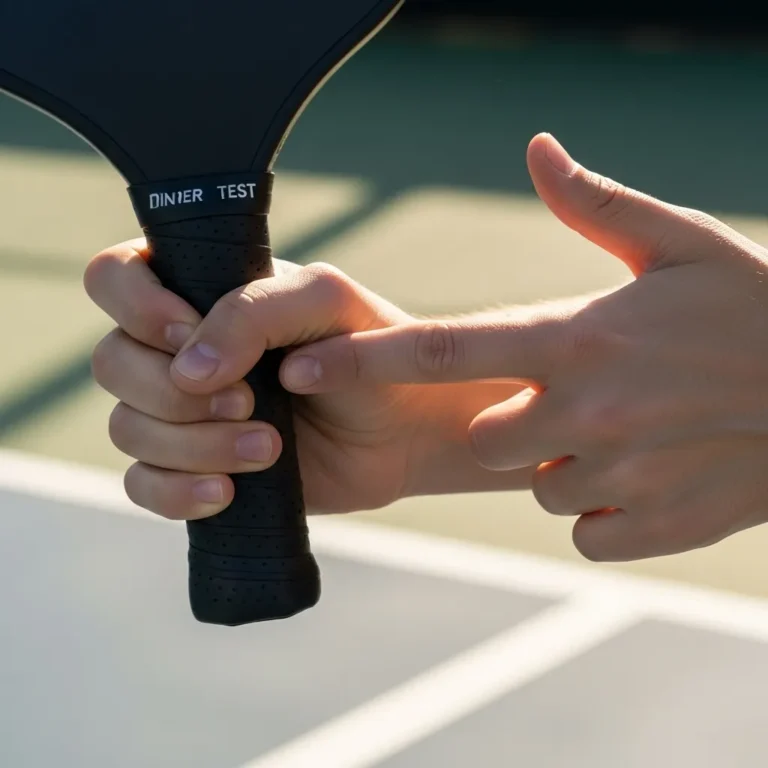
First, let’s talk about the “Finger Test.” This is the classic method used in racquet sports for decades. Hold the paddle using a standard handshake grip (like a continental grip pickleball hold, where the paddle face is perpendicular to the ground). Squeeze the handle gently, just enough to hold it firm. Now, look at the space between the tips of your fingers and the heel of your palm.
Ideally, you want to be able to fit the index finger of your other hand into that gap. It should fit snugly—not too loose, and not so tight that you have to force it. If there is a massive gap where you could fit two fingers, that grip is likely too large for you. If your fingers are touching your palm, it’s definitely too small.
The second method is the “Ruler Test,” which is more precise if you are buying online. Open your dominant hand flat, with your fingers extended and close together. Take a ruler and align the “0” mark with the second horizontal crease in your palm (the one roughly in the middle of your palm). Measure up to the tip of your ring finger. That measurement—usually between 4 inches and 4 5/8 inches—is your ideal grip circumference.
What are the signs that my paddle grip is too large or too small?
Your body is pretty good at telling you when something is wrong, but you have to know how to interpret the signals. The symptoms of a wrong fit can be subtle at first, but they wreak havoc on your game over time.
If your pickleball grip is too large, you’ll likely notice that you have trouble snapping your wrist. A large handle restricts the natural range of motion. More noticeably, you might find the paddle twisting in your hand on off-center hits. Because your fingers can’t wrap all the way around to lock the handle against your palm, the paddle lacks stability. If you feel like you’re constantly readjusting your hold after every hard volley, your grip is probably too bulky.
On the flip side, a grip that is too small causes a different set of problems. The most common sign is excessive forearm fatigue. Because the handle is tiny, your hand has to squeeze significantly harder just to keep the paddle from flying loose. This “death grip” tires out your muscles quickly. You might also notice that the paddle face flutters when you block a hard drive because there isn’t enough surface area contact with your palm to absorb the energy.
Can a wrong grip size actually cause “Pickleball Elbow”?
While I’m not a doctor and can’t give medical advice, there is a widely recognized relationship in the sports world between equipment fit and tendon strain. This is commonly referred to as “Pickleball Elbow.”
Think about the mechanics involved. If your grip is too small, you are engaging the muscles in your forearm constantly, never letting them relax even between shots. This constant state of contraction, combined with the vibration of the ball hitting the paddle, transmits shock directly up the arm to the elbow tendon.
Conversely, if the grip is too large, the muscles responsible for extending your wrist have to work overtime to stabilize that heavy, wide object in your hand. The strain usually comes from the repetitive nature of the sport. It’s rarely one bad shot that hurts you; it’s the thousands of micro-traumas caused by fighting against your own equipment. Ensuring your pickleball paddle grips are the correct circumference allows your arm muscles to work efficiently, rather than straining to compensate for a poor fit.
Recommended Reading
Top Pickleball Gifts 2025:From Stocking Stuffers to Pro Gear
Looking for unique pickleball gifts? We break down practical gear, funny apparel, and budget-friendly ideas to help you surprise the player in your life.
Should I size down if I plan to use overgrips?
This is a pro-level strategy that more recreational players should adopt. An overgrip (that thin, replaceable layer of tape) adds thickness to your handle—usually about 1/16th of an inch, or roughly one size up.
If you measure as a standard 4 1/4″ grip size, and you buy a paddle that is exactly 4 1/4″, adding an overgrip will bump you up to roughly 4 5/16″ or even 4 3/8″, which might suddenly feel too bulky.
Therefore, if you know you love the feel of fresh overgrips (and you should, they are amazing for hygiene and tackiness), it is often smart to buy a paddle with a handle one size smaller than your measurement. If you measure a 4 1/4″, buy a 4 1/8″. This gives you a blank canvas. You can build it up with your favorite overgrip to hit that perfect custom fit. It is always easier to make a small handle bigger than it is to make a big handle smaller (which usually requires sanding down the actual paddle material—scary stuff!).
Types of Grips: Tacky, Dry, & Ergonomic
Once you have the size figured out, you enter the world of texture and materials. This is where personal preference really shines. The market is flooded with options, but they generally fall into a few specific categories. This section focuses on material differences and new “hexagonal” trends that major guides often gloss over.
What is the functional difference between a Replacement Grip and an Overgrip?
This is a common point of confusion for beginners. A Replacement Grip is the thick, cushioned grip that comes on the paddle when you buy it. It has an adhesive backing that sticks directly to the paddle handle (the raw honeycomb or wood). It provides the primary cushioning and determines the base shape of the handle.
An Overgrip, on the other hand, is much thinner, cheaper, and does not usually have a full adhesive backing (just a sticky start and finishing tape). It is designed to be wrapped over the replacement grip.
The functional difference is longevity and feel. You generally strip your paddle down to the bare handle and install a new replacement grip only when the cushion has collapsed or the base is gross—maybe once or twice a year. Overgrips are disposable. You might change them every few weeks. They protect the expensive replacement grip underneath and provide the specific surface texture (tacky or dry) that you want.
Tacky vs. Dry (Absorbent) Overgrips: Which is right for my climate?
Choosing between tacky and dry grips is entirely dependent on your environment and your physiology.
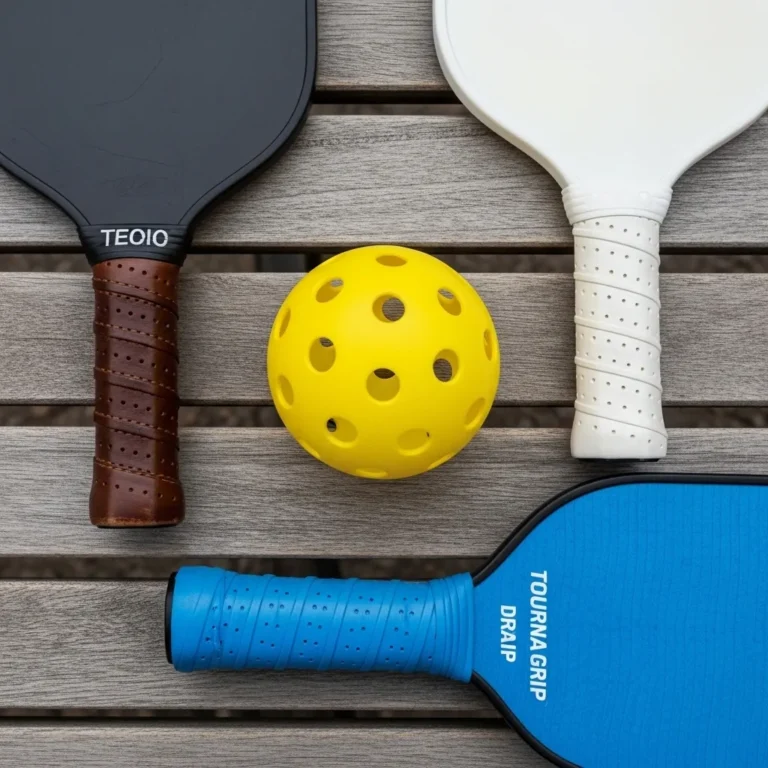
Tacky Grips (like the Wilson Pro or Yonex Super Grap) feel sticky to the touch. When you grab them, they almost grab you back. These are fantastic for cooler climates, indoor play with air conditioning, or players who have very dry hands. They provide immense confidence because the paddle feels glued to your hand. However, if you sweat heavily, moisture can sit on top of a tacky grip, turning that stickiness into a slippery mess, almost like a bar of wet soap.
Dry (Absorbent) Grips (like the famous blue Tourna Grip) have a dry, almost papery or velvety feel. They don’t feel sticky when dry. In fact, they might feel a little slick at first. But their magic happens when you sweat. They are designed to absorb moisture instantly. The more you sweat, the grippier they get. If you are playing in the humid heat of Florida or you are someone whose hands get clammy just looking at a court, dry grips are non-negotiable.
Are hexagonal (ergonomic) grips like Hesacore actually worth it?
You may have seen these odd-looking, honeycomb-patterned silicone sleeves that go under your grip tape. Brands like Hesacore have migrated from Padel to Pickleball, and they are creating quite a buzz. But are they a gimmick?
For many players, they are absolutely worth it. A standard paddle handle is an octagon. A hexagonal or ergonomic under-grip replaces that standard shape with a series of ridges and valleys (hexagons). When you wrap your overgrip on top of this, it creates little indentations for your fingers to settle into.
The benefit is twofold. First, it acts as a guide for finger placement. If you are trying to find that continental grip pickleball players need for dinking, the ridges help your knuckles lock into the correct bevels naturally. Second, and perhaps more importantly, the silicone material dampens vibration. Because the surface is uneven, you get more friction with less squeezing force. This means you can hold the paddle looser (better for soft hands/dinking) without dropping it.
For a complete, detailed guide on this grip, read our dedicated article on: Continental Grip Pickleball
Do leather grips offer any performance advantage in pickleball?
Leather is the “old school” choice, originating from tennis. You won’t find many stock pickleball paddles with leather, but you can buy leather replacement grips.
The primary advantage of leather is “feel.” Leather is firm. It doesn’t compress much. This means when the ball hits the paddle, the feedback is transmitted very clearly to your hand. It also makes the bevels of the handle (the sharp edges of the octagon) feel very distinct. If you are a high-level player who changes grips constantly mid-point, leather helps you feel exactly where the paddle face is pointing.
The trade-off is comfort. Leather is unforgiving and heavy. It doesn’t absorb vibration well, so if you have arm issues, avoid it. It is also terrible with moisture; when leather gets wet, it gets slick. You almost always have to use an overgrip on top of leather.
Customization & Wrapping Techniques
Now we get to the fun part: making the paddle truly yours. Wrapping a grip is a ritual for many players. It’s a moment of zen before the chaos of the tournament. Detailed “How-to” questions here go beyond the basics, including lefty-specifics.
How does adding an overgrip affect my paddle’s weight and balance?
We tend to obsess over paddle weight, but we rarely talk about balance. A standard overgrip weighs between 5 and 8 grams. That might not sound like much, roughly the weight of two pennies, but where that weight goes matters.
Because you are adding this weight to the very bottom of the paddle (the handle), you are shifting the balance point toward your hand. This makes the paddle “head-light.” A head-light paddle feels faster at the net; it’s easier to maneuver during quick volley battles.
However, if you loved the power of your paddle before, making it head-light might slightly reduce the “plow through” on your drives. If you add a thick overgrip (or two!) and find your drives lack pop, you might need to add a small strip of lead tape to the top or throat of the paddle to restore the original balance.
Is there a specific way to wrap a grip for left-handed players?
Yes! And this is something 90% of lefties don’t know because the world is built for right-handers. Standard grips are wrapped clockwise (looking from the bottom cap up). This follows the natural tightening motion of a right-handed player’s fingers.
If a lefty uses a standard wrapped grip, the friction of their hand during a forehand drive actually works against the spiral of the tape. Over time, this forces the grip to loosen, unravel, or bunch up, creating uncomfortable ridges.
If you are a lefty, you should strip the grip and re-wrap it counter-clockwise. This ensures that when you squeeze and twist during a shot, you are tightening the wrap rather than unraveling it. It’s a small detail, but it makes the grip last longer and feel much more secure.
How much overlap should I use when wrapping to adjust thickness?
When you apply an overgrip, you spiral it up the handle. The amount you overlap the previous layer dictates the final feel.
A standard overlap is about 1/8th of an inch. This creates a relatively smooth surface where you can barely feel the ridges between layers. However, if you want your handle slightly thicker or you want more “finger grooves,” you can increase the overlap to 1/2 inch.
By overlapping significantly (almost covering half the previous width on every turn), you create a ribbed effect. This acts almost like the Hesacore we mentioned earlier, giving your fingers ridges to grip onto. It also adds more cushioning because you essentially have a double layer of foam across the whole handle. The downside? You will run out of grip tape before you reach the top of the handle, so you need to buy extra-long XL overgrips if you plan to use a heavy overlap.
Can I use two overgrips (double-wrapping) instead of one?
You absolutely can, and many players with large hands do this. It’s a cheap way to increase grip size without buying a new paddle.
The Pros: It’s super cushioned. It absorbs a ton of sweat. It fits big hands well.
The Cons: We call this the “marshmallow effect.” As you add layers, you round off the sharp edges of the handle’s octagon shape. The handle becomes a circle.
Why does this matter? If your handle is perfectly round, it is very difficult to feel if your paddle face is open, closed, or neutral without looking at it. In the heat of a fast exchange, you rely on feeling those bevels to know your paddle angle. If you double-wrap, try to pull the tape tight to preserve as much definition as possible.
Maintenance & Longevity
Pickleball is cheaper than golf, but costs add up. Extending the life of your gear is just smart economics. These practical questions are about saving money and maintaining peak performance.
How often should I replace my overgrip based on play hours?
There is no “check engine” light on a paddle, but a general rule of thumb for moderate players is every 10 to 15 hours of play. If you play three times a week for two hours a session, that’s roughly every two to three weeks.
However, don’t just rely on the clock. Look for visual signs. If the grip is shredding or flaking, it’s past due. If you see dark spots where your thumb sits, that is accumulated dirt and oil that kills the tackiness. The most telling sign, though, is performance. If you find yourself squeezing the paddle harder than usual to keep it stable, the grip has lost its friction. Change it immediately. A $2 piece of tape is cheaper than the physical therapy for the tendonitis caused by over-squeezing.
Why does my grip get slippery even when it’s new?
It is incredibly frustrating to put on a fresh pickleball grip and have it fly out of your hand ten minutes later. This usually happens for two reasons.
First, the “invisible film.” Some cheaper grips have a manufacturing residue on them.
Second, and more likely, it’s you. Oils from your skin, sunscreen, and lotions are kryptonite to grip tape. If you applied sunscreen to your face and then grabbed your handle, you have effectively greased it. Even natural skin oils can build up quickly.
Always wash your hands with soap and water before you play. If you apply sunscreen, use the back of your hands or scrub your palms afterward. Using a wristband also helps; it stops sweat from your arm dripping down onto the hand, which is often the main culprit for a slippery grip.
What is the best way to clean a tacky grip to extend its life?
You can revive a tacky grip a few times before it needs the trash can. The best method is surprisingly simple: a clean, damp cloth.
Just wet a towel with water (no soap) and give the grip a firm wipe down. This removes the surface layer of dust, salt from sweat, and skin oils. Let it air dry for a few minutes, and you will be surprised at how much “tack” returns.
What to avoid: Do not use rubbing alcohol, Windex, or harsh solvents. While these clean well, they strip the chemical coating that provides the tackiness and dry out the material, making it brittle and slick. Stick to water.
Rules & Regulations (USAPA)
We all want to have fun, but nobody wants to be that player who gets disqualified in a tournament for an illegal paddle. The USAPA (USA Pickleball) has specific rules regarding equipment.
Are there USAPA restrictions on grip color or logo size?
Generally, the USAPA is pretty lenient about what goes on the handle compared to the face of the paddle, but there is one major rule to watch out for: Color distraction.
You cannot have a paddle or grip that obscures the ball. If you are playing with the standard yellow dura-fast ball, wrapping your handle in neon yellow tape could theoretically be challenged by a referee or opponent if they claim it makes it hard to see the ball against your hand. While this is rare for grips (since your hand covers most of it), it’s safer to stick to contrasting colors like white, black, or blue.
Regarding logos, unlike the paddle face which has strict rules about graphics, the grip tape branding is generally exempt, provided it doesn’t have reflective or distracting elements.
Is it legal to alter the handle shape with inserts or foam?
Yes, you are generally allowed to customize the handle to fit your hand. USAPA rules allow for “replacing the hand grip with a tape or other material.” This implies you can build it up.
You can use foam strips to create ridges. You can use a heat-shrink sleeve to increase the size. You can sand down the handle (if it’s wood/pallets) to make it smaller. As long as the paddle remains commercially manufactured and you aren’t altering the playing surface (the face) or exceeding the maximum size dimensions of the paddle (length + width), handle customization is fair game. This is great news for players who need ergonomic adjustments for arthritis or grip strength issues.
Final Thoughts
At the end of the day, your pickleball grip is a personal choice. Some players like it thick and cushioned; others like it thin and raw. Some change it every match; others wait until it’s hanging off by a thread (please don’t be that person!).
The important thing is to realize that you aren’t stuck with what came out of the box. Experiment with different textures. Try a pickleball paddle grip that is slightly smaller or larger than what you’re used to. Wrap it differently.
When you find that perfect combination of size, material, and wrap style, you won’t just feel it in your hand—you’ll see it in your game. Your soft game will get softer, your drives will get more consistent, and you’ll walk off the court with a little less fatigue in your arm. So go ahead, get a grip, and play your best game yet.
you may like it