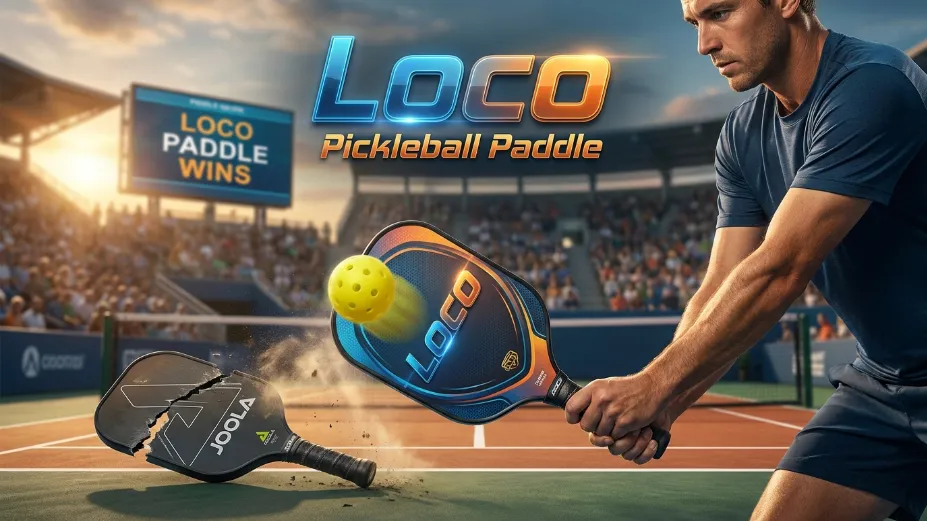
The pickleball court is already flooded with generic raw carbon fiber paddles that feel exactly the same. But when Bread & Butter dropped a full-foam, dual-density thermoformed beast, the competitive meta shifted instantly. If you want to inject pure, unapologetic firepower into your hand battles without constantly spraying volleys past the baseline, the loco pickleball paddle might just be the chaotic upgrade your gear bag demands.
Let’s look past the viral hype and break down how its unique EPP and EVA foam core alters swing mechanics, spin RPMs, and sweet-spot forgiveness.
Pickleball Paddle — Shape Variant Comparison
Dimensions · Core · Swing Weight · Twist Weight · Static Weight
If you are looking to maximize hand speed and defense at the kitchen line without sacrificing offensive pop, the Standard (Widebody) variant is your absolute best option. For players seeking an all-court balance of aggressive drives and stable resets, the Hybrid shape offers the ideal compromise, while the Elongated shape remains a specialized tool for pure baseline power hitters. No matter which shape you select, the loco pickleball paddle delivers elite, tournament-ready performance straight out of the box.
1. The Gen 4 Paradigm Shift in Paddle Engineering
For years, the pickleball equipment market relied on standard copolymer polypropylene honeycomb cores. While these Gen 1 to Gen 3 designs provided a decent balance of lightweight playability, they were plagued by a critical structural vulnerability: core crushing and disbonding. Under repeated heavy impacts, the thin hexagonal cell walls of polypropylene cores collapse, leading to dead spots, erratic response, and a drastic loss of power. The introduction of Gen 4 pickleball paddles fundamentally redefines durability and energy transfer by replacing the hollow honeycomb structure with high-density, full-foam cores.
The bread and butter loco pickleball paddle line stands at the absolute vanguard of this technological evolution. By utilizing a solid, thermoformed foam core, Bread & Butter has eliminated the cellular fatigue associated with honeycomb designs. Instead of air-filled chambers that compress and buckle under stress, the solid core acts as an integrated, uniform energy return system. This structural shift ensures that the paddle performs identically on day one hundred as it did on day one, offering competitive players the mechanical reliability they need during high-stakes tournament play.
This commitment to structural longevity and innovation reached a major industry milestone on May 12, 2026, when Selkirk Sport officially acquired the Bread & Butter Pickleball Company. Backed by financial backing from Bluestone Equity Partners, this acquisition scales Bread & Butter’s operational capabilities, shifting shipping logistics to Selkirk’s massive Idaho distribution center and resolving historical inventory shortages. Crucially, the acquisition upgrades the brand’s customer service, transitioning the previous 6-month limited warranty to a robust, extended 1-year warranty platform while maintaining the Sapusek family at the helm of design and creative branding.
2. Core Architecture and Material Science: Deconstructing the CFC Layup
To understand the unique performance profile of the bnb loco pickleball paddle, one must look closely at its dual-density core architecture and the complex physics of its composite face. While traditional thermoformed paddles use a single uniform material, the interior of the Loco features a masterfully engineered dual-density floating core:
- Expanded Polypropylene (EPP) Center: The central hitting zone is composed of highly resilient, shock-absorbing EPP foam. EPP possesses an exceptional structural memory, allowing it to compress under impact and rapidly return to its original shape, translating stored energy back into the ball with minimal thermal loss.
- Ethylene-Vinyl Acetate (EVA) Perimeter Ring: Encasing the EPP center is a high-density EVA foam bumper. EVA is highly dampening and elastic, expanding the sweet spot laterally and absorbing harsh off-center vibrations before they can travel up the handle.
- Fully Floating Core Isolation: Unlike competitive foam models, the EPP/EVA core in the Loco is chemically isolated from the handle, which is filled with light polypropylene honeycomb. This “floating” design prevents high-frequency impact vibrations from transferring directly to the player’s arm.
This sophisticated dual-density core is wrapped in a highly responsive Carbon-Fiberglass-Carbon (CFC) layup. The exterior face features professional-grade T700 raw carbon fiber, which provides the torsional rigidity and micro-grit texture required for modern topspin play. However, directly beneath this carbon layer lies a hidden sheet of high-elasticity fiberglass. Carbon fiber has a very high modulus of elasticity, making it stiff and quick to react. By inserting a more flexible fiberglass layer beneath the carbon, Bread & Butter creates a hybrid surface with a “dwell-time trampoline” effect. When the ball hits the face, the carbon provides structural stability, while the underlying fiberglass flexes and snaps back, delivering explosive pop that catches opponents completely off guard.
3. The Three-Shape Spec Sheet and On-Court Performance
Every paddle in the Loco lineup is built with a solid 16mm profile and priced at $199 on the official Bread & Butter website, but they are segmented into three mathematically distinct shapes to target highly specific playstyles. Understanding the relationship between swing weight and twist weight is critical to choosing the correct model for your game.
The Elongated Shape: Pure Power and Leveraged Reach
Measuring 16.46 inches in length with a narrow 7.40-inch width, the Elongated Loco is designed for players who want to dominate the baseline with heavy drives and authoritative overheads. By shifting the center of mass further away from the hand, this shape generates a substantial swing weight of 121.4. This high moment of inertia acts like a physical lever, maximizing head speed at the point of contact to deliver deep, crushing shots. However, the trade-off is maneuverability; the Elongated shape is the slowest of the three in quick kitchen exchanges and features a lower stock twist weight of 6.09, making off-center hits less forgiving.
The Hybrid Shape: The Balanced All-Court Weapon
The Hybrid shape is widely considered the “Goldilocks” sweet spot of the loco pickleball paddles line. With a length of 16.26 inches and a wider 7.72-inch profile, it balances the leveraged reach of an elongated paddle with the defensive hand speed of a widebody. Its moderate swing weight of 115.0 allows for effortless transitions from deep baseline drops to rapid hand battles. More importantly, the wider face elevates the twist weight to 6.86, offering a much more forgiving, stable sweet spot on off-center volleys without sacrificing offensive put-away power.
The Standard (Widebody) Shape: Defensive Mastery at the Kitchen
For kitchen-dominant players, the Standard shape is a defensive masterpiece. Measuring 15.91 inches long and a broad 7.99 inches wide, this shape consolidates its mass closer to the player’s hand. This results in a lightning-fast swing weight of just 109.0, giving you unmatched hand speed during intense volley exchanges. Furthermore, its ultra-wide face boasts an elite twist weight of 7.29, which prevents the paddle from twisting in your grip when blocking heavy, hard-hitting drives.
4. Technical Customization: Precise Weight Tuning Configurations
The EPP and EVA floating foam core of the loco paddle pickleball reacts exceptionally well to perimeter weighting. By adding lead or tungsten tape to specific zones, advanced players can dramatically customize the paddle’s playing characteristics to fit their needs.
Elongated Tuning: Throat Stabilization
Because the Elongated shape already has a demanding swing weight of 121.4, adding weight to the tip or sides of the head will push the swing weight past 125, which can lead to rapid shoulder fatigue and joint strain. To stabilize this shape without making it feel like a heavy sledgehammer, place 3-gram tungsten strips directly on the throat/neck of the paddle. This keeps the swing weight stable while raising the twist weight from 6.09 to 6.50, broadening the sweet spot closer to the handle.
Hybrid Tuning: The Balanced 3 and 9 O’clock Pods
To maximize the all-court capabilities of the Hybrid model, place two 3-gram lead tape strips at the 3 and 9 o’clock positions on the edge guard. This raises the static weight slightly while boosting the twist weight from 6.86 to a highly stable 7.50. This modification tames the paddle’s natural fiberglass pop, turning it into an incredibly consistent block-and-reset machine at the kitchen line while keeping the swing weight at a highly manageable 117.4.
Standard Tuning: The Maximum Stability Setup
The Standard shape’s low swing weight of 109.0 gives you the most freedom to add weight. To create an impenetrable defensive shield, place 5-gram weighted strips at the 3 and 9 o’clock positions. This elevates the twist weight to an elite, rock-solid 8.10. At this spec, the paddle face is virtually immune to twisting on off-center hits, allowing you to absorb heavy body shots and redirect them into the kitchen with pinpoint accuracy.
Warning on Grip Customization: While some players choose to install the bnb x Slyce weighted speedcap (1.0 oz) to add counterbalance weight directly to the butt of the handle, be aware that doing so will completely void the manufacturer’s warranty regarding any handle-related structural issues.
5. Uncovering the Information Gaps (What Big Sites Miss)
Standard commercial reviews often focus on superficial playtesting, completely overlooking the nuanced physical mechanics and daily realities of playing with a high-performance foam paddle. Here are the critical details advanced players need to know:
Raw Carbon Fiber Face Grit Wear vs. Dwell-Time Spin Retention
Many players worry when they notice that the physical sandpaper grit of their raw carbon fiber face wears down by 25% to 30% after 40+ hours of heavy play. On standard honeycomb paddles, this grit loss results in a severe drop in spin. However, on the Loco, your spin rates remain remarkably stable, consistently delivering over 2,000 RPM. This is due to the deep pocketing and extended “dwell-time” of the EPP foam core. When the ball impacts the face, the foam compresses deeply, allowing the ball to sink into the paddle. This increased surface contact allows the raw carbon fiber to grip and spin the ball mechanically through structural deformation rather than relying solely on surface friction.
The Two-Handed Backhand Grip Restriction
While the Elongated shape offers a generous 5.67-inch handle that easily accommodates two-handed players, both the Hybrid and Standard shapes feature a shorter 5.3-inch grip length. For players with larger hands, this short handle forces the non-dominant hand to overlap onto the tapered neck of the paddle. This overlap limits your physical leverage, making it difficult to roll your wrists and shape topspin on two-handed backhand drives.
CFC Layup Stiffness and Arm Fatigue
While many reviewers describe the Loco as having a soft, plush feel, the underlying fiberglass layer in the CFC layup actually makes the frame structurally very stiff. For players who have weak forearms or are recovering from joint injuries, this high structural rigidity can transfer harsh impact shock directly to the elbow. To resolve this mechanical issue, we highly recommend installing a dampening inner grip (such as a Hesacore grip) directly over the bare handle before applying your overgrip to help disperse high-frequency vibrations.
6. Head-to-Head Benchmarking Against Elite Competitors
To help you understand where the Loco stands in the current market, let’s compare its playing characteristics directly against three of its closest premium rivals:
Loco vs. Selkirk Labs Project Boomstik
The Boomstick pickleball paddle is one of the most famous and expensive foam-core paddles on the market. On court, the Boomstik has a very hollow, loud, and hyper-poppy response that can feel highly unpredictable during delicate dink rallies. In contrast, the Loco’s dual-density EPP/EVA core delivers a much more solid, dense, and “thuddy” contact feel. This dampens the instant pop just enough to give you superior control over resets and drops, while still matching the Boomstik’s finishing power for over $100 less.
Loco vs. Honolulu J2NF
The Honolulu J2NF is built purely for control and consistency. It features a softer, more dampening core that offers a slightly larger and more forgiving sweet spot than the Loco. However, the J2NF struggles to generate raw finishing power, making it difficult to put away high balls. The Loco trades a tiny fraction of that cushy sweet spot for a much livelier face, allowing aggressive all-court players to transition from patient dinking to explosive speed-ups with ease.
Loco vs. Bread & Butter Filth
The Filth is an elite, classic Gen 2 thermoformed pickleball paddles design utilizing a traditional polypropylene honeycomb core. When comparing the two, the Filth has a much crisper, stiffer, and louder response. However, it lacks the dampening feedback and vibration-isolation of the Loco’s floating foam core. Players transitioning from the Filth to the Loco will notice a slightly muted feel initially but will quickly appreciate the Loco’s superior defensive stability on hard-hitting blocks.
7. The Post-Acquisition Landscape: Buying Advice and Verdict
With Selkirk Sport’s acquisition of Bread & Butter, the Loco lineup is poised to dominate local courts across the United States. This partnership combines Doug Sapusek’s innovative, design-forward engineering with Selkirk’s world-class quality control, manufacturing scale, and retail distribution. More importantly, the upgrade to a 1-year warranty completely removes the risk of buying a premium foam-core paddle, as Selkirk’s industry-leading customer service team now handles all replacements.
If you are ready to upgrade your gear, here is our definitive buying advice based on your physical playstyle:
- Choose the Standard (Widebody) Shape if you are a kitchen-focused doubles player who prioritizes lightning-fast hand speed, rock-solid defensive blocks, and ultimate sweet-spot forgiveness.
- Choose the Hybrid Shape if you are an all-court player who needs a versatile mix of deep, heavy baseline drives and reliable, soft kitchen dinks.
- Choose the Elongated Shape if you have a tennis background, play singles, use a two-handed backhand, and want to maximize your reach and raw power.
Loco Pickleball Paddle – FAQ
Q1: What is the difference between EPP and EVA foam in the Loco core?
A: The inner core uses Expanded Polypropylene (EPP) for structural strength, linear energy return, and long-term durability. The outer edge is wrapped in high-density Ethylene-Vinyl Acetate (EVA) foam to absorb vibrations, expand the sweet spot, and stabilize the paddle on off-center hits.
Q2: Does the Loco paddle have USAP approval for tournament play?
A: Yes, all three shapes of the Bread & Butter Loco are fully USAP-approved and legal for tournament play. With Selkirk’s operational backing, the brand is also securing UPA-A certifications to ensure professional-level compliance.
Q3: How long does the raw carbon fiber grit last on the Loco face?
A: The physical sandpaper grit of the raw carbon fiber face will naturally wear down by 25% to 30% after 40 to 50 hours of intensive play. However, due to the deep ball pocketing and dwell-time of the EPP core, the paddle continues to generate elite topspin even as the surface texture smooths out.
Q4: Will the short 5.3-inch handle on the Hybrid and Standard models hurt my two-handed backhand?
A: Yes, if you have large hands. A 5.3-inch handle is on the shorter side for a two-handed grip, forcing your non-dominant hand to overlap onto the paddle throat. If you rely heavily on a two-handed backhand, the Elongated shape with its 5.67-inch handle is highly recommended.