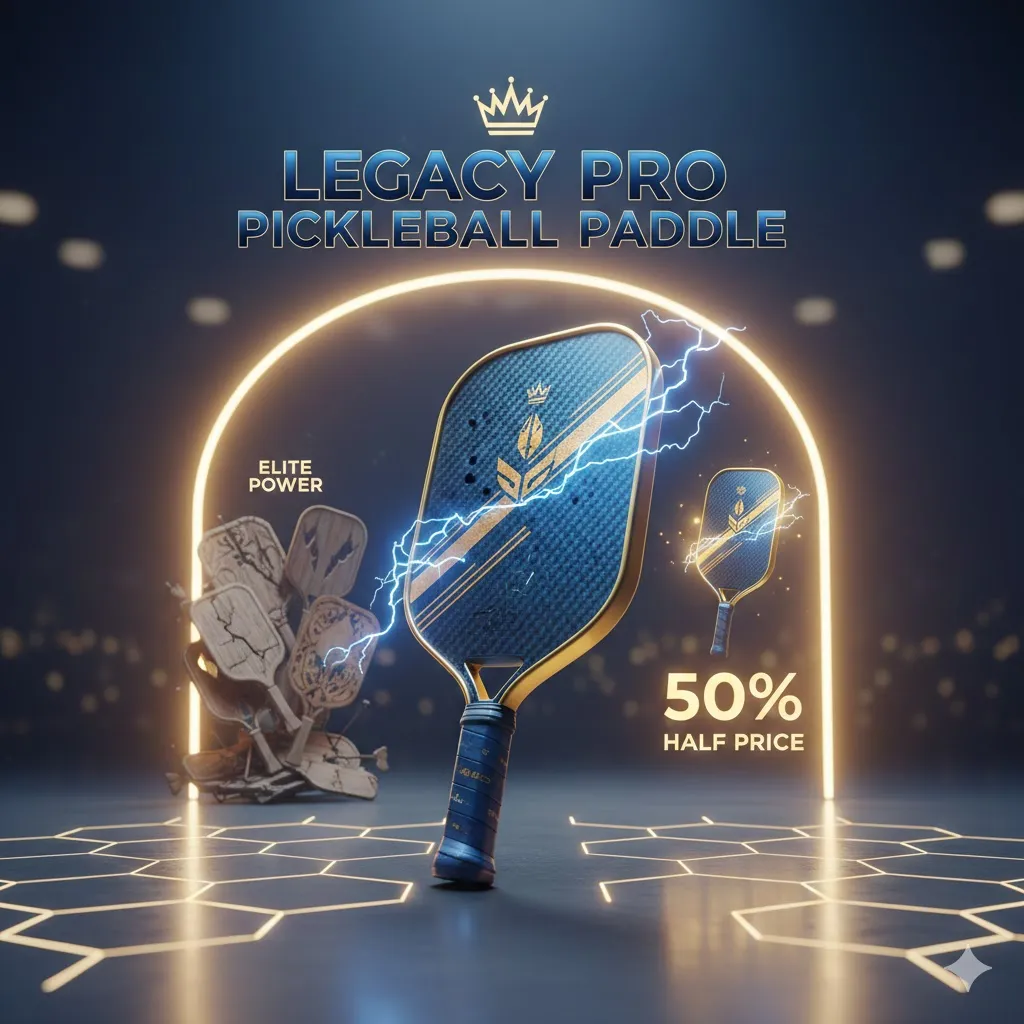
There was a time when high-performance pickleball gear was locked behind a $250 paywall, reserved only for those willing to pay the “big brand tax.” Then came a disruption that shifted the tectonic plates of the industry. When the legacy pro pickleball paddle first hit the courts, it wasn’t just another piece of equipment; it was a manifesto. It proved that elite thermoformed technology, massive spin, and “pro-level” power could be accessible to the everyday player without emptying their savings account.
However, if you’ve spent any time on Reddit or Quora, you know that the story of this paddle isn’t just about the price tag. It’s about the “boardy” break-in period, the legendary pop, and the technical nuances that separate the legacy pro 16mm pickleball paddle from the sea of clones. In this deep-dive, we are moving past the marketing brochures to give you the “insider” verdict on performance, longevity, and how it truly stacks up against the modern titans of the game.
I. The Cult of the Legacy Pro: A Thermoformed Revolution
The legacy pro pickleball paddle earned its cult status by being one of the first to master the “Gen 2” thermoforming process. Unlike traditional paddles that are essentially a sandwich of materials glued together, the Legacy Pro uses heat and pressure to create a seamless, unibody construction. This results in a stiffer, more durable frame with significantly more “pop” than its predecessors.
For players who frequent enthusiast forums, the Legacy Pro is often cited as the “value-pro” king. It successfully bridged the gap between the raw power of elite brands and the affordability of up-and-coming manufacturers. But this power comes with a learning curve that many reviews gloss over. Our goal is to provide a transparent legacy pro pickleball paddle review that addresses the gritty details players actually care about—like why your first ten hours with the paddle might feel a bit strange.
II. Performance & Playability: The “Feel” Factor
The “Break-In” Secret
One of the most frequent questions from new owners is: “Why does my paddle feel like a wooden board?” If you just unboxed your legacy pro 16mm pickleball paddle, you might find the response stiff and unforgiving. This is the “break-in” period. Because of the high-density foam-pickleball-paddles technology used in the perimeter, the carbon fiber face and the polymer core need approximately 10 to 15 hours of aggressive play to “open up.”
During this window, the stiffness gradually transitions into a more responsive, “trampoline” effect. Once the fibers settle, the sweet spot expands, and that “boardy” feel disappears, replaced by a satisfying “thud” that signals the paddle is ready for high-level competition.
Power vs. Plushness: The Pop Reality
When comparing the Legacy Pro to competitors like the Six Zero Double Black Diamond, the primary difference lies in the “plushness.” The Six Zero is often described as having a softer, more cushioned feel. In contrast, the legacy pro pickleball paddle is a power-hitter’s dream. It offers a higher “pop” factor, meaning the ball leaves the face with more velocity with less effort.
This makes it a formidable weapon for baseline drives and overhead slams. However, this power can be a double-edged sword. If you are looking for the best-pickleball-paddle-for-control, you will need to adjust your grip tension. The “trampoline effect” of the thermoformed face can make third-shot drops tricky for those used to softer, non-thermoformed paddles.
Vibration and Arm Health
Because the Legacy Pro is a stiffer, unibody paddle, off-center hits can send more feedback to the arm than a traditional honeycomb core. However, the foam-injected edges do a commendable job of dampening the “sting.” Players with history of severe tennis elbow should approach any thermoformed paddle with caution, but for the average athlete, the stability of the Legacy Pro actually reduces the twisting motion that often causes wrist strain.
III. Durability & Longevity: Beyond the First Month
In the world of legacy pro pickleball paddle reviews, durability is the most debated topic. When you’re hitting the ball at 50+ mph, the equipment takes a beating. Here is how the Legacy Pro holds up over the long haul.
The Grit Lifespan
The T700 Toray Carbon Fiber face is the industry gold standard for friction. On a brand-new Legacy Pro, the spin rates are astronomical, often exceeding 2,000 RPM. But carbon fiber grit isn’t permanent. After 4 to 6 months of heavy play (3+ times a week), you will notice a “smoothing” in the high-impact zone. While the spin remains competitive compared to graphite-pickleball-paddles, it will lose that initial “bite” that makes the ball dive aggressively at the baseline.
Addressing “Core Crush” and Delamination
Early batches of thermoformed paddles across all brands faced issues with delamination (the face separating from the core) and “core crush” (the internal structure collapsing). Legacy has been proactive in addressing these manufacturing hurdles. Modern units are usa-pickleball-approved-paddle-list compliant and feature reinforced bonding agents. If you hear a “crunchy” sound or notice a sudden, illegal jump in power (the “hot paddle” syndrome), it may be a sign of core failure, but these instances have plummeted in recent production runs.
Maintenance: The “White Out” Effect
Because the carbon fiber face is so porous, it tends to collect plastic residue from the ball, appearing as white streaks. This isn’t just an aesthetic issue; it can actually reduce friction. We recommend using a specialized “paddle eraser” to clean the face weekly. This maintains the integrity of the T700 surface and keeps your spin rates consistent.
IV. Direct Comparisons: The “Versus” Battle
Choosing a paddle often comes down to how it compares to its closest rivals. Here is the breakdown:
- Legacy Pro vs. Vatic Pro V7: The Vatic Pro V7 is often seen as the Legacy’s twin. However, the Legacy Pro generally has a slightly higher swing weight, providing more “plow-through” power, while the Vatic V7 feels a bit more maneuverable at the kitchen line.
- Legacy Pro vs. Six Zero Ruby: The Ruby uses Kevlar, which provides a unique “gritty-soft” feel. Is it worth the extra $50? For most intermediate players, the T700 Carbon Fiber of the Legacy Pro provides more than enough performance. The Ruby is for the player who wants the absolute latest in material science.
- Legacy Pro Air vs. Selkirk Power Air: The legacy pro air pickleball paddle is an interesting beast. Unlike the edgeless-pickleball-paddles from Selkirk which are thin and ultra-poppy, the Legacy Air maintains a bit more stability and “dwell time,” making it a hybrid rather than a pure “power-only” tool.
V. Technical Specs & Customization (“The Spec-Head’s Guide”)
For the players who obsess over the numbers, the legacy pro 16mm pickleball paddle offers a very specific profile.
Swing Weight Realities: The average swing weight of the 16mm model hovers around 118-121. This is “head-heavy” territory. While this contributes to the massive power on drives, it can make the paddle feel “slow” during fast hands battles at the net. If you find your volleys are lagging, you may need to focus on a shorter backswing.
The Lead Tape Blueprint: Many pros suggest adding lead tape to customize the feel. For the Legacy Pro, we recommend:
- 3 and 9 o’clock: This expands the sweet spot laterally, making the paddle more forgiving on off-center hits.
- The Handle: Adding a weighted overgrip can help counterbalance the head-heavy nature, improving the “balance point” for better maneuverability.
Handle Ergonomics: The handle is a rounded octagon, which feels natural in the palm. At 5.3 inches, the grip length is perfectly suited for two-handed backhands, a crucial feature for players transitioning from tennis to the ppa-tour style of play.
VI. The Buying Guide: Legacy Pro vs. Legacy Pro Air
Which model should you choose? It comes down to your position on the court.
The Original 16mm is the “Baseline Grinder.” It is designed for the player who wants to dominate with deep serves, heavy drives, and stable blocks. It is a tank that rewards full swings and aggressive play.
The legacy pro air pickleball paddle is for the “Kitchen Speedster.” By reducing the overall weight and slightly adjusting the aerodynamics, the Air model allows for faster resets and quicker hand-speed during volleys. However, you do sacrifice a small amount of “plow-through” power compared to the original 16mm.
What’s in the Box? A common point of confusion is the head cover. Unlike some premium brands that include a cover as standard, Legacy often treats this as a separate purchase or a promotional add-on. Be sure to check your specific retailer’s listing before hitting “buy.” For more technical insights, you can check the official USA Pickleball Equipment Standards to see how these specs compare to tournament requirements.
VII. Conclusion: Is the Legacy Pro Right for You?
The legacy pro pickleball paddle remains one of the most compelling options in the sport today. It isn’t a “beginner’s paddle” in the traditional sense—its power requires a level of touch that takes time to develop. However, for the intermediate to advanced player looking to upgrade from a basic starter set, it offers a performance ceiling that is virtually unmatched at its price point.
The Verdict for Power Players: If you love to drive the ball and want a paddle that feels “solid” on every hit, this is your weapon. It is the bang-for-your-buck king of 2024 and beyond.
The Verdict for Control Players: If your game is 100% dinks and drops, be prepared for a 2-week adjustment period. You will need to soften your hands to manage the thermoformed “pop.”
In summary, the Legacy Pro series isn’t just a trend; it’s a testament to how far pickleball technology has come. Whether you choose the 16mm for its stability or the Air for its speed, you are stepping onto the court with one of the most respected names in the enthusiast community.
Frequently Asked Questions
1. Does the Legacy Pro have a “break-in” period?
Yes. Most players report that the legacy pro pickleball paddle feels quite stiff or “boardy” for the first 10 to 15 hours of play. After this period, the core and face settle, and the sweet spot becomes much more responsive and forgiving.
2. Is the Legacy Pro 16mm too powerful for a beginner?
It can be. While the large sweet spot is helpful, the “pop” of a thermoformed paddle can make it difficult for beginners to control their third-shot drops. It is generally recommended for players at a 3.5 skill level or higher who have developed some touch.
3. How long does the grit last on the T700 Carbon Fiber face?
Under heavy play (3+ times a week), you can expect the peak “bite” of the grit to last about 4 to 6 months. After that, the paddle will still provide good spin, but it will lose the “extreme” RPMs found in the first few weeks.
4. What is the difference between the Legacy Pro and the Legacy Pro Air?
The original 16mm is heavier and more stable, favoring baseline power and “plow-through.” The legacy pro air pickleball paddle features a lighter swing weight and better aerodynamics, making it superior for fast hand battles at the kitchen line.
5. Has the delamination issue been fixed?
Yes. While early thermoformed paddles across the industry had issues with the face separating from the core, Legacy has updated its manufacturing process and bonding agents to significantly reduce these failures in current models.
6. Does the paddle come with a cover?
This varies by retailer and current promotions. Often, the Legacy Pro is sold without a cover to keep the price as low as possible. It is always best to double-check the “What’s Included” section of your purchase.
“`