
dupr pickleball
If you have spent any time on a pickleball court recently, you’ve probably heard the buzz. You finish a great game, paddle tap your opponents, and someone asks the inevitable question: “So, do you know your DUPR?”
For a long time, the world of pickleball was a bit like the Wild West. You had “beginners” who were actually former tennis pros, and “advanced” players who just happened to be very optimistic about their skills. Finding a balanced game was a toss-up.
Enter DUPR (Dynamic Universal Pickleball Rating).
Think of DUPR as the great equalizer. It’s the metric that is rapidly bringing order to the chaos, ensuring that when you step onto the court, you have a fair idea of who you are playing against. But it’s more than just a number; it’s a global language for picklers. Whether you are playing in a local park in Florida or a tournament in California, your DUPR tells your story.
In this guide, we are going to strip away the technical jargon and get down to the nitty-gritty. We will explore how it works, why it sometimes behaves strangely (yes, we’ll explain why winning can sometimes lower your rating), and how you can use it to track your progress. Let’s dive in.
DUPR Basics
Before we get lost in the math, let’s establish the groundwork. If you are new to the sport or just finally deciding to take your rating seriously, this is where you start.
What is DUPR pickleball rating (Dynamic Universal Pickleball Rating)?
Simply put, DUPR is the most accurate global rating system for pickleball players. Unlike other systems that might rely solely on tournament results or subjective club ratings, DUPR is universal. It takes data from virtually everywhere—tournaments, leagues, and even those casual recreational matches you play with friends on a Sunday morning.
Imagine it as a credit score for your pickleball skills. It aggregates your performance across all match types to give you a single number, usually between 2.0 (absolute beginner) and 8.0 (top-tier professional). It doesn’t care about your age, gender, or where you live; it only cares about how you play.
Why is DUPR considered the “Gold Standard” rating system in Pickleball?
You might wonder, “Why does everyone care about this specific app?” The answer lies in neutrality and volume.
Other rating systems often suffer from “data silos.” If you only play local club games, a tournament-based system won’t know you exist. DUPR broke down these walls. It became the gold standard because it allows for rec play logging. This means the millions of matches happening outside of official tournaments actually count.
Because it ingests so much data, it paints a far more realistic picture of a player’s ability than a system that only updates once a month based on a sanctioned event. It’s dynamic, meaning it updates constantly, keeping your rating as fresh as your latest match.
Is DUPR free to use for all players?
Here is the best news: Yes, for the vast majority of us, DUPR is completely free.
You can download the app, create a profile, log your matches, and view your rating without spending a dime. They do have features for clubs and organizers that cost money, and they are rolling out premium analytics features, but the core functionality—getting your rating and logging games—remains accessible to everyone. This low barrier to entry is a huge reason why it has been adopted so quickly by the community.
What is considered a “good” DUPR rating for an amateur?
“Good” is highly subjective, but let’s look at the benchmarks so you can see where you stand.
- 2.0 – 2.9: You are likely a beginner. You are learning the rules, figuring out how to keep score, and working on making contact with the ball consistently.
- 3.0 – 3.49: You are a solid recreational player. You understand the “soft game” (dinking) but might not execute it consistently. You can sustain a rally.
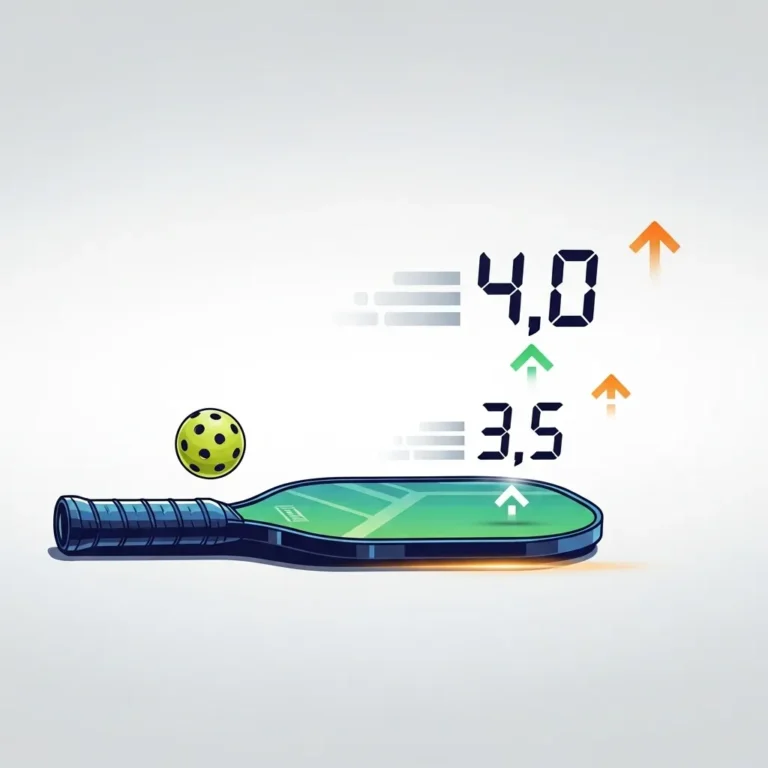
- 3.5 – 3.99: This is often considered the “sweet spot” for competitive amateurs. You have strategy, you can stack, and you have a reliable third-shot drop.
- 4.0 – 4.49 (Pickleball DUPR Rating 4): You are an advanced amateur player. A pickleball DUPR rating 4 indicates strong tactical awareness, consistent shot execution, participation in tournaments, and very few unforced errors.
- 4.5+: You are elite. You are likely the best player at your local courts and perhaps looking at semi-pro opportunities.
So, if you are sitting at a 3.5, give yourself a pat on the back. You are statistically above average and playing high-quality pickleball!
Understanding the Algorithm
This is the section where most people get confused. You might have seen angry posts on Reddit or heard complaints courtside about “broken” ratings. Let’s demystify the algorithm so you can understand what is happening under the hood.
How is the DUPR rating calculated in 2024?
The DUPR algorithm has evolved. In the early days, it was a bit simpler, but in 2024, it is a sophisticated engine. It doesn’t just look at whether you won or lost; it looks at the context of that result.
The calculation relies heavily on three factors:
- The outcome (Win/Loss).
- The score differential (How badly did you win or lose?).
- The rating of your opponents (Who did you play?).
The algorithm is constantly running simulations. Before a match starts, DUPR predicts the outcome based on the ratings of all four players. Your new rating depends on how your actual performance compared to that prediction.
Why did my DUPR rating go down after winning a match? (High Priority Question)
This is the number one source of frustration, but it actually makes sense when you think about it.
Imagine you are a 4.5 rated player (very good). You team up with another 4.5 partner. You decide to play against two beginners who are rated 2.5.
DUPR’s algorithm predicts that you should win this match easily—likely 11-0 or 11-1.
However, let’s say you decide to take it easy on them. You work on your lob, you don’t slam the ball, and you end up winning 11-9.
Technically, you won. But statistically, you underperformed. The algorithm expected a slaughter, and you barely scraped by. Because you performed worse than the “expectation,” your rating might tick downward slightly to reflect that performance. It protects the integrity of the system; otherwise, high-level players could artificially inflate their scores by beating up on beginners.
Do points scored (score differential) matter in DUPR?
Absolutely. In fact, they matter almost as much as the win itself.
In many tournament formats, a win is a win. In DUPR, every point counts. Beating a team 11-0 is worth significantly more to your rating than beating that same team 11-9.
This encourages players to play their best until the very end. If you are down 0-10, fighting back to make it 6-11 will actually save your rating from plummeting as much as it would have if you gave up. It makes every rally meaningful.
Does DUPR treat Singles and Doubles ratings separately?
Yes, and thank goodness for that! Pickleball singles is a completely different animal compared to doubles. Singles requires immense cardio and groundstrokes, while doubles is about strategy, dinking, and hand speed.
You will have a distinct rating for Doubles and a distinct rating for Singles. It is very common for a player to be a 4.0 in Doubles but only a 3.5 in Singles (or vice versa) because the skill sets do not perfectly overlap.
What is “Performance vs. Expectation” in the DUPR algorithm?
This is the secret sauce we touched on earlier. The “Expectation” is the probability DUPR assigns to you winning a match before the first serve is hit.
If DUPR calculates that your team has a 90% chance of winning, and you win, your rating won’t go up much—you simply did what was expected.
However, if DUPR calculates you have a 20% chance of winning (you are the underdog), and you pull off the upset, your rating will skyrocket. This “Performance vs. Expectation” metric is what allows rapidly improving players to climb the ladder quickly.
Accuracy & Reliability
You have a number, but can you trust it? Let’s look at how DUPR ensures that the rating you see is an accurate reflection of your skill.
What is the DUPR Reliability Score and how does it work?
If you look at your profile, you might see a “Reliability Score” expressed as a percentage. This tells you (and others) how confident the system is in your rating.
If you have played 100 matches in the last three months against a variety of rated opponents, your reliability will be 100%. The system knows exactly who you are.
If you played one match six months ago, your reliability will be very low.
The reliability score degrades over time. This is a brilliant feature because skills atrophy. If you take a year off from pickleball, you aren’t the same player you were last year, and the reliability score drops to reflect that uncertainty.
How many matches do I need to play to get a reliable rating?
There is no “magic number” where the system suddenly becomes perfect, but the general consensus is that 10 to 20 matches against rated players gives the algorithm enough data to settle you into your correct bracket.
The key phrase here is “against rated players.” If you play 50 matches against people who also have no rating, the system is just guessing. You need connectivity to the broader pool of players to anchor your rating.
What does a “Provisional Rating” (starred rating) mean?
When you first join DUPR, your rating might have an asterisk (*) next to it. This indicates a “Provisional Rating.”
It’s the app’s way of saying, “This is our best guess, but we need more info.” It usually happens when you have played fewer than 5-10 matches. During this phase, your rating will be very volatile—it might jump up or down 0.5 points in a single day. Don’t panic! This is normal calibration. Once you play enough games, the asterisk disappears, and your rating stabilizes.
Does playing against unrated players affect my DUPR?
This is a tricky one. In the immediate sense, playing against a totally unrated player (someone with zero match history) might not move your rating much instantly because the system doesn’t know how to value the win/loss.
However, DUPR uses “retroactive connectivity.” This is cool: if you play an unrated player today, and next month that player goes on to play 20 matches and establishes a rating of 4.0, DUPR can look back at your match and say, “Ah, they played a 4.0 player back then!” and adjust your rating accordingly. So, yes, it affects you, but sometimes there is a delay while the system waits for data on your opponent.
Managing Matches & Usage
Okay, enough theory. How do you actually use this thing when you are at the courts?
How do I log match scores into the DUPR app?
Logging is designed to be quick so you don’t hold up the next game.
- Open the app and hit “Post a Score.”
- Select the format (Doubles or Singles).
- Search for your partner and your opponents by name.
- Enter the score (e.g., 11-9).
- Submit.
Crucial Step: One player from the opposing team needs to “Confirm” the score on their app. The match doesn’t count toward your rating until it is verified by the opposition. This prevents people from making up fake wins.
Can I enter recreational (rec play) scores, or only tournaments?
You can, and you should, enter rec play scores! This is the beauty of DUPR.
However, a word of etiquette: Make sure everyone agrees before the game starts that “this is a DUPR match.” It changes the vibe. People play differently when their rating is on the line. Ambushing someone after a casual warm-up game by asking to log the score is generally frowned upon in the pickleball community.
How can I delete or edit a match result entered incorrectly?
We’ve all got “fat fingers” sometimes. Maybe you entered 11-2 instead of 11-12.
If the match is still “Pending” (not yet confirmed by the opponent), you can usually delete it or withdraw it.
If the match has already been confirmed, it’s harder. You generally have to contact DUPR support to get a confirmed match removed or edited to prevent abuse of the system.
How do I claim my player profile if it already exists?
Sometimes, a tournament director might have uploaded your name and results before you ever downloaded the app. You create an account and realize there is already a “John Smith” with your match history.
Don’t create a duplicate! Instead, search for that profile. There should be an option to “Claim Profile.” You will likely need to verify your identity (usually via email or phone number associated with the tournament registration) to merge that history into your new account.
Comparisons & Context
Finally, let’s look at how DUPR fits into the bigger picture of pickleball ratings.
What is the difference between DUPR and UTPR?
UTPR (USA Pickleball Tournament Player Ratings) used to be the only game in town.
- UTPR: Only counts matches played in USA Pickleball sanctioned tournaments. It is very accurate for tournament players but ignores the other 95% of matches people play.
- DUPR: Counts tournaments and rec play.
Think of UTPR as your “Exam Grade” and DUPR as your “Class Participation + Exam Grade.” DUPR is generally considered more holistic and current.
How does DUPR compare to UTR-P?
UTR (Universal Tennis Rating) recently launched UTR-P for pickleball. It is very similar in concept to DUPR (using an algorithm to rate players globally).
However, DUPR currently has the “first-mover advantage” in the pickleball specific world. It has a larger database of pickleball-only players. While UTR-P is growing, DUPR is currently the language spoken by the majority of the pickleball community.
It is also worth noting that while DUPR is popular, many leagues use the Global Pickleball Network for managing local ladders.
Can I use my DUPR rating to enter official tournaments?
Increasingly, yes.
In the past, tournaments only looked at UTPR. Now, many tournament directors, especially for larger amateur events and pro-qualifiers, are using DUPR to bracket players. They prefer it because it prevents “sandbagging” (where a good player enters a lower skill bracket to win easy gold medals). Since dupr rating pickleball updates more frequently, it’s harder for a shark to hide in a goldfish pond.
Conclusion
pickleball dupr isn’t just an algorithm; it’s a tool that helps us find better games, track our personal improvement, and connect with the global community of picklers. It removes the awkwardness of mismatched games and gives us a concrete goal to strive for.
So, the next time you head to the courts, don’t be afraid to ask, “What’s your DUPR?” It might just be the start of the best match you’ve ever played.
you may like it