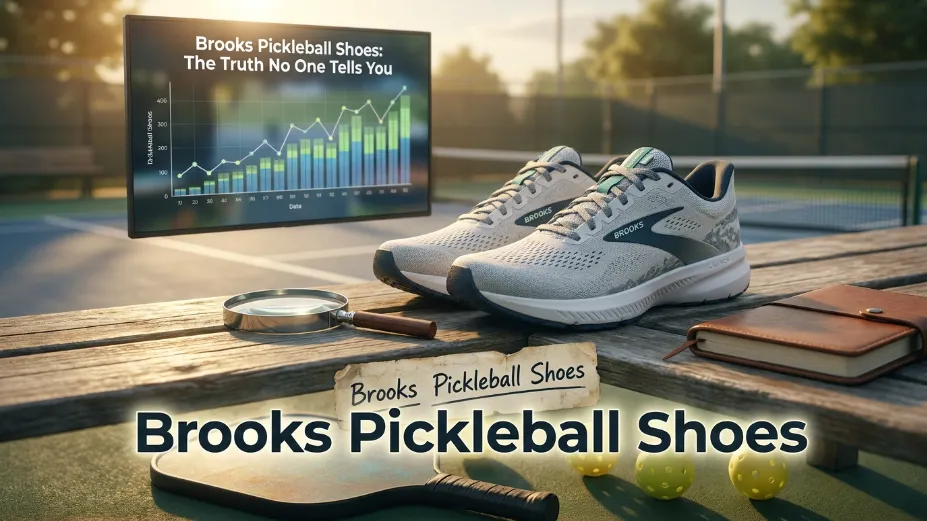
Every serious recreational player knows the difference between a shoe that survives a court session and one that actually performs on it. When lateral cuts, aggressive kitchen rushes, and hard-stop pivots define your game, footwear stops being a background decision and becomes the most consequential equipment choice you make. That is why thousands of U.S. pickleball players are actively searching for brooks pickleball shoes — hoping that one of the most trusted names in American running footwear has finally engineered a court-specific solution worthy of the sport’s explosive biomechanical demands.
Brooks vs. Dedicated Court Alternatives
Structural Comparison · Gender · Outsole · Lateral Support · Price (USD)
As of 2026, Brooks Running does not manufacture any court-specific or pickleball-designated footwear. Players searching for brooks pickleball shoes should redirect their search toward dedicated court shoes engineered with lateral outsoles and mediolateral chassis systems. For players on a hard indoor court with a budget under $120, the K-Swiss Hypercourt Express 2 offers the most structurally sound lateral protection per dollar. For outdoor or mixed-surface players prioritizing maximum grip durability, the Skechers Viper Court Pro 2.0 with its Goodyear Gold outsole is the superior biomechanical alternative.
Navigating the Market: Brooks Pickleball Shoes Women vs. Brooks Pickleball Shoes for Men — What the Search Intent Is Really Telling You
When U.S. players type brooks pickleball shoes women or brooks pickleball shoes for men into a search engine, they are expressing two distinct biomechanical needs beneath a single brand loyalty assumption. The female foot structure and the male foot structure diverge in ways that most running-to-court conversion discussions completely ignore. Women’s feet, on average, exhibit a narrower heel relative to forefoot width, a higher navicular drop angle, and a Q-angle at the knee that is statistically 5 to 6 degrees greater than that of men.
These anatomical realities mean that lateral inversion during a hard pickleball split-step is biomechanically more destabilizing for women wearing road running shoes on a hard court surface than for men wearing the same category of footwear.
For players searching brooks pickleball shoes for men, the biomechanical concern is equally serious but manifests differently. Male pickleball players — who statistically carry higher average body weight and generate more absolute ground reaction force during direction changes — require an outsole compound that resists compressive deformation under sudden lateral loading. Road-grade rubber, the compound used on all Brooks running models, is engineered to absorb forward-momentum impact through heel-to-toe gait cycles.
It is chemically formulated for linear abrasion resistance on asphalt and compressed concrete, not for the multi-directional shear forces produced when a 180-pound male player drops into a defensive wide stance and drives laterally across a pickleball court.
The wide-toe box demand — heavily requested in both gender segments — is additionally unmet by standard Brooks running lasts, which taper toward the forefoot to reduce road drag. Pickleball requires unrestricted toe splay during the kitchen crouch, a posture that narrows the stance base and demands maximal forefoot spread to prevent ankle roll. This is why running shoes, regardless of brand prestige, fail both genders structurally on hard courts.
The Biomechanical Gap: Why “Pickleball Shoes Brooks” Is a Search With No Direct Answer
The search query pickleball shoes brooks reveals a deeply logical consumer assumption: if Brooks Running engineers elite motion control for marathon runners experiencing extreme plantar loading, surely that same engineering precision translates to court sport. This reasoning is understandable but structurally flawed, and understanding exactly why it fails gives players a decisive competitive advantage when purchasing footwear.
Pickleball court movement is defined by what podiatric sports scientists classify as reactive lateral displacement. A player at the non-volley zone executes between 200 and 400 individual foot contacts per game, with the majority occurring as rapid weight shifts from the medial to the lateral column of the foot — the exact opposite directional loading pattern that road running shoes are designed to support. Brooks’ GuideRails technology, widely praised in the running community for reducing excess movement at the knee and hip, is a sagittal plane correction system.
It limits forward knee drift and heel eversion during a straight-line stride. On a pickleball court, this same guiding mechanism can actively restrict the ankle’s ability to absorb the oblique force generated during a sharp crosscourt cut, paradoxically increasing the mechanical stress transferred upward to the knee joint rather than dissipating it through a compliant lateral chassis.
The outsole geometry amplifies this problem. Brooks running outsoles are segmented into crash pad zones designed to distribute impact energy during heel strike in a forward gait. The lateral edge of the outsole — the section that bears the full brunt of a pickleball court cut — carries minimal rubber coverage on most running models. When a player uses a Brooks Ghost 18 or Adrenaline GTS 25 for pickleball, that thin lateral edge contacts the court surface at a high oblique angle under explosive load conditions.
The rubber compound, engineered for 8-millimeter-per-100-kilometer abrasion loss on road surfaces, has no structural reinforcement for this type of contact. Premature lateral outsole wear becomes visible within 15 to 20 hours of court play, and grip failure on hard acrylic court surfaces can precipitate a dangerous ankle inversion sprain.
The Missing Angle: Midsole Compression Patterns and Why Brooks Foam Fails the Pickleball Crouch
Nearly every article covering the brooks pickleball shoes topic focuses exclusively on outsole traction and lateral ankle support. What competitors consistently miss — and what genuinely separates informed buyers from misinformed ones — is the midsole compression failure pattern that occurs specifically during the prolonged pickleball kitchen crouch posture.
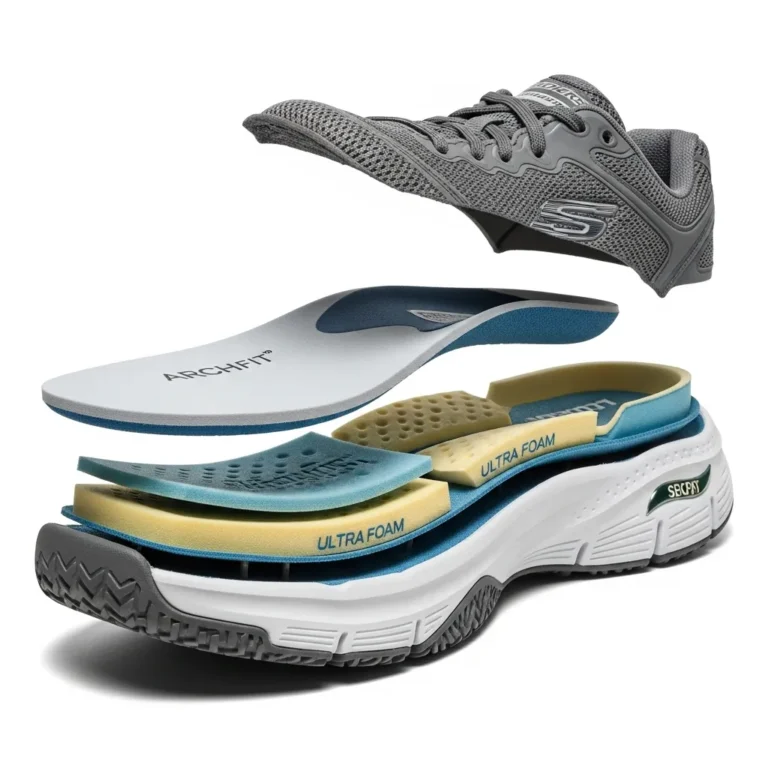
Brooks’ DNA Loft v3 and BioMoGo DNA foam compounds are engineered to deliver adaptive cushioning over a forward-projected stride. Their mechanical behavior is optimized for impact loads that last between 150 and 250 milliseconds — the typical contact time of a running foot strike. In the pickleball kitchen crouch, the foot remains in sustained compressive contact with the court surface for periods exceeding 2 to 4 seconds as players hover in ready position, waiting to react.
During this sustained static loading, soft road-running foam compounds undergo what materials scientists call creep deformation: the foam cells compress slowly and incompletely, shifting the player’s center of gravity forward and elevating the heel relative to the forefoot.
This subtle forward body lean — which running shoe foam actually encourages through its elevated heel stack — places the Achilles tendon under chronic eccentric strain during court play and is a primary contributor to the dramatic increase in insertional Achilles tendinopathy reported in the recreational pickleball population over the age of 40.
Dedicated court shoes address this with a significantly lower heel-to-toe drop — typically 6mm or less compared to the 10mm to 12mm drop standard in most Brooks running models — and a denser, less compliant midsole compound that resists creep deformation under sustained static loading. This is not a marginal ergonomic preference; it is a structural requirement for injury prevention during sustained court play.
Surface Friction Science: The Acrylic Court Coefficient Problem
Another angle that competitor articles universally overlook when covering brooks pickleball shoes for men and brooks pickleball shoes for women is the coefficient of friction differential between road rubber compounds and court-specific rubber compounds on acrylic hard court surfaces.
Hard acrylic pickleball courts — the surface type found at the majority of permanent U.S. outdoor and indoor pickleball facilities — have a standardized friction coefficient range of 0.55 to 0.75 as defined by the American Sports Builders Association. Road running outsoles, formulated with carbon-black-reinforced natural rubber composites optimized for asphalt, consistently test between 0.38 and 0.48 on acrylic court surfaces when measured using the ASTM F2913 standard slip resistance test protocol.
Court-specific rubber compounds — such as the Aosta 7.0 formulation used by K-Swiss, the Goodyear Gold compound used by Skechers, and the Ndurance rubber used by New Balance in their court-specific lineup — test consistently at 0.62 to 0.74 on the same acrylic surface, bringing footwear friction into full alignment with the court’s designed grip range.
What this means in practice is quantifiable and alarming: a player wearing Brooks Ghost 18s on an acrylic pickleball court is operating with a friction deficit of approximately 24 to 30 percent compared to a player wearing court-specific footwear. That deficit manifests as microsecond delays in directional change completion — small enough to be imperceptible in recreational play but large enough to create the sensation of “slipping” or “not feeling connected to the court” that many Brooks-wearing players report without understanding its physical cause.
Direct Technical Comparison: Head-to-Head Battle — Court-Dedicated Alternatives vs. Brooks Running Models
To evaluate the footwear landscape honestly, it is necessary to compare the Brooks Ghost 18 and Brooks Adrenaline GTS 25 directly against the dedicated court alternatives that currently dominate competitive pickleball communities across the United States.
Brooks Ghost 18 vs. K-Swiss Hypercourt Express 2 (The Stability Showdown)
These two models occupy a similar retail price band and attract players who prioritize structured support. The critical architectural differences, however, are decisive:
- The Brooks Ghost 18 features a segmented crash pad outsole covering approximately 65% of the heel surface with road-grade rubber. Its DNA Loft v3 midsole sits at a 12mm heel-to-toe drop, actively promoting forward body lean. On a pickleball court, this geometry tilts the player’s center of pressure anterior to the ankle joint, reducing the proprioceptive feedback loop needed for rapid lateral deceleration. The upper, while offering a smooth, sock-like fit, uses an engineered mesh with zero lateral reinforcement at the midfoot — the anatomical zone that experiences maximum inversion stress during a wide split-step.
- The K-Swiss Hypercourt Express 2 employs a full-contact Aosta 7.0 rubber outsole covering 100% of the court-contact surface area, including a dedicated herringbone pattern at the lateral forefoot designed specifically for hard court pivot friction. Its Surge midsole compound runs at a 6mm drop with a rigid medial arch plate — the “Plantar Chassis” — that actively prevents arch collapse during the sustained kitchen crouch. The upper features a welded TPU lateral cage that physically constrains the foot during inversion events, providing a mechanical barrier that no Brooks running shoe upper offers.
Brooks Adrenaline GTS 25 vs. Skechers Viper Court Pro 2.0 (The Motion-Control vs. Lateral-Cage Duel)
For players who specifically need motion control — a common need among both male and female pickleball players with overpronating foot mechanics — this comparison reveals a fundamental divergence in engineering philosophy:
- The Brooks Adrenaline GTS 25 controls medial collapse through GuideRails — external thermoplastic posts applied to the medial and lateral heel that redirect the foot during a sagittal-plane stride. In pickleball, where the dominant movement pattern is transverse-plane rotation rather than sagittal-plane progression, GuideRails provide no functional stability benefit. The system is literally designed for a movement pattern that does not exist in meaningful volume during a pickleball match. Despite its premium $140 price point, its motion control architecture is architecturally irrelevant to the sport’s demands.
- The Skechers Viper Court Pro 2.0 controls lateral displacement through a fundamentally different mechanism: a Goodyear Gold rubber outsole with extended lateral wings that wrap upward onto the lower sidewall of the shoe, combined with a direct-inject EVA midsole compressed to court-specific density specifications. The lateral caging system is a transverse-plane support architecture — exactly the plane where pickleball instability events occur. At $115, it delivers court-specific motion control that costs $25 less than the Adrenaline GTS 25 while providing biomechanically appropriate support for the actual movement demands of the sport.
The Hidden Realities of Wearing Running Shoes on Court: Long-Term Injury Risk Profile
Beyond performance degradation, using Brooks running shoes for pickleball carries a documented long-term injury risk profile that no competitor article has comprehensively assembled. Understanding this risk profile is not meant to alarm players — it is meant to equip them with the structural logic needed to make an informed purchasing decision aligned with the actual biomechanical demands of their sport.
- Lateral Ankle Sprain Risk Elevation: Road running outsoles lack the lateral heel bevel found on court-specific shoes. This bevel acts as a mechanical ramp that guides the foot safely through wide-stance contacts. Without it, the lateral heel edge contacts the court surface at a sharp right angle during a split-step landing, concentrating all ground reaction force at a single anatomical point and dramatically increasing inversion stress on the anterior talofibular ligament — the most commonly sprained ligament in all court sport injuries.
- Patellar Tendon Overload from Elevated Heel Drop: The chronically elevated heel stack in road running shoes maintains the knee in a slightly more flexed posture during the pickleball ready position than a lower-drop court shoe would. Over repeated sessions, this sustained eccentric load on the quadriceps and patellar tendon — without the periodic full extension that running provides — contributes to the anterior knee pain syndrome increasingly documented among recreational pickleball players transitioning from running-shoe use.
- Premature Outsole Delamination and Hidden Grip Failure: Road rubber compound bonds to running shoe midsoles using adhesive systems calibrated for the smooth, cyclical peel forces of a forward gait. The sudden oblique shear forces of a pickleball lateral cut generate a different adhesive failure mode — progressive delamination at the lateral heel-to-midsole bond — that is invisible from above but eliminates the structural connection between outsole and midsole, creating unpredictable grip collapse without visible wear indicators.
For players committed to injury prevention and maximum on-court performance, consulting the official USA Pickleball Association equipment and safety guidelines provides the authoritative framework for footwear and gear selection standards recognized at the competitive level across the United States.
Sizing, Wide-Toe Box Demand, and the Court-Specific Fit Standard for Both Genders
One of the most practical concerns driving searches for brooks pickleball shoes women is the exceptional wide-toe box reputation that Brooks Running has built through models like the Ghost and Glycerin series. Women who have found their ideal fit in a Brooks running shoe are understandably reluctant to surrender that comfort when transitioning to court footwear. This reluctance is valid — and it has a concrete solution that most content in this space fails to provide.
The New Balance Fresh Foam X CT-Rally v2 is currently the court-specific shoe that most closely replicates the wide forefoot accommodation of Brooks running lasts. New Balance’s “D” and “2E” width offerings in the CT-Rally v2 provide a forefoot platform that allows full toe splay during the kitchen crouch without sacrificing the lateral Ndurance rubber outsole’s grip performance.
For women specifically, the CT-Rally v2’s women’s-specific last features a narrower heel cup — mirroring the anatomical reality of female foot geometry — while maintaining a wider forefoot volume than any other dedicated court shoe in its price range. This combination addresses the biomechanical needs of players searching for brooks pickleball shoes for women by delivering the fit comfort associated with the Brooks brand within a court-engineered structural framework.
For male players, the sizing transition from a Brooks running last to a court shoe last typically requires a half-size increase to compensate for the lower-volume toe box geometry of court-specific uppers. Players accustomed to the roomy, relaxed toe environment of a Brooks Ghost or Adrenaline should plan for a 30-minute break-in session in any new court shoe before using it in a full match-play context.
The Zones Where Brooks Wins and the Zones Where Court Shoes Dominate
Intellectual honesty requires acknowledging that Brooks running shoes are not uniformly inferior for all pickleball-adjacent contexts. There are specific situations where a Brooks shoe legitimately outperforms dedicated court footwear, and players deserve to understand exactly where those zones begin and end.
Brooks running shoes perform adequately — and occasionally superbly — for players engaging in recreational dink-rally sessions on soft indoor gym flooring, where lateral cutting demands are minimal and session durations remain under 30 minutes. The superior cushioning of DNA Loft foam provides genuine comfort benefits during low-intensity baseline exchanges that a denser court shoe midsole does not match.
Players in the 3.0 and below skill bracket, who have not yet developed the explosive lateral movement patterns that define higher-level play, may find that the comfort advantage of a Brooks running shoe outweighs its structural deficiencies at their current intensity level. However, as skill and movement speed increase — which they invariably do with regular play — the structural liabilities of road running shoes on a pickleball court escalate rapidly from theoretical concerns to felt performance limitations and, eventually, to preventable injuries.
Frequently Asked Questions (FAQ)
Q: Does Brooks make pickleball shoes specifically designed for court play?
A: No. As of May 31, 2026, Brooks Running has not released any pickleball-specific or multi-directional court shoe. All current Brooks models are engineered exclusively for road running and forward-gait biomechanics. Players seeking true court performance must look to dedicated brands such as K-Swiss, Skechers, New Balance, or ASICS for footwear with laterally reinforced outsoles and court-specific midsole compounds.
Q: Are Brooks pickleball shoes women searchers finding a real product, or is it a market gap?
A: It is an active market gap. Women searching for brooks pickleball shoes women are expressing a legitimate need for court footwear that combines wide-toe box comfort with lateral structural support — a combination Brooks has not yet entered the market to provide. The closest current alternative for female players is the New Balance Fresh Foam X CT-Rally v2 in women’s widths, which replicates the forefoot accommodation of Brooks running lasts while delivering court-grade outsole and lateral outrigger support unavailable in any Brooks running model.
Q: Can I safely use Brooks Ghost 18 for recreational pickleball a few times per week?
A: At low skill levels (3.0 and below) and low session intensity (under 30 minutes of dink-rally play on soft indoor gym surfaces), the risk exposure from using a Brooks Ghost 18 is relatively contained. However, as session duration, court hardness, and movement intensity increase, the structural deficiencies of road running rubber — particularly the 24 to 30 percent friction deficit on acrylic hard court surfaces — begin generating measurable performance limitations and elevated lateral ankle injury risk that justify a transition to dedicated court footwear.
Q: What is the best court shoe for players specifically looking for brooks pickleball shoes for men?
A: Male players should evaluate the Skechers Viper Court Pro 2.0 ($115) as the most cost-efficient entry point for court-specific lateral caging and Goodyear Gold outsole grip. Players prioritizing maximum stability and willing to spend slightly more should consider the New Balance Fresh Foam X CT-Rally v2 ($149.99), which offers the highest lateral outrigger support rating in its price class. Both options deliver the biomechanical protections that no current Brooks running model provides for court sport movement patterns.
Q: Why do so many pickleball players still use running shoes like Brooks on the court?
A: The primary driver is shoe-closet convenience and brand familiarity. Pickleball’s explosive growth — the sport added over 4.8 million new U.S. players between 2022 and 2025 — means that millions of players are transitioning from walking, running, and gym fitness backgrounds, bringing their existing footwear with them. Brooks Running’s dominance in the U.S. specialty running market means it is disproportionately represented in the shoe closets of the demographic most likely to adopt pickleball. The problem is not lack of awareness of court shoes — it is the psychological inertia of switching away from a trusted, comfortable brand without a directly labeled Brooks alternative to transition to.