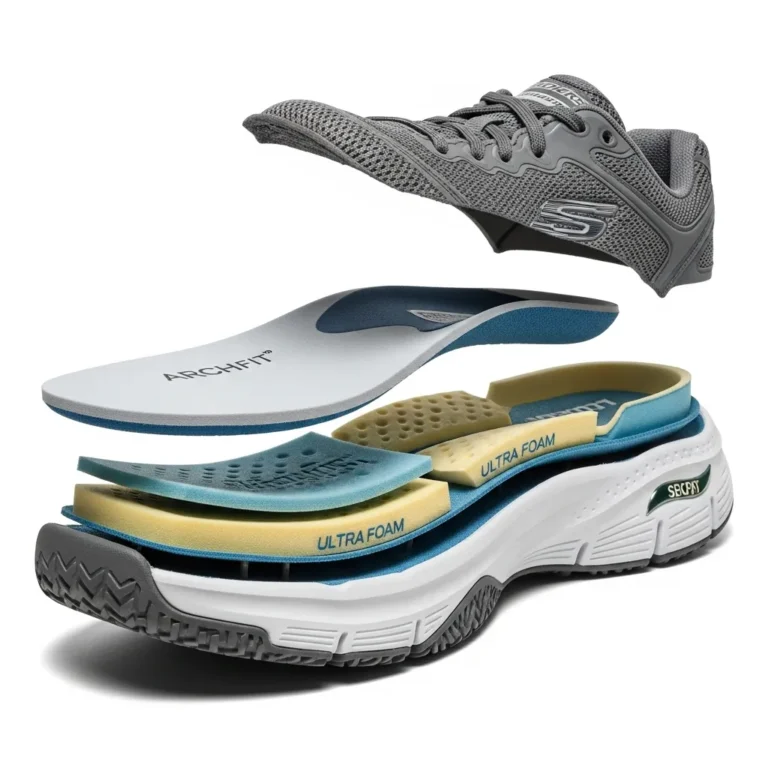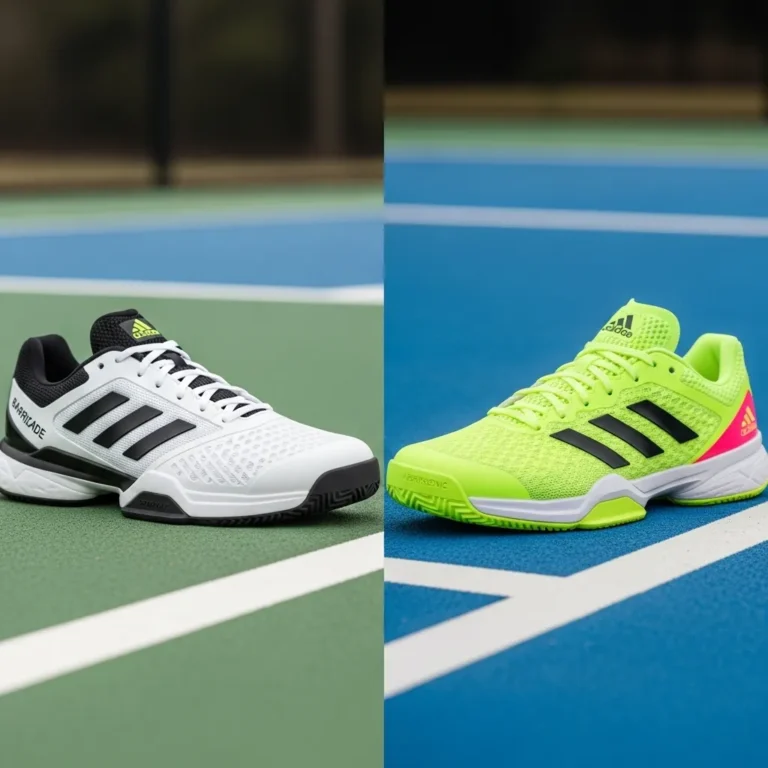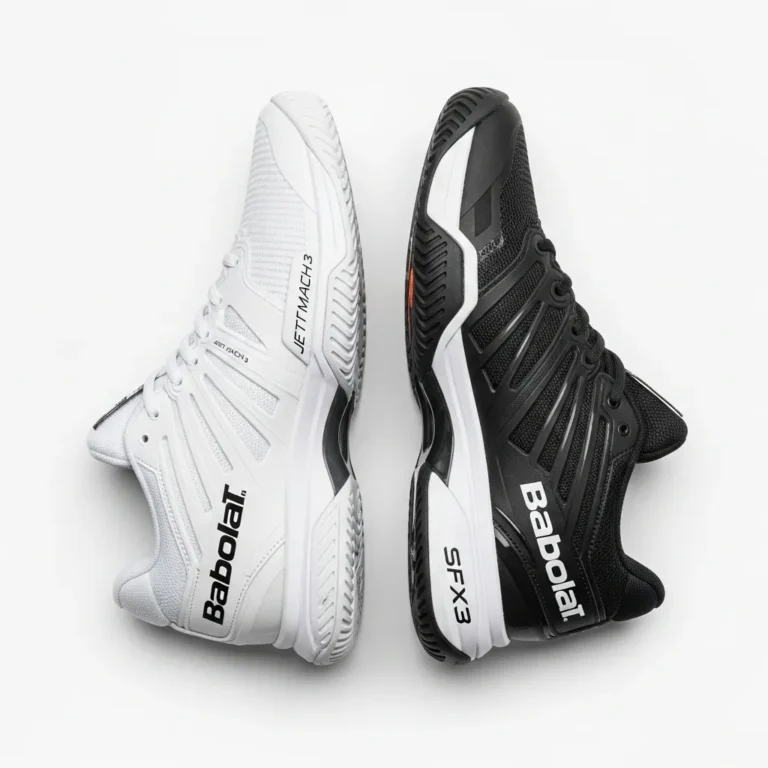
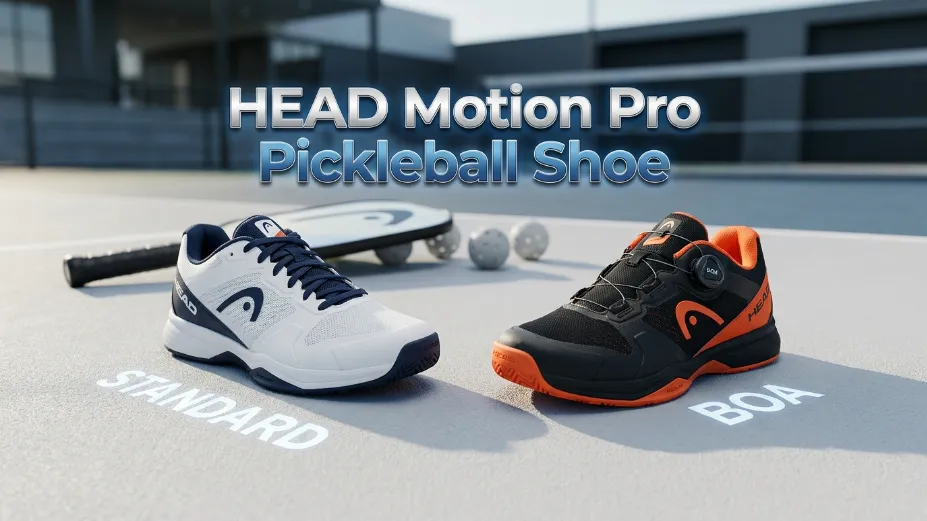
When a shoe is engineered from the court floor up specifically for the violent lateral cuts of modern pickleball, players notice. The head motion pro pickleball shoe isn’t just another tennis hybrid with a re-branded sole; it represents a major shift in court footwear physics. Whether you are eyeing the traditional lace-up model for its classic lockdown or weighing the micro-adjustable premium of the BOA dial system, finding the exact performance truth matters before spending your hard-earned money. Let’s break down the real-world traction, durability, and lateral stability in this definitive, data-backed breakdown.
HEAD Motion Pro Pickleball Shoes
Closure · Performance · Weight · Player Profile
Biomechanical Breakdown: HEAD Motion Pro Pickleball Shoe Review
To write an objective head motion pro pickleball shoe review, we must first address the specific physical forces generated on a pickleball court. Unlike tennis, where players cover long distances with gliding strides, pickleball is characterized by rapid, short-burst accelerations, constant transitions from the baseline to the non-volley zone, and aggressive side-to-side shuffling. Understanding the fundamental mechanics of court movement is the first step when learning . Wearing standard running shoes or tennis footwear lacking targeted stabilizers often results in severe ankle rollovers and rapid outsole wear.
The standard-laced iteration of the head motion pro pickleball shoe addresses these biomechanical demands through an integrated suite of proprietary technologies. The core of its responsive underfoot feel lies in the Dynafoam midsole. Unlike traditional Ethyl Vinyl Acetate (EVA) foams used in mid-tier court shoes, Dynafoam is formulated by injecting microscopic air cells into a thermoplastic polyurethane compound. This structural composition yields an exceptionally light, bouncy, and resilient cushion layer that retains its elasticity twice as long as standard EVA, preventing the shoe from packing out over months of intense court play. This is highly beneficial for the longevity of the shoe, securing its place on our curated list of the .
Complementing the cushioning is HEAD’s Drift Defense technology. Aggressive movers frequently drag the inner portion of their forefoot during low-to-the-ground defensive lunges. To counter this, HEAD extended a robust, abrasion-resistant TPU shield from the outsole up over the medial vamp of the shoe. This acts as a protective barrier, preventing friction from eroding the breathable mesh upper and preserving structural integrity. When analyzed alongside options like the market, this targeted medial wrap stands out as a genuine, engineering-first solution to a sport-specific wear pattern that many major brands overlook.
For players who value a light, agile feel on court, the standard version excels. At 13.6 ounces for a men’s size 10.5 , it offers an optimal strength-to-weight ratio. The upper features a dual-layer mesh construction integrated with a Lockdown Strap lacing system. This strap is a rubberized anchor that runs from the base of the midsole directly up to the eyelets, wrapping around your midfoot and securing it firmly against the footbed during sharp, lateral deceleration steps. This creates a secure, highly responsive on-court feel that keeps you connected to the playing surface.
The Curved “Last” Dilemma: Forward Momentum vs. Lateral Stability
One of the most radical features of the standard head motion pro pickleball shoes is the physical geometry of its sole. Traditional court shoes are engineered with flat, wide outsoles to maximize surface area and keep the player’s center of mass close to the ground, while running shoes have a curved last that allows for easier access to the balls of the feet for forward movement. HEAD engineered the Motion Pro with a curved last shape (the physical curve of the sole from heel to toe).
This design choice creates a clear mechanical trade-off :
- The Forward Transition Benefit: The curved toe-spring and heel taper naturally roll the foot forward. This reduces the mechanical effort required to stay on the balls of your feet, making transitions up to the kitchen line feel effortless. Dishing out low, aggressive drops at the non-volley zone requires strict adherence to , and being in an active athletic stance is vital to react to fast kitchen volleys.
- The Lateral Stability Compromise: Because the heel of the sole is rounded rather than completely flat, players transitioning from traditional tennis shoes may initially feel less “anchored” to the court. During heavy, wide-angle lateral cuts—especially in singles play—the foot feels slightly less planted on heel-pivots.
To offset the potential rolling hazard of the curved last, HEAD integrated their Lateral Control+ technology—a stiff, raised rubber sidewall on the lateral margin of the forefoot. This acts as a physical outrigger, ensuring that even under high-velocity lateral cuts, the shoe resists tipping or rolling over, transferring the energy back into your foot for a secure recovery step.
The Dialed-In Standard: HEAD Motion Pro BOA Pickleball Shoe Analysis
If you are a high-performance player seeking to eliminate any trace of foot movement inside your footwear, the premium head motion pro boa pickleball shoe is HEAD’s crown jewel. Priced at $199 MSRP , this shoe swaps out traditional laces for a dual-dial micro-adjustable closure system engineered in direct partnership with BOA. It features a full elastic sock bootie construction wrapped by the BOA PerformFit Wrap, which utilizes three structural panels that pull from the medial side of the shoe to wrap the foot like a custom-molded glove.
The dual-dial configuration utilizes low-profile Li2 dials paired with highly durable TX6 textile laces (woven from recycled polyester and high-density polyethylene). This setup enables incredibly precise adjustments down to the millimeter:
- The Upper Dial: Controls tension around the ankle collar and heel cup. Tightening this dial pulls the heel down and back into the padded pocket, eliminating heel slippage entirely.
- The Lower Dial: Controls the volume across the forefoot and midfoot, allowing players to customize the snugness around their arch while leaving ample room for toe splay.
This zoned adjustability makes the head motion pro boa pickleball shoes highly effective at optimizing lateral containment. By tightening the upper dial while keeping the lower dial moderately relaxed, players with wide forefeet and narrow heels can achieve a perfect custom fit that standard lace-up shoes simply cannot replicate. Furthermore, the BOA system offers a unique quality-of-life benefit during intense tournament play. Between games or while switching sides of the court, you can simply pull the dials up to instantly release all lacing tension and let your feet relax. When the next game is ready to begin, you push the dials down, spin them to click-lock, and step back onto the court fully secure.
However, real-world wear-testing has exposed a critical vulnerability in the BOA model. Because the lower Li2 dial is positioned on the outer lateral edge of the forefoot, it sits directly in the path of aggressive lateral scrapes and slides. During high-intensity singles matches, players who execute low-to-the-ground foot drags have experienced the lower dial physically popping off mid-game due to hard friction against concrete courts. While the dial is designed to be removable and can easily pop back in, this on-court failure represents a notable hazard. Additionally, the dual-dial hardware adds a weight penalty, bringing the shoe to 15.3 ounces in a size 10.5 , which may feel slightly clunky for players who prefer a lightweight speed shoe.
Mitigating Heel Slippage: The Slipper Tongue and Runner’s Knot Protocol
A frequent player complaint regarding the standard lace-up model is minor heel slippage. This issue stems directly from HEAD’s decision to utilize a 1-piece slipper tongue (bootie sock construction) rather than a traditional 3-piece tongue. While the elastic bootie offers immense step-in comfort and eliminates any potential tongue-shifting or pressure points across the top of the foot, it inherently limits how tightly you can pull the laces around the ankle collar.
To eliminate this heel rise without over-tightening the midfoot and cutting off circulation, players must utilize the Runner’s Knot (also known as a heel-lock lace) using the extra, offset eyelets at the top of the shoe collar. This mechanical lacing technique is executed through a simple step-by-step protocol :
- Take the lace on the right side and thread it directly through the extra top eyelet on the same side from the outside in, creating a small loop on the collar’s edge.
- Repeat this step on the left side to create an identical loop.
- Cross the right lace over and thread it entirely through the loop you created on the left side.
- Cross the left lace over and thread it through the loop on the right side.
- Pull the laces straight down and then forward; this mechanical pull tightens the collar directly around your ankle and locks your heel firmly into the shoe’s cup. Tie a standard bow knot to secure.
This lacing configuration is a highly reliable solution, ensuring an absolute heel-lock for low-volume or narrow feet. It is also a massive mechanical upgrade compared to previous HEAD designs. In the older HEAD Revolt Pro 4.5, the manufacturer utilized internal fabric loops stitched deep within the upper lining instead of standard punch eyelets. Under the extreme shear forces of lateral cuts, these fabric loops frequently snapped and popped their stitching, rendering the shoes completely unwearable. The Motion Pro’s punch eyelets, supported by the external rubber Lockdown Strap, successfully resolve this structural weakness.
Critical Buyer Alert: Padel vs. Pickleball Outsole Treads
A common buying mistake made by US players shopping online is purchasing the Padel version of this shoe instead of the dedicated Pickleball model. Because HEAD markets the Motion Pro heavily in both sports with nearly identical upper designs and colorways , buyers must look closely at the outsole tread pattern before purchasing.
The differences are highly technical and govern how the shoe interacts with the court surface :
- The Padel Outsole: Designed in collaboration with Mondo strictly for sand-filled synthetic turf courts. It features a deep, clay-court-style herringbone pattern. This tread is engineered to dig into loose sand, providing controlled sliding and release to protect player knees on synthetic turf.
- The Pickleball Outsole: Designed for hard acrylic, concrete, asphalt, or sport tile courts. It features a dense, non-marking HyBrasion+ rubber compound with a modified honeycomb tread pattern. This design maximizes rubber-to-court surface contact for instantaneous grip and extreme wear resistance on dry, gritty hard courts.
If you mistakenly wear the Padel herringbone tread on a hard, abrasive outdoor pickleball court, the rough concrete will shred the thin rubber channels within weeks, destroying your traction. Conversely, wearing the flat, honeycomb pickleball outsole on sand-filled padel turf will result in immediate slipping and sliding, drastically increasing the risk of ligament tears and severe ankle sprains. To shop the correct model, always check the() to ensure you are selecting a hard-surface-approved outsole.
Head-to-Head: HEAD Motion Pro vs. Top US Competitors
To establish where the HEAD Motion Pro stands in the US court market, we must compare it directly against the leading specialized footwear currently occupying courts across the United States.
HEAD Motion Pro vs. Skechers Viper Court Pro 2.0
For players seeking a direct alternative, the() are the closest competitor. Skechers utilizes a flat, highly stable platform paired with a heavy-duty Goodyear rubber outsole. While the Goodyear compound offers superior wear resistance on gritty outdoor concrete courts compared to HEAD’s HyBrasion+ rubber , it comes at the cost of flexibility. The Skechers midsole is noticeably stiffer, lacking the smooth, forward rolling transition and athletic stance prompted by the curved last of the HEAD Motion Pro. Players who prioritize pure outdoor tread life often favor Skechers, whereas players who value step-in comfort and indoor court agility heavily prefer HEAD’s Dynafoam setup.
HEAD Motion Pro vs. Diadem Court Burst
The Diadem Court Burst is widely praised for its incredibly light weight (13.0 ounces) and highly breathable performance knit upper. It is exceptionally fast and agile around the kitchen line. However, the Court Burst lacks robust medial toe protection. For players who are aggressive toe-draggers or sliders, the knit upper on the Diadem wears through rapidly. HEAD’s thick Drift Defense TPU wrap offers far superior structural protection in these high-punishment zones , making the Motion Pro a much more durable investment for hard-court players with active footwork.
HEAD Motion Pro vs. HEAD Revolt Pro 5.0
If you are a heavy player who destroys shoes in weeks and demands an indestructible tank, the HEAD Revolt Pro 5.0 is HEAD’s heavy-duty court shoe. Weighing a hefty 15.6 ounces , the Revolt Pro 5.0 prioritizes sheer stability, featuring a rigid 3D TPU heel counter and a thick PU molded chassis. It is the only shoe in HEAD’s lineup that comes backed by a 6-month outsole durability warranty. However, for quick transitions up to the kitchen, the Revolt Pro 5.0 feels slow, bulky, and restrictive compared to the agile, highly breathable, and flexible chassis of the Motion Pro.
The Impact Equation of Dynafoam Cushioning
To understand the joint-protective qualities of the Dynafoam midsole , we can analyze the mechanical deceleration force acting on a player’s knee joint during a vertical landing. This deceleration force is governed by the kinetic energy equation:
F=2⋅dm⋅v2
Where:
- F represents the average deceleration force felt by the player’s joints.
- m is the mass of the player.
- v is the velocity of the impact during landing.
- d is the compression depth of the midsole foam.
Because traditional EVA foam is highly dense and compresses minimally under rapid impact, the compression depth (d) is small, resulting in a massive deceleration force (F) transmitted directly up into the player’s ankles and knees. The microscopic, air-cell-rich structure of Dynafoam allows for deeper, highly controlled compression upon impact. By increasing the compression depth (d) under load, Dynafoam significantly lowers the average deceleration force (F), keeping your joints comfortable during long, multi-hour court sessions on hard concrete.
Final Verdict: Standard or BOA?
Deciding between the standard and BOA iterations of the HEAD Motion Pro comes down to a clear analysis of your foot shape, play style, and budget :
- Buy the Standard HEAD Motion Pro if: You have medium-to-wide feet, prioritize lightweight agility, and want outstanding out-of-the-box comfort. If you play mostly doubles and want to save $70, the standard model is a highly breathable, high-performance bargain. If heel slip occurs, simply implement the Runner’s Knot protocol to secure your heel.
- Buy the HEAD Motion Pro BOA if: You demand an absolute, glove-like lock on your foot and frequently suffer from ankle rollovers or heel slippage. For aggressive singles players with narrow ankles, the millimeter-precise zoned tensioning and instant heel lock-in offered by the dual-dial BOA system justify the premium $199 price point and minor weight penalty.