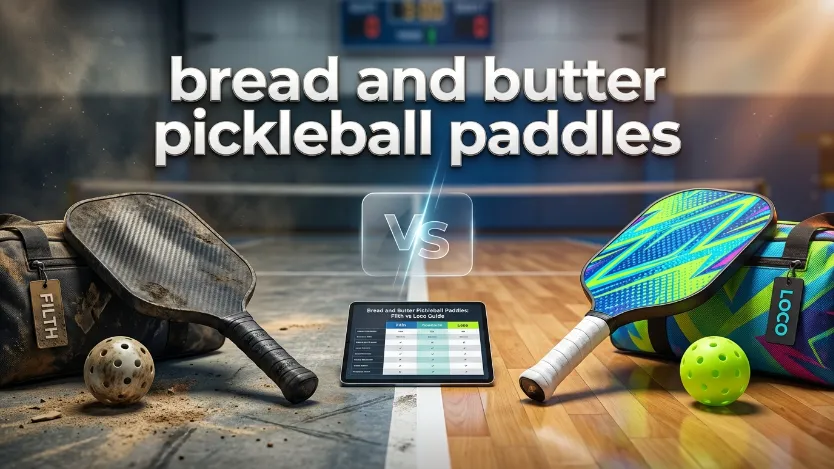
Have you ever stepped onto the court, perfectly positioned at the kitchen line, only to have your shot pop up weakly because your paddle lacked the necessary punch? It is a frustrating scenario that many players face when transitioning from beginner gear to high-performance equipment. If you are serious about upgrading your game, bread and butter pickleball paddles have rapidly become one of the most talked-about and disruptive options in the United States. Moving away from traditional wood and simple polymer, modern equipment relies on advanced thermoforming and carbon fiber engineering.
In this comprehensive guide, we will dive deep into the technical specifications, biomechanics, and consumer realities of choosing a bread and butter pickleball paddle. We are answering the highly specific, technical questions intermediate to advanced players are asking—questions that mainstream marketing often overlooks. Whether you are hunting for the best pickleball paddles for intermediate players or a pro-level weapon, understanding the science behind the swing is crucial.
Power and Control Dynamics: The “Loco” Foam Core Dilemma
The transition to Gen 4 full-foam core technology has completely shifted the landscape of paddle performance. For anyone seeking a comprehensive and honest bread and butter loco pickleball paddle review, it is vital to understand the acoustic and structural science beneath the surface. Unlike the harsh, high-pitched “crack” of Gen 2 paddles, the Loco utilizes a highly advanced dual-density foam core—combining EPP (Expanded Polypropylene) and an EVA foam edge wall—which produces a deeper, muted “boom” sound while drastically reducing elbow vibrations. Furthermore, it uniquely incorporates a layer of fiberglass sandwiched between the carbon fiber layers, delivering elite, tournament-ready power right out of the box.
However, this intense power brings a significant dilemma for intermediate (3.5 level) players. Transitioning from plush, control-oriented Gen 2 thermoformed pickleball paddles to the Loco can be jarring. The extreme “pop” means the ball leaves the paddle face faster than expected, making it incredibly difficult to execute a precise pickleball dink or keep third-shot drops low in the transition zone. On the flip side, advanced players (4.0+) favor this bread and butter loco pickleball paddle because the aggressive energy return allows for fast put-aways and heavy, punishing drives from the baseline.
Paddle Geometry and Biomechanics: Selecting the Right Shape
Figuring out how to pick a pickleball paddle involves dissecting two critical physics metrics that competitors rarely highlight: swing weight (SW) and twist weight (TW). Bread and Butter offers their flagship models in Elongated, Hybrid, and Standard/Widebody shapes, completely altering how the paddle maneuvers in your hand.
- The Filth Family: The bread and butter filth pickleball paddle isn’t just a single paddle anymore; it has evolved into a full family of shapes (Standard, Hybrid, and Elongated). Constructed with a patented thermoformed unibody and a Nano T700 Raw Carbon Fiber face, the Elongated Filth boasts a hefty swing weight of 121, acting as a massive mechanical lever for extreme baseline power. It is a dream for former tennis players who rely on aggressive groundstrokes.
- The Loco Widebody: With a much lower swing weight of exactly 110 and an exceptionally high twist weight of 7.34, this shape offers unmatched stability. High twist weight prevents the paddle from rotating in your hand during off-center hits, making it the premier choice for defense and fast kitchen line hand battles.
- The Loco Hybrid & Elongated: The Hybrid shape strikes a perfect balance with a 112 swing weight and 6.52 twist weight. Meanwhile, the Loco Elongated is purely for offensive juggernauts, demanding a heavier swing (123 swing weight) but rewarding the player with devastating plow-through power.
Surface Maintenance: Titanium vs. Raw Carbon Fiber
Generating massive topspin requires a textured surface, but maintaining that friction over time is a common challenge for competitive players. If you are using a premium carbon fiber pickleball paddle like the Filth, which uses T700 raw carbon fiber, you must use a rubber paddle eraser regularly. This eraser pulls out the plastic ball dust and court debris trapped inside the microscopic grooves of the peel-ply texture, ensuring you consistently play with the best pickleball paddle for spin.
The Bread and Butter Shogun, however, features a highly unique Titanium-Carbon weave. A major misconception is treating this paddle like standard carbon fiber. You must never use an abrasive rubber eraser on the Shogun, as it can damage the titanium threads. Instead, players should strictly use a damp microfiber cloth to gently clean the surface and preserve its longevity.
Grip Sizing and the Hidden Warranty Trap
One of the biggest missing angles in the paddle market involves the discrepancy between advertised and actual grip sizes. While Bread and Butter lists their standard Loco and Filth grip circumference at 4.25 inches, meticulous players have measured the factory grip to be much thinner, sitting closer to 4.125 inches (4 1/8″). For players with larger hands, a grip that is too small forces a tighter squeeze, which leads directly to forearm fatigue and tennis elbow.
To fix this, players often want to strip the stock grip and install an ergonomic aftermarket grip like the Hesacore. Beware: doing this triggers a major warranty trap. According to the company’s official 2026 policy, removing the original factory grip, altering the butt cap, or using PU inserts instantly voids the 30-day return policy and the 6-month structural warranty. You are allowed to add overgrips over the original handle, but modifying the base is strictly prohibited if you want to keep your buyer’s protection intact.
Structural Integrity: Core Crush vs. Foam Cores
The advent of Gen 2 thermoforming brought unprecedented durability to the outer edges of paddles, but it introduced complex internal failure points, most notably core crush. During the thermoforming baking process, the intense heat and pressure can sometimes cause the internal polypropylene honeycomb cells to wrinkle or weaken. Over time, the ballistic impact of hard drives causes these weakened cells to collapse, resulting in a “crunchy” sound and uncontrollable power spikes.
This is exactly why the bread and butter loco pickleball paddle review community is so hyped about Gen 4 foam cores. By moving away from purely hollow honeycomb structures to a fully foam-encased internal core, the Loco practically eliminates traditional core crushing issues. However, consumers still need a reality check: for avid competitors playing four to five times a week, the realistic lifespan of the surface grit on any $200 paddle is roughly 2 to 8 months. High-performance paddles are consumable items, but ensuring your equipment remains safe and compliant with the USA Pickleball Approved Paddle List is vital for sanctioned tournament play.
Product Lifecycle Strategy: Sunset Models and New Releases
The paddle tech race forces brands to iterate rapidly. Bread and Butter employs a strict product lifecycle strategy, quickly “sunsetting” models that do not dominate the market. For example, the aggressive Wild Thang paddle was rapidly discontinued and liquidated at steep discounts without warranties to make room for superior technology.
Rising from its ashes is the highly anticipated Psycho paddle. Breaking away from the standard 16mm mold, the Psycho utilizes a 14mm core combined with a layer of fiberglass to create what the brand describes as “unhinged” and “terrifying” pop. With a swing weight sitting incredibly low, the Psycho is designed for twitchy, lightning-fast hand speed at the net while remaining fully USAP approved for tournament play.
Conclusion
Bread and Butter has successfully cemented itself as a major disruptor in the premium pickleball market. By pushing the boundaries with full-foam cores, titanium weaves, and aggressive product lifecycles, they offer equipment that truly elevates a player’s game. However, purchasing a high-performance paddle requires an educated consumer.
You must look past the marketing hype and critically evaluate your own skill level. If you are an intermediate player, be wary of the Loco’s explosive pop. If you are a tennis convert, embrace the Elongated Filth. Above all, protect your warranty by leaving the factory grip intact, and mentally prepare for the reality that your paddle will likely need replacing within a year if you play competitively. By understanding these biomechanical and structural realities, you can step onto the court with absolute confidence.
Common Questions About Bread and Butter Pickleball Paddles
What is the main difference between the Bread and Butter Filth and the Loco?
The Filth is a Gen 2 thermoformed paddle featuring a T700 raw carbon fiber face and a hollow honeycomb core, providing a stiffer feel and high swing weight. The Loco is a Gen 4 paddle featuring a dual-density full-foam core (EPP and EVA) and an added fiberglass layer, resulting in a more muted sound, reduced vibration, and significantly higher “pop” and power right out of the box.
Will changing the grip on my Bread and Butter paddle void the warranty?
Yes. According to Bread and Butter’s strict return and warranty policy, removing the original factory grip, altering the butt cap, or installing PU inserts (like the Hesacore grip directly on the bare handle) will instantly void both the 30-day return policy and the 6-month warranty. You are only allowed to add overgrips over the original factory grip.
Which Loco shape is best for defense and fast hands?
The Loco Widebody (Standard shape) is the absolute best choice for defense. It boasts a very low swing weight of 110 (making it fast to maneuver) and a remarkably high twist weight of 7.34. This high twist weight keeps the paddle stable in your hand during off-center blocks and resets at the kitchen line.
Is it normal for the grip to feel smaller than advertised?
Yes. While Bread and Butter advertises a 4.25-inch grip circumference for these models, many players have manually measured the factory grip to be closer to 4.125 inches. If you have larger hands, you will likely need to wrap 2 to 3 overgrips around the factory handle to achieve a comfortable, ergonomic fit without voiding your warranty.