Author: The Pickleball Gang Team
pickleball rules
If you’ve walked past a local park recently and heard a distinctive pop-pop-pop sound accompanied by laughter and the occasional groan of a missed shot, you’ve likely stumbled upon pickleball. It’s the sport that seems to have taken over the world overnight, blending elements of tennis, badminton, and ping-pong into something entirely unique. But here is the thing: while it is incredibly easy to pick up a paddle and start hitting, the game has a specific set of rules that can feel a little quirky to the uninitiated.
Understanding rules of pickleball isn’t just about avoiding arguments with your neighbors; it’s about unlocking the strategy that makes the game so addictive. Whether you are a total beginner trying to figure out why everyone keeps talking about a “kitchen” or an intermediate player looking to refine your knowledge of specific faults, this guide is for you. Let’s walk through everything you need to know, not like a textbook, but like we’re chatting on the sidelines while waiting for our turn to play.
I. General Overview & Court Setup (The Basics)
Before we start keeping score or worrying about foot faults, we need to understand the arena. Pickleball is famous for being accessible, and a huge part of that is the manageable size of the court and the simple equipment.
What are the basic objective and layout of a pickleball game?
At its heart, the goal of pickleball is simple: hit the ball over the net and land it within the court boundaries so that your opponent cannot return it. The game is usually played to 11 points, and you generally have to win by two.
The layout looks suspiciously like a tennis court that has been shrunk in the wash. You have a baseline at the back, sidelines, a centerline dividing the service courts, and the famous Non-Volley Zone (the Kitchen) near the net. The beauty of the layout is that it encourages long rallies and social interaction because you are physically closer to your opponents than in tennis.
What is the standard court size and how does it compare to tennis?
If you are coming from a tennis background, the court will feel cozy. A standard pickleball court measures 20 feet wide by 44 feet long. This is the same size for both singles and doubles play.
To put that in perspective, a tennis court is 60 feet wide (for doubles) and 78 feet long. You could essentially fit four pickleball courts onto a single tennis court. This smaller footprint is why the game is less about raw power and running speed, and more about placement, patience, and quick hands.
Pickleball Rules Doubles: What is the difference between singles and doubles rules in pickleball?
While the court size remains identical (20×44 feet), the strategy and serving rotations differ.
- Doubles: This is the most common format. Two players per side. The server’s score determines which side they serve from, but both partners usually get a chance to serve during a rotation (except for the very first serve of the game).
- Singles: Just you against the world. The rules are largely the same, but the server’s score dictates the side: even scores serve from the right, odd scores serve from the left. There is no second server in singles; if you lose the point, the serve goes immediately to your opponent.
What equipment (paddle and ball specifications) is required to play legally?
You can’t just use any old racquet. You need a specific pickleball paddle. These were originally wood (and heavy!), but modern paddles are high-tech composites of graphite, carbon fiber, or fiberglass with a honeycomb core. They are solid, not strung.
Then there is the ball. It looks like a wiffle ball, made of durable plastic with holes. There are slightly different specifications for indoor balls (usually larger holes, softer plastic) and outdoor balls (smaller holes, harder plastic to withstand wind). To be legal, the equipment must meet USAPA (USA Pickleball Association) standards—basically, no customized paddles that give an unfair spin advantage.
II. Serving Rules (Starting the Point)
Every point starts with the serve. Unlike tennis, where the serve is often a weapon used to ace the opponent, the serve in pickleball is more of a “point starter.” The rules here are strict to prevent the serve from becoming too dominant.
What are the three main criteria for a legal volley serve? (Underhand, below waist, paddle below wrist)
Most players use the Volley Serve, meaning they hit the ball out of the air before it bounces. To keep this fair and prevent overhead smashes, you must adhere to three mechanical rules:
- Underhand Motion: Your arm must be moving in an upward arc when you strike the ball. You can’t slice down on it or serve side-arm.
- Below the Waist: The contact point (where the paddle hits the ball) must be below your navel.
- Paddle Below Wrist: The highest point of your paddle head must be below the highest part of your wrist (the joint) at the moment of impact. This ensures the paddle head is pointing somewhat down, reinforcing that underhand motion.
What is the “Provisional Drop Serve” and how does it differ from a standard volley serve?
If the mechanics of the volley serve feel unnatural, you can use the Drop Serve. This was introduced relatively recently and is a game-changer for beginners.
Here is the rule: You simply drop the ball from your hand and hit it after it bounces on the ground.
- The Catch: You cannot throw the ball down or toss it up to add bounce. You must let gravity do the work.
- The Benefit: You don’t have to worry about the “paddle below the wrist” or “below the waist” restrictions as strictly, because the bounce naturally limits how hard you can hit it.
Where must the server’s feet be positioned during the serve?
Foot placement is crucial. At the moment you contact the ball, at least one foot must be on the ground behind the baseline.
- You cannot touch the baseline or the court area (including the imaginary extension of the sidelines or centerline).
- Essentially, stay behind the line and inside the imaginary corridors of your serving side until the ball leaves your paddle.
Can the ball hit the net (a “let”) on a serve and still be played?
Yes! In the old days (pre-2021), if a serve hit the net tape and landed in the correct box, it was a “let” and you replayed it.
Current Rule: If the ball hits the net cord and lands in the correct service box, it is a live ball. You play it. There are no “service lets” anymore. If it hits the net and lands out or in the Kitchen, it’s a fault.
III. The Two-Bounce Rule (The First Few Shots)
This section covers the rule that confuses tennis players the most. It is the specific regulation that neutralizes the “serve and volley” advantage and extends the rally.
What is the “Two-Bounce Rule” (or Double Bounce Rule)?
This is the golden rule of pickleball strategy. It states that:
- When the ball is served, the receiving team must let it bounce before returning it.
- Then, the serving team must also let the return shot bounce before hitting it.
That is two bounces total: one on the receiver’s side, and one on the server’s side.
Can I volley the ball (hit it in the air) immediately after the return of serve?
No, absolutely not. If you are the server (or the server’s partner) and you rush the net to smash the return of serve out of the air, you lose the point immediately.
Why does this rule exist?
Without it, the serving team would have a massive advantage. They could serve and immediately run to the net to crush the receiver’s return. The Two-Bounce Rule forces the serving team to stay back at the baseline until the third shot, giving the receiving team a chance to get to the net and establish position. It’s what makes the “Third Shot Drop” (a soft shot into the kitchen) such a vital skill.
IV. The Non-Volley Zone (The Kitchen) – Pickleball Kitchen Rules Explained
The “Kitchen” is the unique 7-foot zone on either side of the net. It is the source of the most debates, the most foot-faults, and the most confusion for new players.
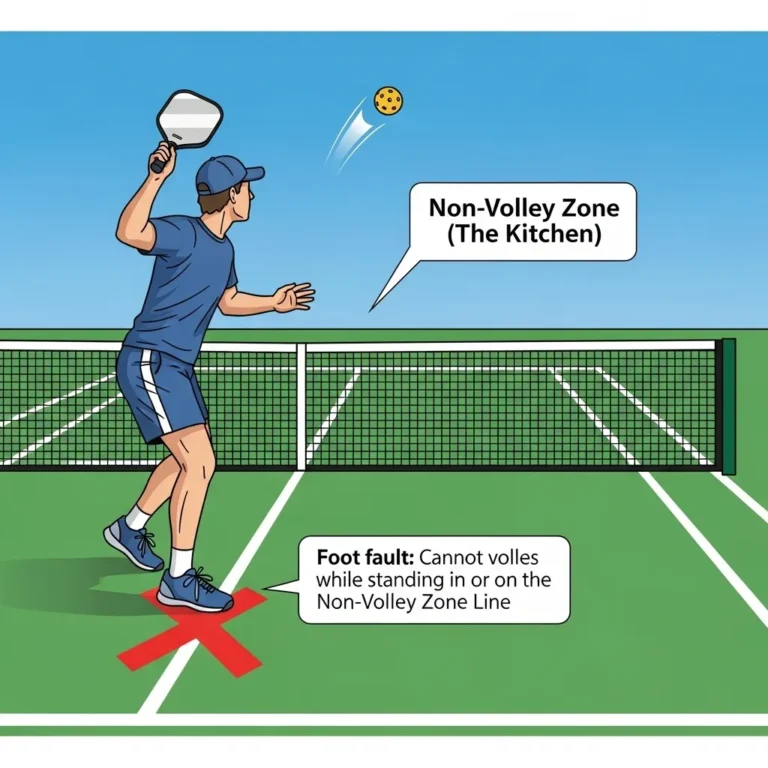
What is the “Kitchen” (Non-Volley Zone) and where is it located?
The Kitchen is the area between the net and the Non-Volley Line (located 7 feet back from the net). This zone extends across the full width of the court.
The purpose of the Kitchen is to prevent players from standing right on top of the net and smashing everything down. It forces players to back up slightly, allowing for more dinking (soft shots) and strategic play.
Can I step into the Kitchen at any time, or only under specific conditions?
There is a common misconception that you can never go in the Kitchen. That’s false!
- You CAN step in the Kitchen: You can stand in there all day if you want, admire the net, or tie your shoe. BUT…
- You CANNOT volley from the Kitchen: You cannot hit the ball out of the air while standing in the Kitchen (or touching the line).
- The Condition: You can only hit a ball while standing in the Kitchen if the ball has already bounced. If your opponent hits a short drop shot that lands in the Kitchen, you can step in, hit it, and then step out.
What is the “Momentum Rule” regarding the Kitchen? (e.g., falling in after a volley)
This is the tricky part that catches people out. The rule says that if your momentum carries you into the Kitchen after you volley the ball, it is a fault.
- Even if you hit a winner.
- Even if the point is arguably “over” before your foot touches the Kitchen line.
- If you volley, you must be in control. If you stumble forward and your toe touches the line after the shot, you lose the point.
Is it a fault if my paddle or clothing touches the Kitchen zone while volleying?
Yes. It is not just your feet. If you volley the ball and your hat falls off into the Kitchen, or your paddle scrapes the Kitchen surface, or your glasses fall off into the zone, it is a fault. Your body and anything you are wearing must stay out of the zone during the act of volleying.
V. Scoring System
If you think tennis scoring (Love-15-30-40) is weird, pickleball scoring might give you a headache at first. But once it clicks, it makes perfect sense.
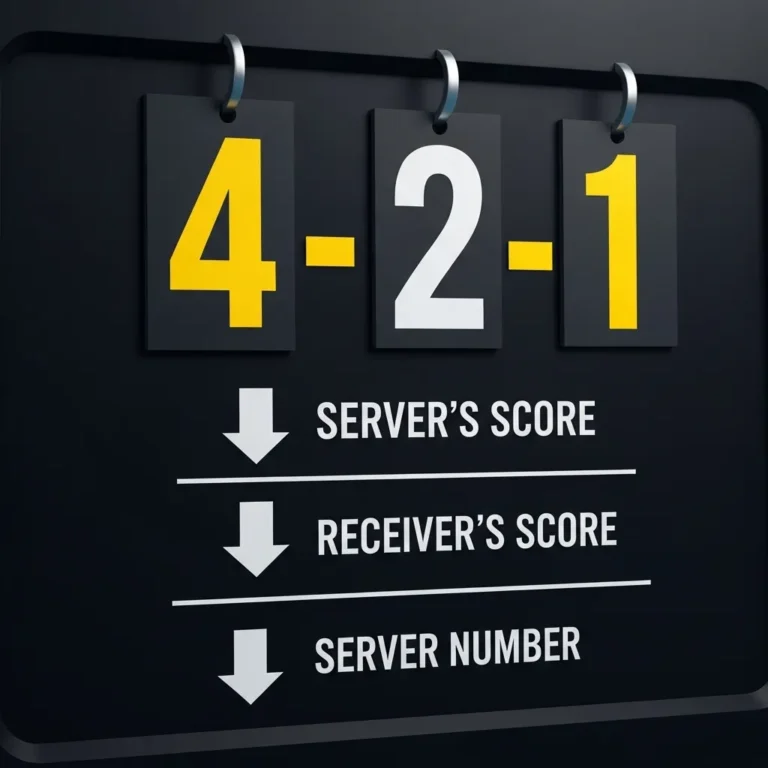
What do the three numbers in the score represent? (e.g., 4-3-1)
In doubles, the score is called out as three numbers:
- The Serving Team’s Score (e.g., 4)
- The Receiving Team’s Score (e.g., 3)
- The Server Number (Either 1 or 2)
So, if you hear “4-3-1,” it means the serving team has 4 points, the receiving team has 3, and this is the first server of the rotation. If that team loses the rally, the ball goes to the partner, and the score becomes “4-3-2.”
How does “Side-Out” scoring work vs. Rally Scoring?
Traditional pickleball uses Side-Out Scoring. This means you can only score points when you are serving.
- If you are receiving and you win the rally, you do not get a point. You simply win the right to serve (or move to the second server).
- Rally Scoring is sometimes used in leagues to speed up play (where a point is scored on every rally regardless of who served), but standard tournament and recreational play is almost exclusively Side-Out.
To how many points is a standard game played, and must you win by two?
A standard game is played to 11 points, and you must win by 2 points.
So, if the score is 10-10, you continue playing until someone is two points ahead (e.g., 12-10 or 15-13). In some tournaments, matches might go to 15 or 21, but 11 is the neighborhood standard.
How do players determine server rotation and starting positions?
- First Serve of the Game: The game starts with a unique exception. The team that serves first only gets one server. The score starts at “0-0-2” (or “0-0-Start”). If they lose the point, the serve goes to the other team (Side Out).
- Standard Rotation: Once the serve goes to the other team, both partners get a chance to serve.
- The player on the Right always serves first for the team.
- If they score a point, the serving team switches sides (Left/Right), and the same server serves to the other box.
- They keep switching sides as long as they score.
- Once they lose a rally, the serve passes to the partner (Second Server), who serves from whichever side they are currently standing on.
VI. Faults, Line Calls, and Dead Balls (Specific Scenarios)
Now that we know how to play, let’s look at the technicalities that often cause “spirited discussions” on the court.
What exactly constitutes a “fault” in pickleball?
A fault is any action that stops play because of a rule violation. Common faults include:
- The ball hitting the net and not going over.
- The ball landing out of bounds.
- Violating the Two-Bounce Rule.
- Volleying from the Kitchen.
- The ball hitting a player (or their clothing) before bouncing.
Are the lines considered “in” or “out” in pickleball?
In pickleball, lines are IN.
- If the ball hits the sideline or baseline, it is good.
- The Exception: The Kitchen line. On the serve only, if the ball hits the Kitchen line, it is a fault (short). However, during the rest of the rally, the Kitchen line is considered part of the Kitchen; so if a ball lands on it, it is “in” the Kitchen (meaning you can step in to hit it).
What happens if the ball hits a player or an object on the court?
This is often called getting “tagged” or a “Nasty Nelson.”
- If the ball hits you or your paddle while you are standing out of bounds before it bounces, you lose the point. It is your responsibility to dodge the ball. If it hits you, it’s a dead ball and a fault on you.
- The logic? The ball is live until it hits the ground. By hitting you, it technically didn’t hit the ground out of bounds.
Can I reach over the net to hit a ball? (Around the post/Over the net rules)
Generally, you cannot cross the plane of the net. However, there are two cool exceptions:
- The “Erne”: You can jump around the side of the Kitchen (outside the court boundaries) and smash a ball, as long as you don’t touch the Kitchen zone.
- ATP (Around the Post): If the ball is hit wide, you can return it around the net post, rather than over the net. The ball can be just inches off the ground.
- Over the Net: If the ball bounces on your side and spins back over the net to your opponent’s side (due to extreme backspin or wind), you are allowed to reach over the net to hit it (without touching the net) to win the point.
Pickleball rules might seem like a lot to digest at first glance, but they are designed to make the game fun, fair, and accessible to everyone from 8 to 80. The best way to learn? Get out there, find a court, and don’t be afraid to ask questions. The pickleball community is famously friendly, and someone will be more than happy to explain the “Kitchen” to you one more time.
you may like it