
how to play pickleball
So, you’ve finally decided to see what all the fuss is about. Maybe you’ve seen the courts popping up at your local park, heard the distinct pop-pop-pop sound while walking your dog, or perhaps your friends haven’t stopped talking about their weekend matches. Welcome to the world of pickleball!
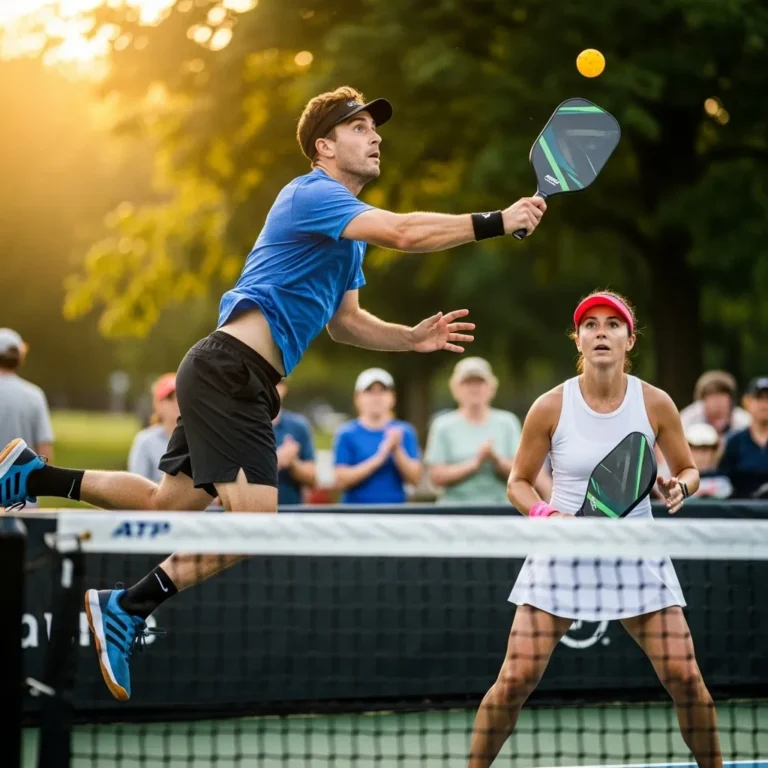
Honestly, it’s not hard to see why this sport has exploded in popularity. It sits right in that “Goldilocks” zone—it’s not as physically demanding as tennis, it’s faster-paced than badminton, and it has a social vibe that is unmatched by almost any other sport. It’s the kind of game where you can be laughing with your opponents one minute and fiercely battling for a point the next.
But, like starting anything new, walking onto the court for the first time can feel a little intimidating. You see people standing near a specific line, shouting out three random numbers before serving, and talking about something called a “Kitchen.” It can feel like they are speaking a different language.
Don’t worry. We’re going to break this down together. Think of this guide as a coffee chat with a friend who’s been playing for a while. We aren’t going to bog you down with the rulebook’s fine print right away. Instead, we’re going to walk through how to play pickleball in a way that makes sense, so you can grab a paddle and feel confident from your very first serve. Let’s get you ready to play.
Getting Started: The Essentials
Before we worry about strategy or fancy shots, let’s get the logistics out of the way. You can’t play the game if you don’t know what you’re aiming for or what gear you need to bring along.
What is the objective of pickleball?
At its heart, pickleball is a game of strategy, patience, and placement. While it looks like tennis, the objective isn’t just to smash the ball as hard as you can. The main goal is to win the rally by hitting the ball over the net so that your opponent can’t return it, or so that they make a mistake—like hitting it out of bounds or into the net.
You are racing to reach a specific score, usually 11 points. However, there’s a catch that adds a lot of drama to the end of a match: you have to win by at least two points. So, if the score is 10-10, you can’t just win the next point and go home. You have to battle it out until one side has that two-point cushion (like 12-10 or 15-13).
What equipment do I need to start playing?
One of the best things about learning how to play pickleball is that the barrier to entry is incredibly low. You don’t need a garage full of gear.
- The Paddle: Unlike the stringed racquets used in tennis or squash, a pickleball paddle is a solid surface. When you are just starting, you don’t need a $200 carbon-fiber paddle. A simple wooden or composite paddle works just fine to learn the mechanics. As you get better, you might want a honeycomb-core paddle, which offers more control and is lighter on the wrist.
- The Ball: It looks like a wiffle ball, doesn’t it? It’s a lightweight plastic ball with holes in it. We will talk about the specific types in a moment, but just know you can’t use a tennis ball!
- Footwear: This is the one area where I suggest you don’t skimp. Please, for the sake of your ankles, avoid running shoes. Running shoes are designed to move you forward. Pickleball requires a lot of lateral (side-to-side) movement. You want court shoes—tennis or volleyball shoes—that provide stability so you don’t roll an ankle when you make a quick cut to reach a ball.
What are the dimensions of a pickleball court vs. a tennis court?
If you step onto a tennis court, you know it feels huge. A pickleball court is much more intimate. It is actually the exact same size as a doubles badminton court—20 feet wide by 44 feet long.
To put that in perspective, you can fit four pickleball courts inside the standard footprint of a single tennis court. This smaller size is a major reason why the game is accessible to so many ages; you don’t have to run miles to enjoy a good match. However, don’t let the size fool you. Because the court is smaller, the ball comes back at you much faster, testing your reflexes rather than your sprinting speed.
What is the difference between indoor and outdoor pickleball?
You might think, “A court is a court, right?” Not exactly. The biggest difference lies in the ball you use and the floor you run on.
Outdoor pickleball is usually played on a hard court surface (similar to tennis). Because you have to deal with wind and rougher asphalt, outdoor balls are made of harder plastic and usually have 40 smaller holes. They play faster but can crack in the cold.
Indoor pickleball is often played on gym floors (wood or composite). Indoor balls are softer, slightly lighter, and have 26 larger holes. This makes them slower and easier to control, and they don’t skid as much on the smooth gym floor. If you take an indoor ball outside on a windy day, you’ll find it gets blown around like a feather!
The Serve: Starting the Point
Every rally starts with the serve. In tennis, the serve is often an aggressive weapon meant to score an ace immediately. In pickleball, the serve is more of a “point starter.” It’s about getting the ball in play rather than overpowering your opponent.
What are the legal requirements for a serve in pickleball?
This is where tennis players often get tripped up. In pickleball, you must serve underhand.
When you make contact with the ball, three things need to happen for the serve to be legal:
- Your arm must be moving in an upward arc.
- The contact point with the ball must be below your waist (specifically, below the navel).
- The highest part of your paddle head must be below the highest part of your wrist (meaning the paddle is pointing somewhat down).
The vibe here is “friendly invitation to play,” not “overhead smash of doom.”
Does the serve have to land diagonally?
Yes, it does. You serve from behind the baseline, and you must hit the ball into the opponent’s service court that is diagonal to you.
For example, if you are standing on the right side of your court, you must aim for the right side of your opponent’s court (from their perspective). If you hit it straight across to the person directly in front of you, it’s a fault, and you lose the serve. Also, you must clear the “Kitchen” line (we’ll get to that soon)—if your serve lands short, it’s no good.
What is the difference between a Volley Serve and a Drop Serve?
You have two choices for how to actually hit the ball to start the game.
- The Volley Serve: This is the traditional way. You toss the ball gently in the air with one hand and hit it with your paddle before it touches the ground. You have to be careful here to ensure you follow all the underhand rules mentioned above.
- The Drop Serve: This was introduced more recently and is fantastic for beginners. You simply hold the ball out and let it drop to the ground. After it bounces, you hit it. The beauty of the drop serve is that the strict rules about “wrist height” and “waist height” are relaxed because gravity limits how high the ball bounces. You just can’t throw the ball down to make it bounce higher; you have to let it fall naturally.
How many serve attempts do I get?
In tennis, if you mess up your first serve, you get a “second serve.” In pickleball, you generally get one shot. If you hit the ball into the net or hit it out of bounds on your serve, that’s it—your turn to serve is over (with a slight exception for a “let” serve where it hits the net but still lands in, though this rule varies by recreational vs. pro play).
Because you only get one chance, accuracy is far more important than power. Just get it in!
Core Gameplay Rules
Once the ball is in play, the game moves fast. There are a few unique mechanics that govern the flow of the game, and understanding them is the difference between a confused beginner and a confident player.
What is the “Double Bounce Rule”?
This is hands-down the most confusing rule for new players, but it is vital for balancing the game. It stops the serving team from having an unfair advantage.
Here is how it works:
- Bounce One: The server hits the ball. It goes over the net and bounces in the opponent’s court. The receiving team must let it bounce before hitting it back.
- Bounce Two: The receiving team hits the ball back to the serving team. The serving team must also let the ball bounce before hitting it.
Only after these two bounces have occurred (one on each side) can players start “volleying” the ball (hitting it out of the air without letting it bounce). If the serving team rushes forward and hits the return immediately out of the air, they lose the point. This rule forces the serving team to stay back at the baseline initially, giving the receiving team a chance to get into position.
What constitutes a “fault” or a dead ball?
A “fault” basically means the play is over because a rule was broken. If you commit a fault, you lose the rally. Common faults include:
- Hittiing the ball into the net.
- Hitting the ball out of bounds (behind the baseline or past the sidelines).
- Letting the ball bounce twice on your side before hitting it.
- Violating the serve rules (like serving overhand).
- Violating the Kitchen rules (more on that in a second).
- The ball hitting your body or clothing. Even if you didn’t mean to, if the ball hits your shoe, you lose the point.
Are the lines considered “in” or “out”?
In pickleball, the lines are your friends. If the ball lands on the line, it is considered in.
There is one major exception to this: the Non-Volley Zone line (the Kitchen line) during a serve. If your serve hits the Kitchen line, it is considered a fault (short). But during normal play after the serve, if the ball hits the Kitchen line, it is good.
The Non-Volley Zone (The “Kitchen”)
If you have heard anything about pickleball, you have heard about the “Kitchen.” It is the defining feature of the sport and what makes it so tactical.
What is the “Kitchen” and where is it located?
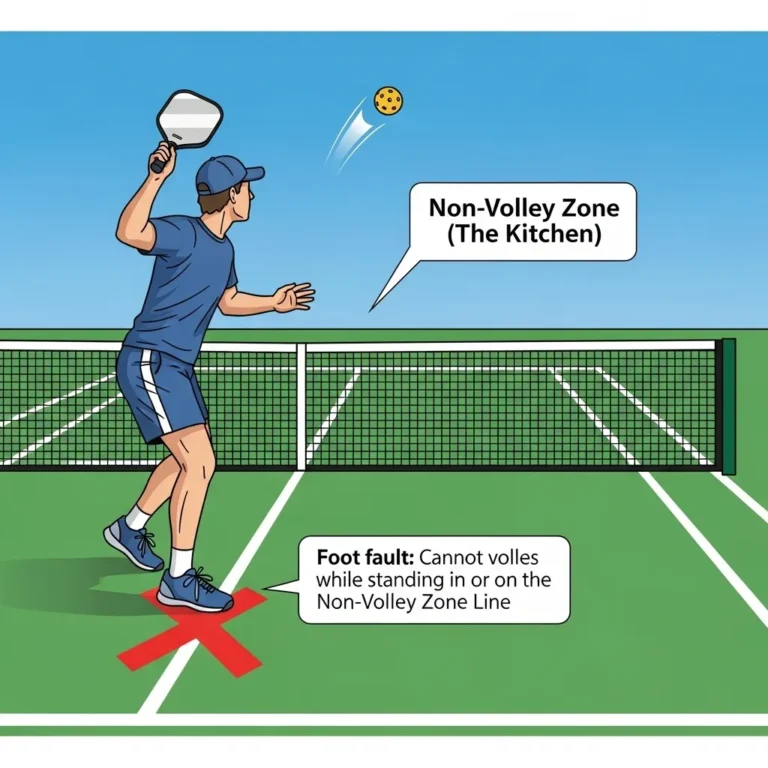
The Kitchen is the 7-foot area on both sides of the net. It extends from the net back to the “Non-Volley Zone line.”
Visualizing it helps: imagine the net is the center of the universe. The 7 feet of ground directly touching the net on your side is the Kitchen. The same goes for your opponent. This creates a 14-foot buffer zone in the middle of the court where aggressive play is limited.
Can I step into the Kitchen at any time?
Yes and no. This is a common misconception. You can step into the Kitchen whenever you want—you could stand there and eat a sandwich if you liked! BUT, you cannot hit the ball while standing in the Kitchen unless the ball has bounced first.
If the ball is in the air (a volley), you must keep your feet behind that Kitchen line. The rule exists to prevent players from standing right at the net and smashing every ball that comes over. It forces players to be patient and engage in “dinking”—soft shots that just barely clear the net.
What happens if my momentum carries me into the Kitchen after a volley?
This is the “gotcha” rule that catches everyone. Let’s say you are standing safely behind the line. A high ball comes to you, and you smash it out of the air for a winner. But, your forward momentum causes you to stumble forward, and your toe touches the Kitchen line after you hit the ball.
Guess what? That is a fault. You lose the point.
It doesn’t matter if the ball was already dead or the point was “over.” If your momentum from a volley takes you into the Kitchen, it’s a violation. You have to be in control of your body at all times near that line.
Scoring System
Okay, take a deep breath. The scoring is the part that makes people scratch their heads the most. But once it clicks, it’s actually quite logical.
How does scoring work in pickleball?
Pickleball traditionally uses Side-Out Scoring. This means you can only score points when your team is serving.
If you are receiving the serve and you win the rally, you don’t get a point. Instead, you just win the right to serve. This makes the games last longer because you have to earn the serve and then earn the point.
(Note: Some tournaments use “Rally Scoring” where a point is won on every rally regardless of who served, but recreational play is almost exclusively Side-Out).
What do the three numbers in the score mean (e.g., 0-0-2)?
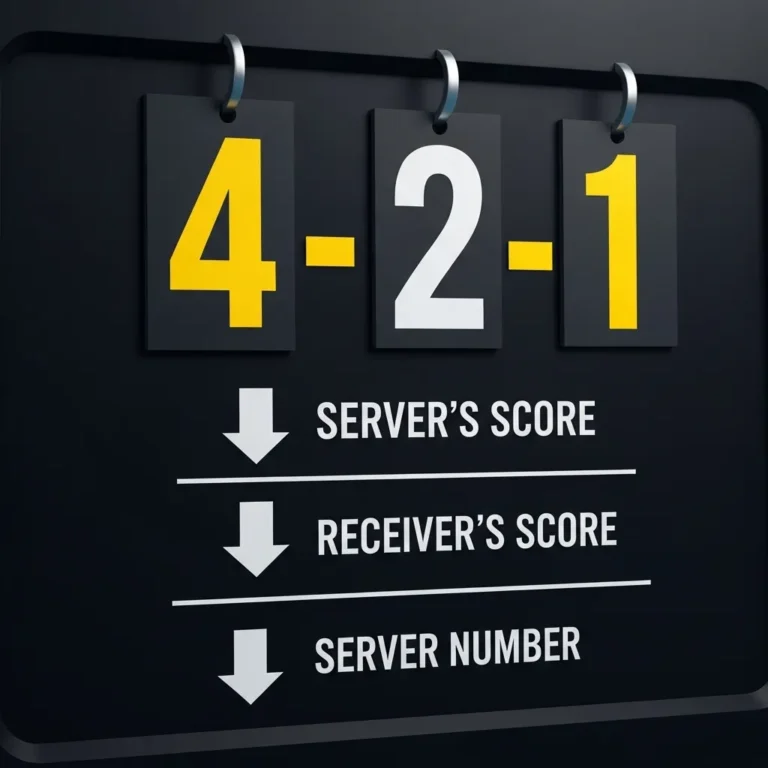
When you announce the score in doubles, you say three numbers. For example: “4 – 2 – 1”.
Here is what they represent in order:
- First Number: The serving team’s score. (We have 4 points).
- Second Number: The receiving team’s score. (They have 2 points).
- Third Number: The server number (Server 1 or Server 2).
In doubles, both partners get a chance to serve before the serve goes to the other team (a “side-out”).
- If you are the first partner to serve and you lose the point, the serve goes to your partner (Server 2).
- If you are Server 2 and you lose the point, the serve goes to the other team.
Exception: At the very start of the game, only one person on the starting team gets to serve. The score starts at 0-0-2 (or “Start”). This is to prevent the team that starts with the ball from having too big of an advantage.
To what number do we play, and must we win by 2 points?
A standard game is played to 11 points. However, as mentioned in the introduction, you must win by 2 points.
This can lead to some intense overtime battles. I’ve seen games go to 16-14 or even higher! In some tournament settings, matches might be played to 15 or 21, but for your Saturday morning pickup game, 11 is the magic number.
How to Play Pickleball Singles: Singles vs. Doubles Strategy
Most people play doubles because it’s more social and requires less running, but singles is a great workout. The rules are mostly the same, with a few tweaks.
How does the serving rotation work in doubles?
This is all about the “Even/Odd” sides.
- When your score is Even (0, 2, 4, etc.), the first server starts from the Right side of the court.
- When your score is Odd (1, 3, 5, etc.), the first server starts from the Left side.
When you score a point, you and your partner switch sides (left and right), but the receiving team stays put. This means you serve to a different person each time you score.
What are the main rule differences between singles and doubles play?
In Singles, there is no “second server.” If you lose the rally, the serve goes immediately to your opponent.
Also, the strategy changes drastically. In doubles, the goal is to get to the Kitchen line as fast as possible. In singles, rushing the net can be dangerous because you don’t have a partner to cover the open court behind you. Singles is often a game of deep, passing shots, while doubles is a game of patience and quick hands at the net.
Conclusion
And there you have it! You have just navigated the essentials of how to play pickleball. It might seem like a lot of rules—especially the Kitchen and the scoring—but I promise you, after about 15 minutes on the court, it becomes second nature.
The beauty of pickleball isn’t in mastering the rulebook; it’s in the laughter after a clumsy miss, the high-five after a great shot, and the community you build between games. So, grab a paddle (borrow one if you have to), put on those court shoes, and head to the nearest park. Don’t be afraid to tell people you are new; pickleball players are famous for being welcoming to beginners.
Now, go get that first point!
I hope I have answered the most important question: How to play pickleball for beginners